

mR.rUBINSHTEIN
I’m a Senior Environment Artist and a sole owner of Rubin's Worldworks who is bringing seven years of game industry experience directly to VRChat. My work covers everything from optimized private rooms and massive event-ready venues, to custom PBR assets and technical audits that fix lag in existing spaces. Writing custom scripting tools for world creators which would help them to build worlds faster and easier, that way reducing the entry into world creation and making it more beginner friendly.Every build follows a strict studio pipeline. We start with a detailed brief, you physically walk through a playable blockout to approve the layout, and I deliver a fully optimized, ready-to-upload Unity project.This is a professional operation governed by transparent terms. More importantly, I never charge a deposit before you see real progress. I build your initial blockout entirely at my own risk, and you only fund the project once you have explored the space and love the direction we're heading.
| LATEST WORLD RELEASES |
| Club NEVERMORE 18+ (Private World) |
|---|
| Release September 2026. Experience a gothic, Alice in Wonderland inspired environment carefully tailored to immerse you in a legendary universe. Explore an iconic setting spanning over a century of lore. Ask me for a private tour or join |
| >>>Club NEVERMORE (link to discord will be added later)<<< |
| Blind Wolf: The CORONET (Public World) |
|---|
| Released on May 29th. Experience a luxurious, Art Deco-inspired environment engineered to perfectly balance high-end visual fidelity with flawless performance. Drop a portal and explore the new standard of world design firsthand. >>>Launch The Coronet<<< |
| CREATING MEMORIES YOU WANT TO REVISIT |
| Featured Worlds |
|---|
| Club Lucky Lynx, Blind Wolf : The Coronet, more coming soon |
Why choose a professional for your VRChat project?
Performance Architecture: Built for 40+ players. By utilizing advanced draw-call batching, texture atlasing, and efficient light-baking workflows, I ensure your world runs at high frame rates on both PC and Quest without tanking headsets.
High-Fidelity Visuals: I specialize in industry-standard PBR workflows and cinematic lighting. From custom geometry to careful spatial design, I create deeply atmospheric, premium environments that feel grounded and unique to your brand.
Studio-Level Reliability: I treat every commission like an actual studio contract. You get a clear production timeline, transparent communication, and clean files delivered to industry standards. No ghosting, no missed deadlines, no excuses.
MY CLIENTS

Club Lucky Lynx

Blind Wolf

Eye of Veritas
Club NEVERMORE

Your logo here
Your Logo Here
Your Logo Here
Your Logo Here
Your Logo Here


Navigation
Professional Standards
I’ve spent seven years in the professional game industry, and I bring those exact studio standards to my VRChat commissions.My core philosophy is simple... You shouldn't have to choose between a beautiful aesthetic and a stable frame rate. There's a misconception in VR that highly detailed worlds have to lag. They don't. Stability and high-fidelity art belong in the exact same space.Here is the technical blueprint of how I build environments that look like AAA games, but run effortlessly in VR.
| 1. Intentional Art & Lighting |
|---|
| Making the space feel real. |
| Physically Based Rendering (PBR): I use industry-standard material workflows so that every surface reacts to light the way it should in reality. Leather looks scuffed, metal catches the glare of a lightbulb, and glass actually feels like glass. |
| Baked Global Illumination: Lighting makes or breaks a world. I use Bakery to bake high-end global illumination, ambient occlusion, and soft shadows directly into the textures. This means you get a deeply atmospheric, moody environment that costs the GPU absolutely nothing in real-time. |
| Spatial Design: A world needs to feel good to walk through. I apply professional level design principles to guide where players naturally want to gather, ensuring the scale feels right in VR before making it look pretty. |
| 2. Hardcore Optimization |
|---|
| The "No-Lag" Guarantee. |
| Killing Draw Calls: Draw calls are the biggest killer of VRChat frame rates. By manually atlasing textures and batching static meshes, I keep those numbers as low as humanly possible. This is why my worlds stay smooth even when an instance is packed with 40+ people. |
| VRAM Respect: Nobody likes an "Out of Memory" crash. I carefully manage texture resolutions by saving sharp 2K textures for hero assets right in front of the player, while compressing background props. You get a crisp looking world that won't crash mid-range PCs or headsets. |
| Vertex Shaders over Physics: Instead of using heavy cloth physics or rigidbodies that tank the CPU just to make a flag wave or leaves rustle, I use mathematical vertex animation. You get the beautiful, organic movement of a living world for a fraction of the performance cost. |
| 3. The Player Experience |
|---|
| Details you feel, even if you don't notice them. |
| Lighting Avatars Properly: It’s incredibly jarring when a brightly lit avatar walks into a dark room and stays bright. I map out custom light and reflection probes throughout the map so that avatars actually absorb the environment’s lighting. It anchors players into the space so they look like they belong there. |
| Frictionless Movement: Getting stuck on a staircase or a complex doorframe ruins immersion. Instead of using the raw mesh for collisions, I build invisible, simplified primitive colliders over the environment. Walking, running, or sliding against walls feels buttery smooth. |
| Clean Unity Packages: When I hand over the project files, it isn't a mess. The Unity hierarchy is organized, nested, and properly labeled. If you ever want to add new features later, or hire another dev to expand it, they will be stepping into a clean, developer-grade foundation. |
| 4. Professional Reliability |
|---|
| Treating VRChat like a studio project. |
| Zero Ghosting: The VRChat commission space has a notoriously bad reputation for creators disappearing or missing deadlines. I run my commissions like actual studio contracts. You get a timeline, and I stick to it. |
| The Grey-box Phase: We don't just guess what the world will look like. We start with a grey-box blockout which is a simple, untextured version of the map, so you can walk around it in VR, check the scale, and approve the layout before I commit to the heavy art. |
| Constant Communication: No surprises, and no being left in the dark. You are involved, updated, and consulted at every single major milestone of the build. |
Navigation
| Commissions |
|---|
| Worlds, Assets and any content commissioned by clients on VRChat. |

Worlds

Assets

| Personal |
|---|
| My most noteworthy projects from professional portfolio. |

Environments

Props & Assets
Navigation

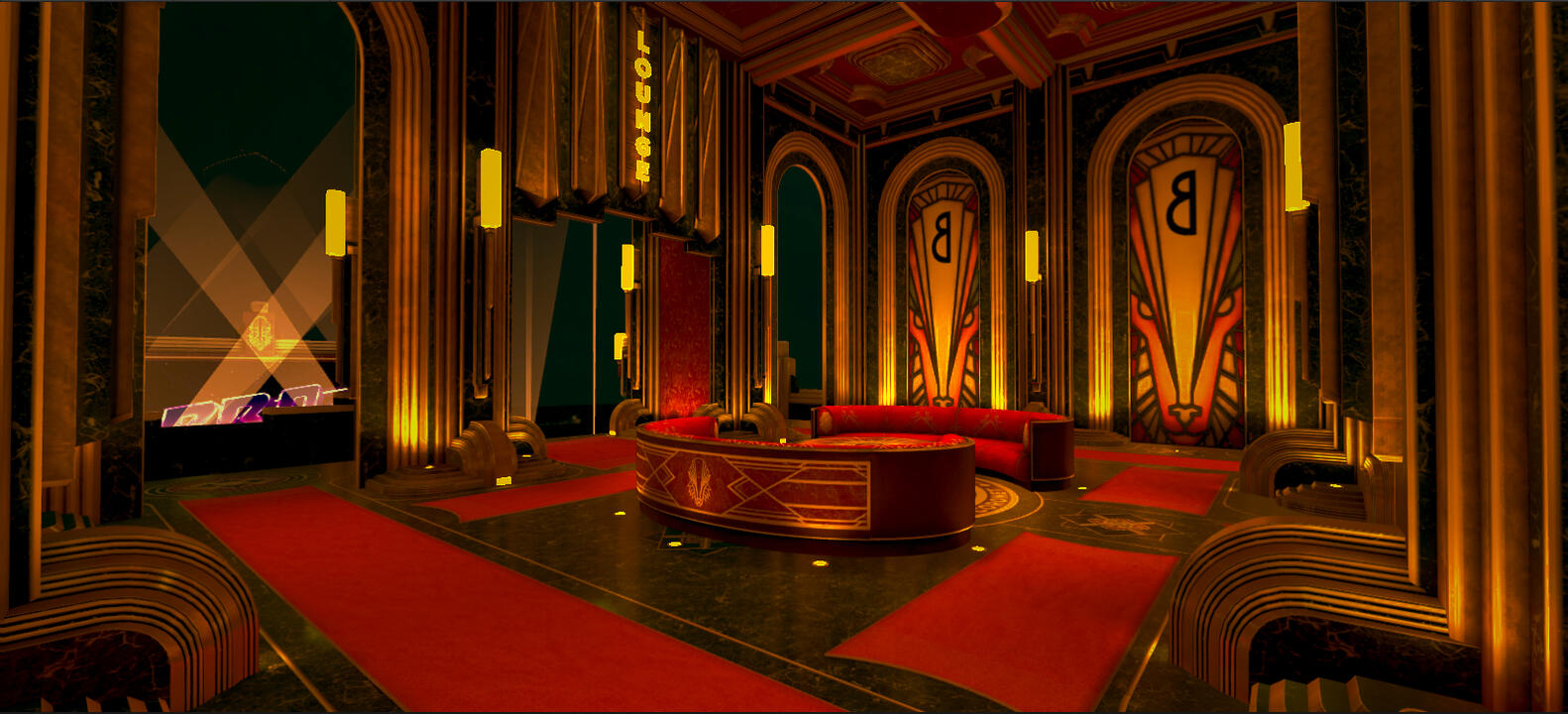
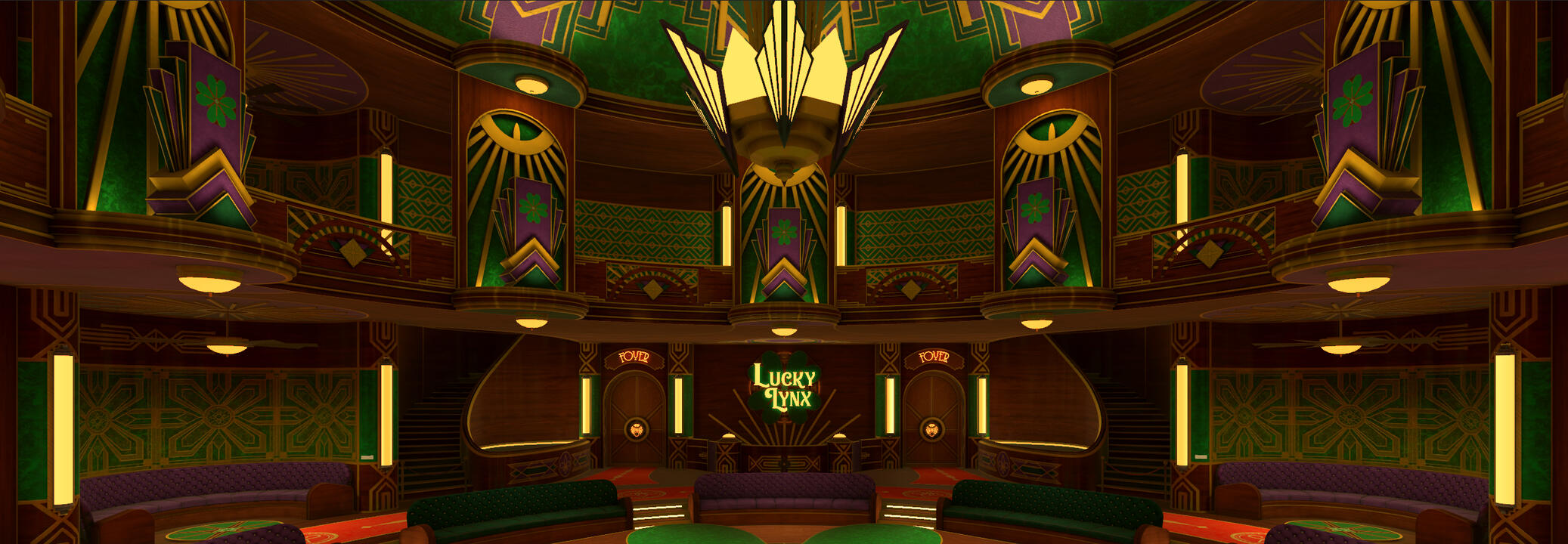
Club Lucky Lynx 18+
Blind Wolf : The Coronet
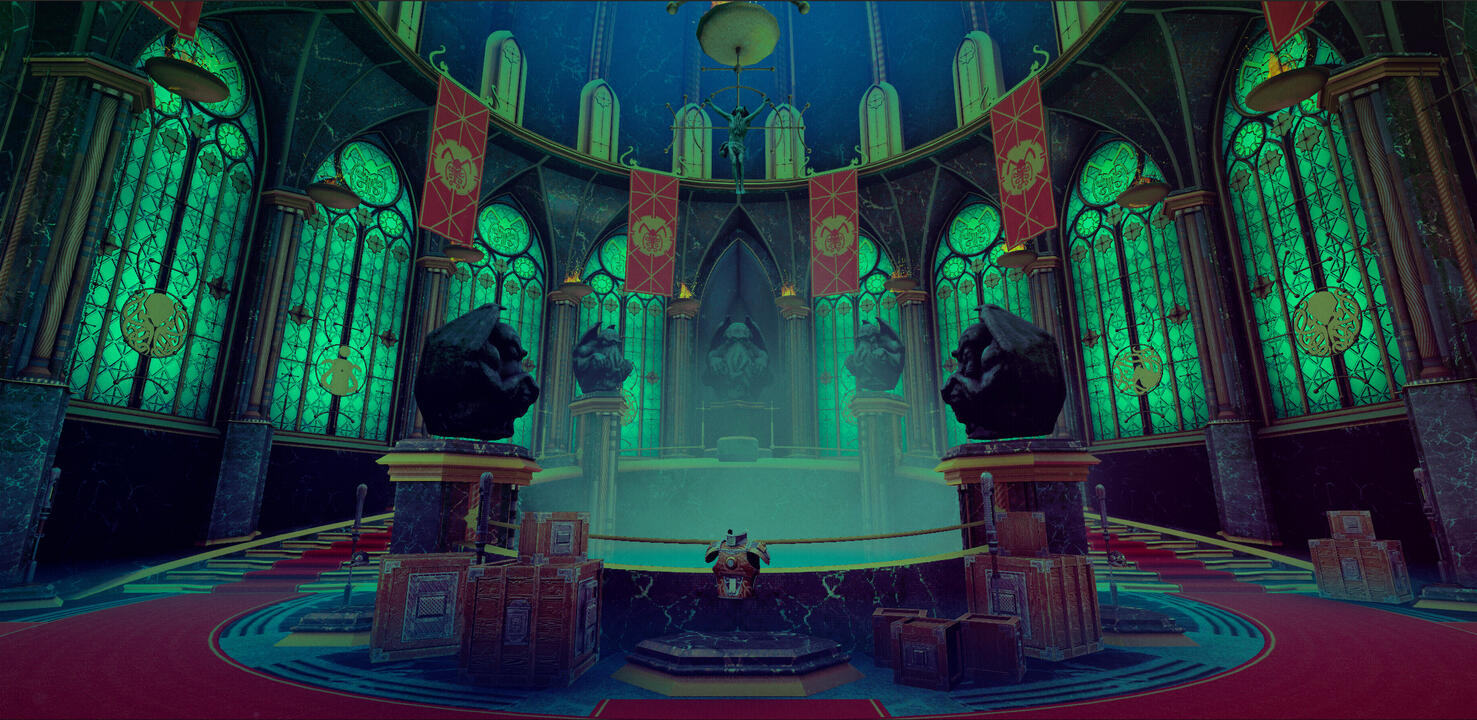
Club NEVERMORE 18+ (Release at the end of September) - First event will be held on October

Mysterious World (NDA)
Slot Reserved
Open Slot
Open Slot
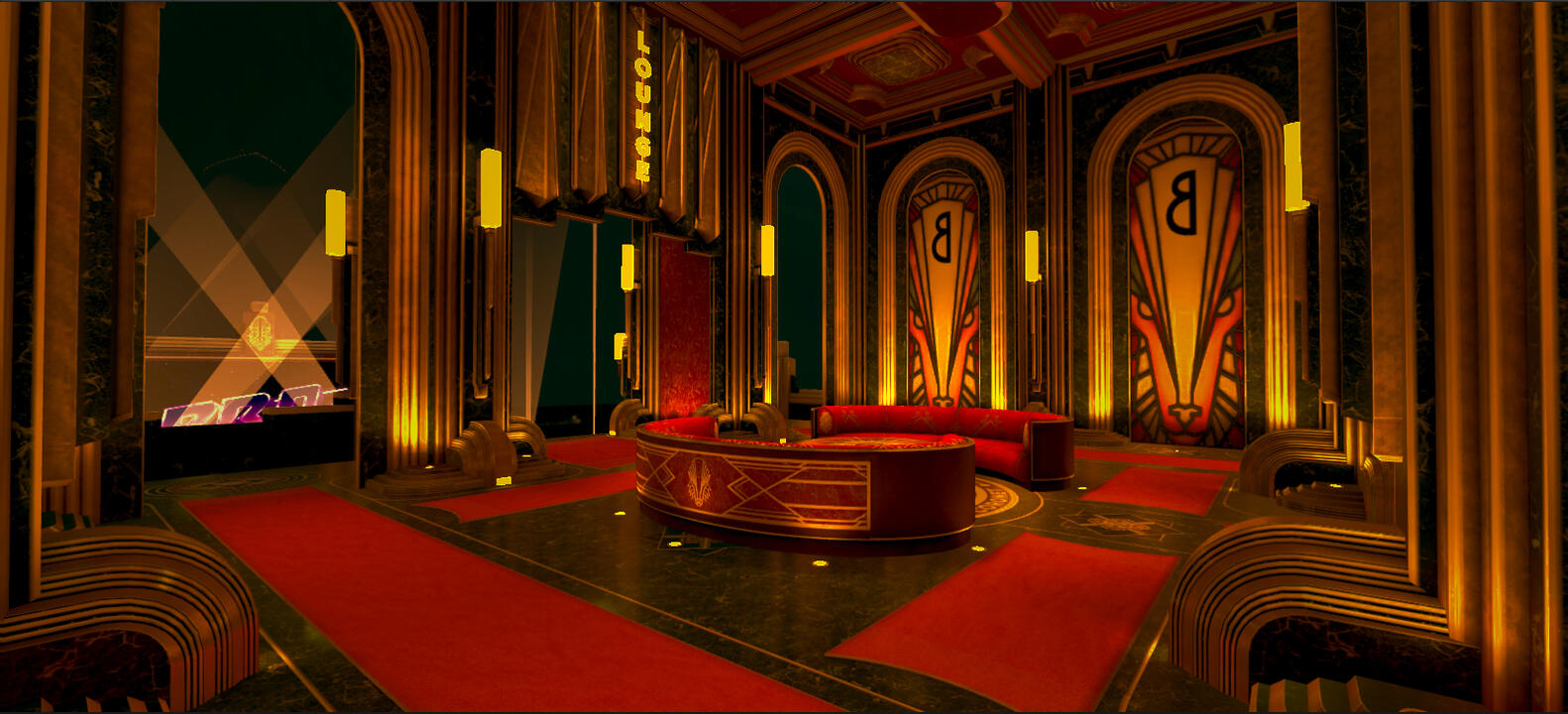


Navigation
Club Lucky Lynx 18+
| Commission for katana276 & ceasar_draakovich |
|---|
| Step into the elegant nightlife of the 1930's New Orleans French Quarter. A luxurious and excellent performing sanctuary designed for the furry community to relax and unwind. |
| Feedback and reviews available via Discord |
| The Development |
|---|
| Video showcasing every stage of the development and how it came to its conclusion. |

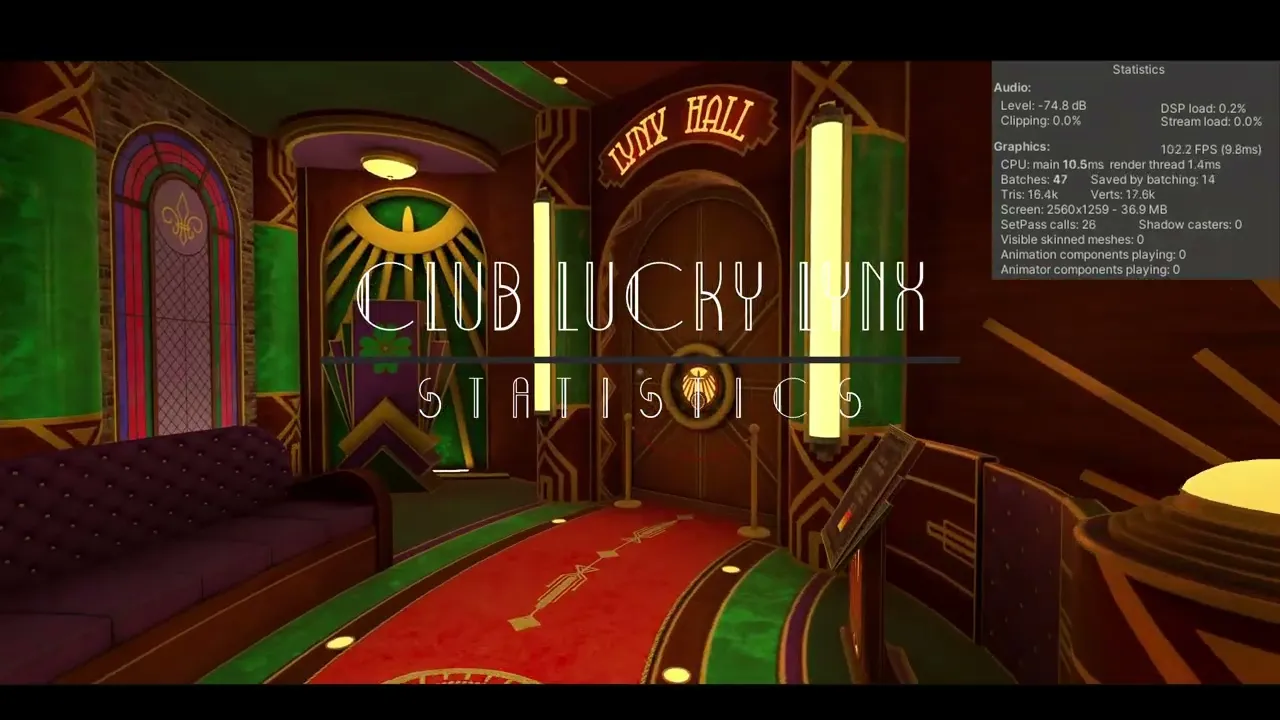
| The Statistics |
|---|
| 4K Video walkthrough showcasing live the backend statistics of the world through unity stats window. Here you will see information about batches, setpass calls, cpu threads and more. |
| Zoomed the statistics window for a better overview |
| Dev Blog Navigation |
|---|
| Below is presented the whole development process with a detailed breakdown of every single process. |
| The Idea |
|---|
| The project began with an initial first-floor layout designed by ceasar_draakovich. My objective was to translate that layout into a space inspired by the New Orleans Art Deco movement. I wanted to capture the soul of that era, utilizing a palette of deep, contrasting colors to fully immerse guests in a historic yet vibrant atmosphere. |

First floor layout idea by ceasar_draakovich

| Once I joined the project, we collaborated closely to refine the initial concepts. We implemented several quality-of-life improvements and polished the first-floor layout to ensure a better player flow and more intuitive navigation. This phase was crucial, as it established a solid foundation for the rest of the development process. |

Polished layout and solidified concept

| Blockout (Version 1) |
|---|
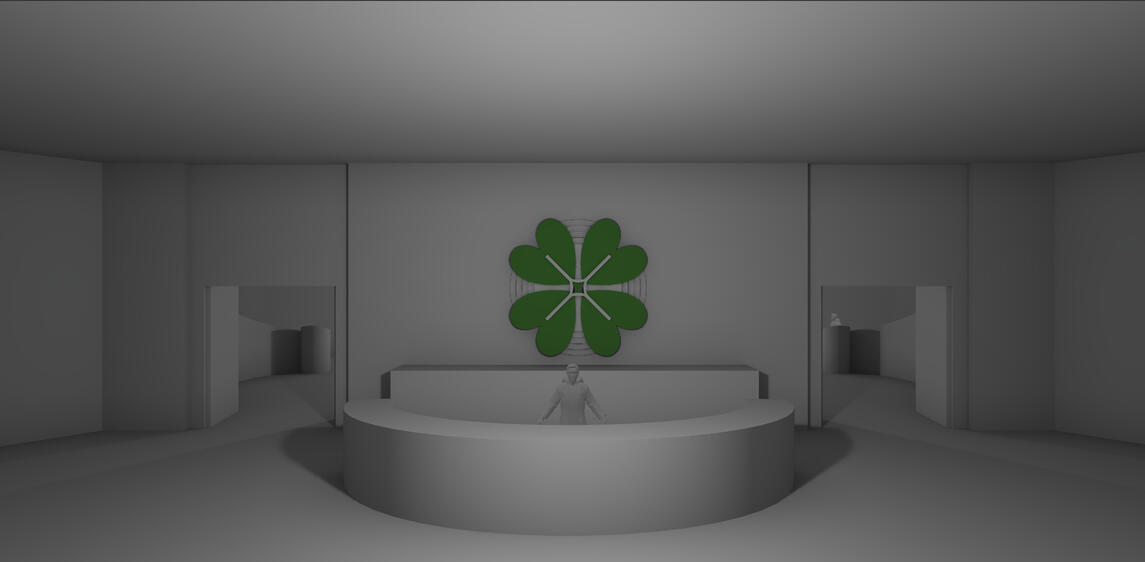
| With the layout finalized, I moved into the blockout phase. This process was divided into three distinct stages to ensure every detail was accounted for. |
| In the first iteration, I focused heavily on polishing metrics and scale. It was vital to ensure the proportions felt right for the players before moving into high-detail work. This stage acted as my "3D sketch," allowing me to visualize the volume of the club in real-time. |
| One of the primary creative challenges during this phase was the vertical architecture. I had to conceptualize how the second floor would integrate with the first, specifically focusing on how the two levels would converge at the ceiling to create a grand, cohesive interior. |
1) Foyer

2) Main Hall

3) Grand Staircase

4) Second Floor with Stage


| Blockout (Version 2) |
|---|
| Following the initial blockout, we conducted a thorough feedback audit. I worked closely with the owners to implement their specific vision, making the necessary structural adjustments to ensure the space met all project requirements. |
| In this second iteration, I began to introduce a preliminary color palette and initial lighting passes. Setting the lighting early in the process is crucial for me, as it allows to define the mood and "read" the environment's depth. This helped us visualize the direction of the atmosphere and ensured the Art Deco theme was translating correctly from concept to 3D space. |

1) Foyer

2) Main Hall

3) Grand Staircase

4) Second Floor with Stage


| Blockout (Version 3) |
|---|
| The final blockout iteration was driven by a second feedback audit, where I solidified the lighting and established the core color scheme within Unity. By moving from a greybox into a basic color pass, I could finally see the environment’s personality emerge. |
| I intentionally introduced dark, grey-toned walls at this stage to establish high-contrast anchors. Defining wall colors can be challenging early on, so my philosophy is to start small and iterate. By setting these neutral foundations first, I created a "canvas" that allowed me to push the color scheme further and experiment with bolder Art Deco accents without losing the sense of the space. |

1) Foyer

2) Main Hall

3) Grand Staircase

4) Second Floor with Stage


| Texturing Phase (Version 1) |
|---|
| With the blockout approved and everyone aligned on the direction, I moved into the texturing and material polish phase. This is where the environment truly begins to feel like a living space. Like the blockout, this was a three-phase process designed to bridge the gap between simple geometry and a finished, high-fidelity experience. |
| In the first stage of this phase, I focused on neatly tying the assets together while pushing the color scheme further. I took a more experimental approach with the accents, using bold, vibrant colors to make the environment "pop." My goal was to ensure that every surface didn't just look realistic, but specifically served the New Orleans Art Deco aesthetic we established at the start. |

1) Foyer

2) Main Hall

3) Grand Staircase

4) Second Floor with Stage


| Texturing Phase (Version 2) |
|---|
| The second stage of the texturing phase was dedicated to high-level refinement and the implementation of "micro-details" that make a world feel lived-in and intentional. |
| I began introducing more complex elements, such as custom carpet symbol guides. This wasn't just an aesthetic choice, it was a functional design move to help guide guests through the space naturally. During this time, I also conducted further lighting experiments, fine-tuning how the light interacted with new material surfaces to ensure the Art Deco accents remained the focal point. This phase is all about pushing those "extra" ideas that transform a static room into an immersive experience. |

1) Foyer

2) Main Hall

3) Grand Staircase

4) Second Floor with Stage


| Texturing Phase (Version 3) |
|---|
| As we reached the final stretch, my focus shifted to targeted refinement. In my workflow, the texturing and polishing phases are deeply symbiotic since you cannot truly finish one without the other. As the textures reach their final state, they often reveal areas that need slight geometric adjustments or lighting tweaks to achieve perfect visual harmony. |
| This stage is all about addressing the "friction" in the environment by smoothing out transitions, adjusting material properties (like roughness or metallic values) to catch the light just right, and ensuring that every corner of the club meets the high standards we set at the beginning. It is a meticulous process of constant back-and-forth, ensuring that the final output is a seamless blend of art and technical execution. |

1) Foyer

2) Main Hall

3) Grand Staircase

4) Second Floor with Stage


| Polishing Phase |
|---|
| The final stage of development is dedicated to the "invisible" work that separates a hobbyist project from a professional-grade environment. This phase focuses on comprehensive optimization, material refinement, and ensuring a consistent level of quality across every corner of the world. |
| While the visual art is largely complete, this stage involves: |
| - Background Optimization: I perform a deep dive into the environment's performance, optimizing draw calls and texture memory to ensure a high frame rate for all players. |
| - Material Harmonization: I revisit every material to ensure they react correctly to the finalized lighting, creating a seamless visual experience. |
| - Scripting & Backend Testing: A significant portion of this phase is dedicated to technical implementation. I conduct various backend tests and refine scripts to ensure that interactive elements like the teleport systems or lighting triggers that function flawlessly. |

1) Foyer

2) Main Hall

3) Grand Staircase

4) Second Floor with Stage


| VIP Hallway: Honeypot |
|---|
| To expand the environment efficiently, the VIP hallways were built using repurposed assets. By leveraging mesh and material batching, I was able to add these engaging new spaces with minimal performance impact—extending the world without compromising the frame rate. |

VIP Hallway (WIP)

VIP Hallway Reception (WIP)


VIP Hallway Finished

VIP Hallway Reception Finished


| VIP Hallway Functionality |
|---|
| I developed a system for the VIP areas to enhance player privacy and immersion. Using a mix of scripting and interactive triggers, the rooms react in real-time to user activity: |
| Dynamic Signage: Interactive displays switch between "Open" and "Busy" based on room occupancy. |
| Privacy Logic: Once a room is locked, entry buttons are hidden and a velvet rope appears in the hallway to signal the room is in use. |
| Anti-Softlock Measures: To ensure the room remains accessible, I’ve implemented logic that automatically unlocks the space if a user crashes or respawns. |

1) VIP Room Open State

2) VIP Room Close State


1) VIP Room Open State

2) VIP Room Close State


| VIP Rooms |
|---|
| In line with the project's optimization strategy, the VIP Suites were designed using repurposed assets to maintain a high level of detail without increasing the technical load. |
| These spaces were crafted to provide a cozy, intimate atmosphere, complete with a functional privacy lock system controllable from the inside. |

1) VIP Room Entrance

2) VIP Room Guest POV


1) VIP Room Entrance

2) VIP Room Guest POV


| Dancer Room |
|---|
| The Dancer Room was constructed entirely through strategic asset reuse, utilizing existing meshes and materials to keep the environment lightweight and performance-friendly. |
| The layout was specifically designed for player flow, featuring three mirrors and three distinct performance zones. This allows dancers to spread out evenly, ensuring the area remains open and uncluttered. |

1) Dancer Room

2) Dancer Room Teleport Map


| Dancer room functionality |
|---|
| To further improve movement throughout the club, I integrated a direct teleportation hub. This system features a top-down projection map of the entire venue. The interface is highly intuitive: |
| Interactivity: Dancers can hover over the map to see destination points. |
| Visual Cues: Teleporting points are represented by illuminated lamps. |
| Seamless Travel: Simply clicking on a glowing lamp instantly teleports the user to the corresponding area. |
| By combining visual feedback with functional UI, I’ve ensured that the club is not only beautiful but also effortless to navigate for the dancers. |

Teleport Map

Using the teleport


| Project Technical Stats |
|---|
| //////////////////////////////////////////////////////////////////////////////// |
| General Information | |
|---|---|
| Tier | Themed Environment |
| Zones | Main Area, 2 VIP Hallways, 8 VIP Rooms, Dancer Room |
| Size | 32MB |
| Finished | 40 days |
| Technical Stats | |
|---|---|
| Size on GVRAM | ~300MB |
| Triangles | 450K |
| Material Count | 32 |
| Batches | 100-200 average in the main area. Less then 100 in other parts. |
| SetPass Calls | Less then 100 |
| CPU Threads | 10-11.1 ms at all times |
| PostProcessing | None |
| FPS at all times (PCVR Quest2) | Capped 90 |
Navigation
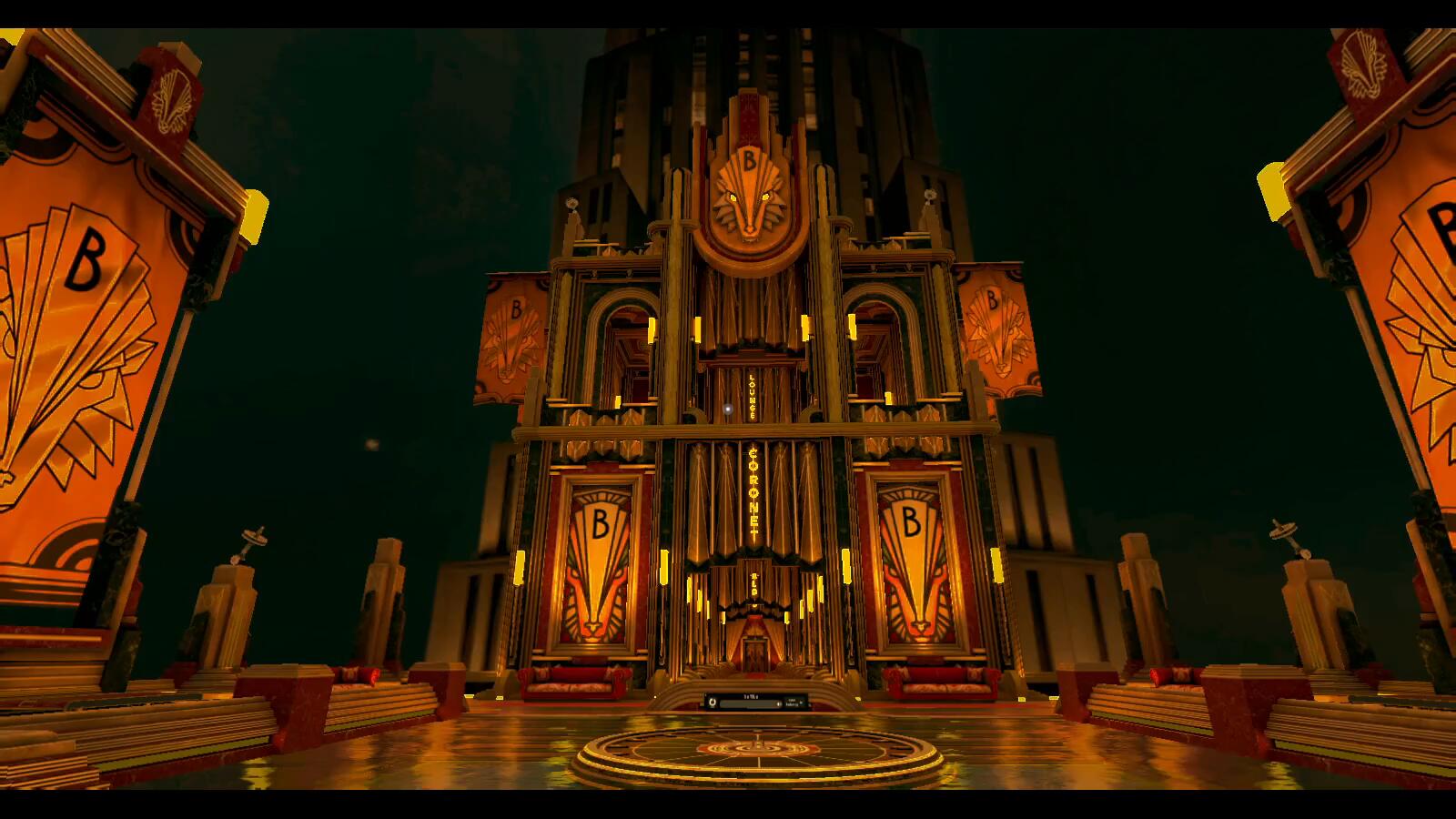
The Coronet
| Credits |
|---|
| The Coronet was commissioned by Disz for Blind Wolf. |
| References and directional input from Disz, WonderingWendigo, JaxFox, Xanaecor and the rest of the Blind Wolf upper staff shaped the world it became. |
| This world was built with care for the Blind Wolf community by Mr. Rubinshtein |
| Additional references and community support available through the Official Blind Wolf Discord. |
| Final Result |
|---|
| Below you will see the result of my hard work that i performed, from beautiful visuals up to the most smallest technical breakdown you can ever find. |
| The Development |
|---|
| Video showcasing every stage of the development and how it came to its conclusion. |

| The Statistics |
|---|
| Video walkthrough showcasing live the backend statistics of the world through unity stats window. Here you will see information about batches, setpass calls, cpu threads and more. |

| Dev Blog Navigation |
|---|
| Below is presented the whole development process with a detailed breakdown of every single process. |
| The Project |
|---|
| Project was developed in full secrecy under NDA from the community as a surprise for Blind Wolf's 4 year anniversary, limiting the access only to few directors of Blind Wolf. |
| THE IDEA |
|---|
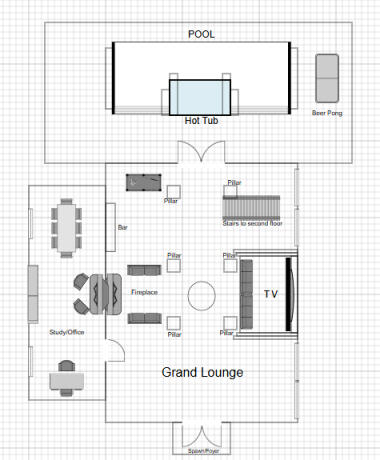
| The project began with an initial first-floor layout designed by Disz himself. My objective was to translate that layout into a space inspired by the New York Art Deco movement. The idea was to create a luxurious space for the community of Blind Wolf which would reflect perfectly everything they stand for. So was established the foundation with the sketches below. |
Layout Sketch by Disz

Layout sketch with second floor


| Eventually Disz made some more sketch concepts from which I could bounce off of and start building. While the sketches were an amazing foundation to start with, I had pretty much full creative freedom and was free to change things however I found applicable. |

Sketch for Movie area

Sketch for the fireplace area

Top down and front view of pool

Pool water system


| Golden selling point of the world needed to be building itself and Disz suggested several options which I could choose and mix together in order to achieve that art deco feeling. I went with Option C as that was perfect for showcasing the Blind Wolf logo and the structure itself was very promising. With taking that into consideration I added my own interpretation of the concept in order to contribute to the feeling of the building being in motion. |

Option A

Option B

Option C


| Blockout (Iteration 1) |
|---|
| With the initial layout, sketches, and a solid collection of references locked in, it was finally time to dive into the first phase of the blockout stage. Using the provided layout sketches as my blueprint, I began establishing the foundational forms of the world. |
| Even at this early, rough stage, I started heavily experimenting with the look and feel of specific geometric shapes. Playing around with these initial volumes allowed me to find my footing early on and truly dial in the distinct Art Deco style I was aiming for before committing to the finer details. |
| A massive source of inspiration for this project came straight from the heart of New York's iconic interior of the Chrysler Building. I was absolutely captivated by its lobby, particularly the way the lighting forms those striking, arrow like shapes. That single detail became the foundational anchor for the entire environment, eventually inspiring the name of the world itself... The Coronet. |
| Because Art Deco is inherently monumental, getting the scale right was crucial. The physical size and metrics of the architecture had to immediately convey a grand, sweeping feeling the moment you step inside. From the very beginning, I focused on blending sharp, striking geometric shapes with smooth, elegant curves. This creates a beautiful visual contrast throughout the space, giving the world a dynamic and rich sense of depth. |

Spawn Lobby

Lounge


| This version of blockout entered its first feedback audit and was presented to some of the owners of Blind Wolf - Disz, WonderingWendigo and JaxFox for evaluation which in the end was very well received. |

Spawn Lobby

Lounge

Lounge Full

Pool Terrace

The Coronet


| Blockout (Iteration 2) |
|---|
| After the first feedback audit I desperately needed a breakthrough which would give this place its signature look already, that would define the rest of the development. This version of the blockout already was significantly different as it introduced many bold changes to the original layout and shaped it further intro its own character. |
| Proper lighting was introduced to the scene which would setup the iconic warm feel of the vintage art deco alongside with big changes of layout such as adding a second floor to it with the personal office, bedroom and more, which would eventually evolve into lounge area for guests. The terrace area with pool got significantly modified alongside with the facade of the building, where I added yet another iconic symbol of 1930's era that are searchlights which majestically illuminate the Blind Wolf logo at the top of the building. |
| While searchlights were used in wars mainly at that time to spot enemies, later on it didn't prevent them from becoming one of the distinctive visit cards of not only art deco but also became a new language of art. Addition of searchlights was inspired by the iconic 20th Century Fox intro. Slowly I introduced as well more color to the blockout to make things more vibrant in order to break down mundane grey color which can blend things together way too much. |

Searchlight used in war
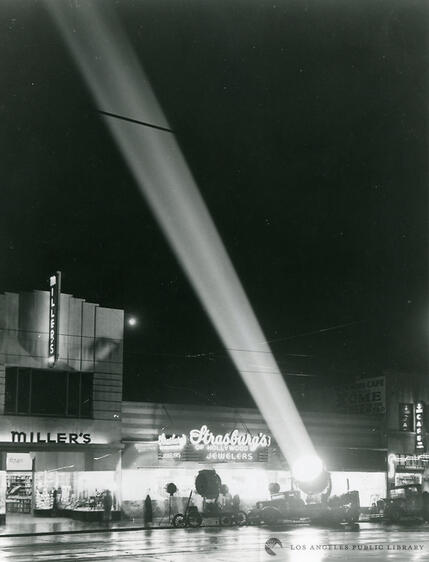
Searchlight used in a civilian setup

Searchlights illuminating LA


| This version of blockout entered its second feedback audit and was presented to some of the owners of Blind Wolf - Disz, WonderingWendigo and JaxFox for evaluation which in the end was very well received as well. |

Spawn Lobby

Lounge

Lounge Full

Pool Terrace

The Coronet

The Coronet Main View

The Coronet Second Floor


| Blockout (Iteration 3) |
|---|
| After the second feedback audit we got to the final stage of the blockout which was groundbreaking point because it finally settled down on the whole visual style and storytelling of the environment itself. This version drastically pushes the boundaries forward towards that classy probation-era style of art deco. Here a proper coloring was introduced to the whole space and final metrics/sizes were set in stone. Some elements here at this stage already can be seen fully textured such as windows and some posters, which is done for the sake of already experimenting with future color scheme of the world and general understanding what do we want to get in the end. |
| Perhaps the most defining addition to the world's overall style is the new Pool Terrace. Here, a massive emphasis was placed on the searchlights, turning them into the true centerpiece of the environment. Even while static, their striking composition gives the space an incredibly uplifting energy, but just wait until you see them sweep into motion when the DJ takes the stage. |
| The entire terrace is designed to make you feel like the "king of the hill." Stepping onto the rooftop's beautiful red carpet, surrounded by a majestic city view and the glow of the Blind Wolf symbol looking down from above, immerses you right in the center of high society. It perfectly captures that feeling of being the star of the most exclusive, vibrant gathering spot in town. |
| A massive shoutout goes to Wendigo, the graphic designer behind the signature art style of Blind Wolf. They provided some incredible visual artworks that were absolutely instrumental in developing the gorgeous stained glass windows which really sealed the Coronet’s premium aesthetic. |
| Finally, at its heart, this project is a community world designed to comfortably host over 60 people at a time. To make sure everyone has a place to gather and hang out, we added a massive drinking table down by the pool that can easily seat 24 people. And for those looking for a slightly more relaxed vibe, that custom built card table which was later replaced by a comfy lounge area for much more casual time spending away from the main area up on the second floor of the Coronet. |

Spawn Lobby

Lounge

Lounge Full

Pool Terrace

The Coronet

The Coronet Main View

The Coronet Second Floor


| Technical Flex |
|---|
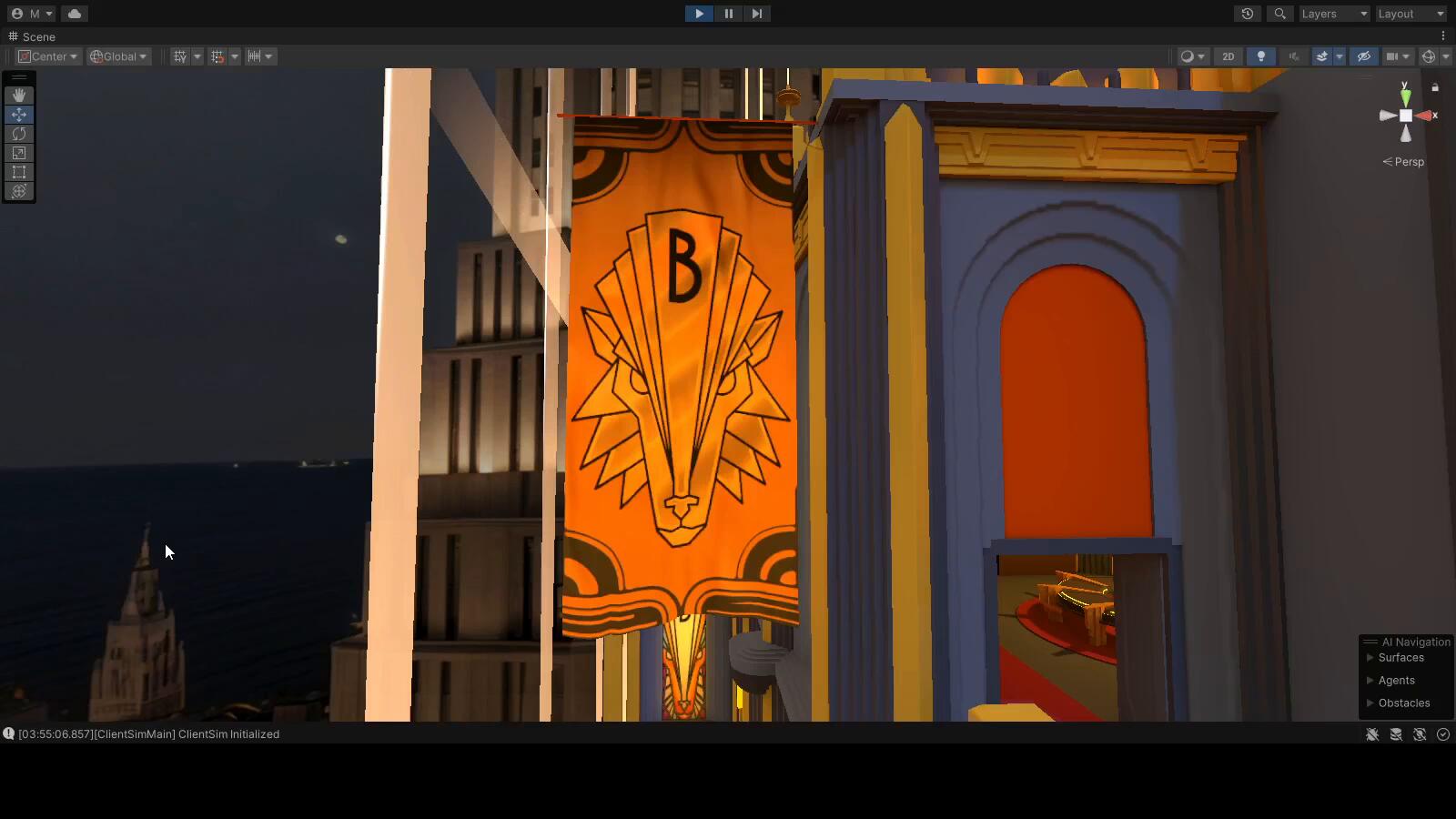
| To bring even more life into the environment, I wanted the posters to wave gently in the breeze. But how do you add that kind of dynamic movement without tanking the framerate? The answer is a clever, lightweight technique called Vertex Animation. |
| Instead of relying on heavy, performance-draining cloth simulations, this method uses some sneaky math to move the geometry of the mesh in a specific pattern. It perfectly emulates the feel of fabric catching the wind while using a microscopic 0.0006% of the GPU's processing power. What makes this setup even better is the attention to detail. None of the posters wave in the exact same way. Each one references its closest neighbor and naturally offsets its animation, creating a beautifully randomized, organic flow across the entire space. |
| Poster Idea Exploration |
|---|
| One of the most exciting ideas I explored in this space was leaning into a dreamy, retro futuristic take on Art Deco. While people often associate the style purely with luxury and status, it was originally a highly visionary movement focused on a scientifically advanced future. To capture that spirit, I incorporated another iconic symbol of the era: double metal propellers. |
| These propellers are attached to coronet shaped holders that display massive Blind Wolf posters on either side of the terrace. The constant spinning adds life and movement to the area, posing a fun "What if?" scenario what if society advanced into a sci-fi future but kept its Art Deco aesthetics? The best part is how incredibly optimized it is. The entire visual relies on a simple bobbing animation and rotating geometry, which costs practically zero processing power for your GPU. |

Brass/Burungudy

Coronet Shaped

Monumental

DJ Screen

Balcony View


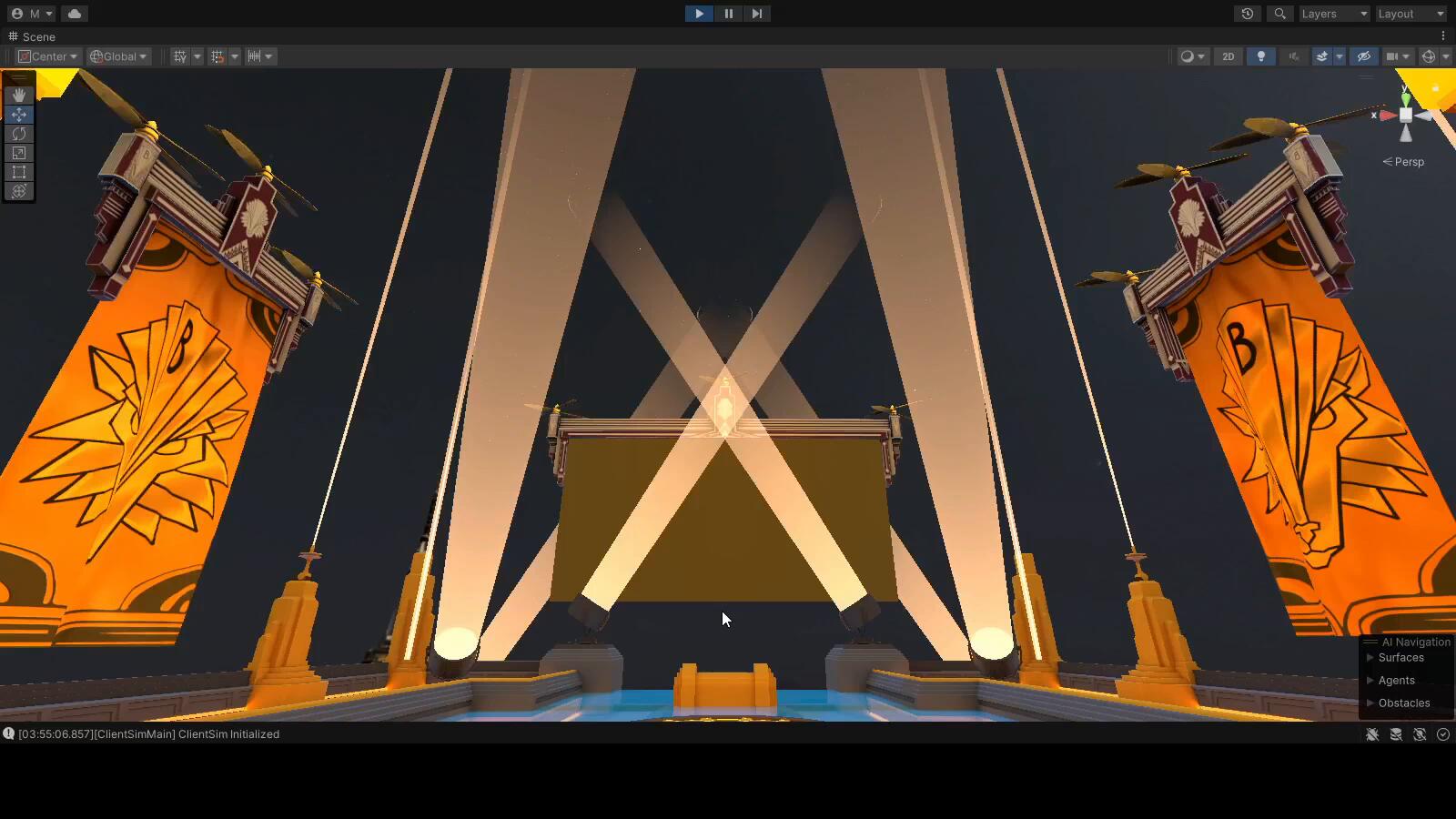
| However, world-building is all about iteration! After a feedback audit, we realized that having levitating screens and posters introduced a bit too much visual distraction. More importantly, it started to shift the tone away from Blind Wolf’s core identity and its grounded 1920s–30s Art Deco foundation. |
| To keep the atmosphere cohesive, we made the call to bring things back down to earth a bit. I swapped the floating propellers for elegant, stationary mounts. It turned out to be the perfect compromise, we got to keep the striking visual layout of the posters, but in a way that feels much more authentic to a real-world historical timeline. Even though the flying displays didn't make the final cut, it was a fantastic, fun experiment that ultimately helped us refine the true vibe of the space. |
| Texturing Phase (Iteration 1) |
|---|
| Following our third feedback audit, it was finally time to dive into one of the most critical phases of the project which would be texturing. Smart texturing has the power to completely elevate a world and save its look if you know how to play to its strengths. |
| To pull this off, I leaned heavily into the modularity of the environment. If you have ever wondered how your favorite games manage to look incredible while still running smoothly, this is the secret! By building the world out of a flexible, optimized set of decorative modules, I was able to maintain a consistent style while keeping performance rock solid. Preparing this foundational kit gave me exactly the right building blocks to start bringing the final, polished look to life. |
| It might sound like development magic, but the six modules you see below all share just one single material. What makes them truly powerful is their flexibility, you can stretch, scale, and snap them together in endless combinations to construct completely new, intricate structures. |
| Building a modular system like this is a fun but demanding challenge. It requires strict math and exact, rounded measurements to ensure every piece clicks together flawlessly, much like lego bricks. While there are some wildly advanced tricks I use to push optimization even further, getting these basics right is crucial. The more precise these foundational building blocks are, the more natural the world’s scale feels. It ultimately gives us the freedom to pack in even richer, high quality details without ever sacrificing performance. |

Module Set


Module Set

| Moving from greybox to a more textured geometry was a massive leap for both visuals and optimization. By leveraging efficient UV unwrapping and custom compression, the entire world runs beautifully on just 10-12 materials as of this phase. I locked the textures at 2K resolution for now, putting our total GPU VRAM footprint at an easy 130MB. Vast majority of the 2K textures would be eventually switched to 1K with special compression settings to ensure optimized GPU memory with barely any loss of quality. |
| With the groundwork laid, I shifted my focus to the lighting to craft that perfect cozy atmosphere. After five solid days of tweaking, the space really started to come to life, as you can see in the shots below. |
| The secret to this monumental yet inviting look is a carefully balanced three-color palette. A rich, dark green marble serves as the foundation of the room, while brass and gold accents step in to break it up, adding elegant ornaments and guiding lines. Because the lighting is so warm, it bounces beautifully off the gold highlights. It gives the whole environment a luxurious, welcoming feel that makes it the ultimate spot for community gatherings. |
| Finally, when shaping the finer details of the environment, I leaned heavily on the 3-5-7 rule. At its core, this is a classic interior design principle that relies on odd-numbered proportions to create visual balance. Odd numbers naturally feel more organic and less rigid than perfectly symmetrical even numbers. If you take a close look around the space, you'll start to notice this pattern hidden in plain sight, whether it's a set of three steps, three decorative lines, or a grouping of five arrows. It's a subtle psychological touch, but it goes a long way in making the world feel harmonious and naturally inviting. |

Spawn Lobby

Lounge

Lounge Full

Pool Terrace

The Coronet

The Coronet Main View

The Coronet Second Floor


| Every inch of this environment is carefully engineered with sightlines and perspective in mind, ensuring that no matter where you stand, you are treated to a beautifully framed view. |
| For example, in the shot below, you can see the main spawn area all the way from the upper terrace where a future DJ booth will be set up. Notice how crisp and readable the details remain, even from a distance. Designing with this kind of visual clarity in mind is exactly what gives the world its massive, immersive sense of depth and scale. |

Spawn Lobby

Terrace View


| To make exploring the world feel effortless, I used inviting perspective lines that naturally guide your eye toward key points of interest. It acts as a subtle, intuitive navigation system that draws you exactly where you need to go without ever needing a map. |
| You might also recognize a major source of inspiration for this space from the iconic Chrysler Building. Its influence is baked right into the architecture, like the striking five-arrow doorway. In the second picture, the elevator doors are actually a direct homage to the Chrysler Building's famous design. As a fun little detail, I even inserted a small Blind Wolf logo into the metalwork, blending it in so nicely that it feels like a natural piece of the original ornamentation. |

Chrysler elevator door

Chrysler elevator doors texture


Coronet Doorway

Chrysler elevator doors reference


| Stepping up to the second floor of The Coronet, you are immediately welcomed by a beautifully cozy hallway. Large, striking paintings line the walls on either side, while carpets naturally guide your steps toward the main area. This floor is designed as an inviting, private retreat. Following the path which leads you right to a classic card table the perfect spot to gather with friends and hang out in a more intimate space, far away from the loud music and bustling energy of the main lounge below. |

Second Floor Hallway

Card Table View


Room Overview

| Texturing Phase (Iteration 2) |
|---|
| After the fourth feedback audit, many new elements have been introduced in the iteration 2. I introduced more vibrant textures into the environment, brought in decals to add small bits of details on the surfaces, revamped the entire lighting of the world and of course most importantly optimized the world aggressively by reducing batches and setpass calls. I went through and replaced almost all of the rough, temporary placeholder geometry with the final, polished assets. Seeing the true architecture of the world finally stand on its own was a massive milestone. |
| Firstly to push the aesthetic even further, a major goal for this phase was to introduce a new complementary color that would break up the existing palette. Drawing inspiration once again from the Chrysler Building, I brought in a rich, striking red marble. This new material beautifully bridged the different architectural elements that way giving the entire space a much more vibrant, dynamic look. |
| If you look closely at the latest shots, you can really notice how beautifully these colors contrast to create a deeply balanced environment. That is exactly why the red marble was introduced. It acts as the perfect complementary anchor, creating points of interest that naturally guide your eye around the room. It prevents the dark green from becoming too overwhelming and elegantly balances out the entire visual composition, giving the space a much more curated and intentional feel. |

Spawn Lobby

Lounge

Lounge Full

Pool Terrace

The Coronet

The Coronet Main View

The Coronet Second Floor


| DECALS |
|---|
| From there, it was all about the finer details. I began layering in mesh decals, which essentially act like highly detailed digital stickers. They allow me to stamp specific touches like intricate geometric patterns or subtle wear and tear directly onto surfaces without taking a hit to performance. |
| For this environment, I created a custom kit of just seven decal modules to enrich the existing textures. To keep things incredibly optimized, all seven of these decals share just one single material. You might be wondering if seven decals are really enough to detail an entire space, but that is the true magic of modular design! Because I carefully pre-planned how these shapes connect and overlap, they can be combined however I want to create complex new designs. It is a perfect example of why you should never underestimate modularity as it not only makes the workflow cleaner and easier, but it keeps the world running flawlessly. |

Decal Set


Square Decal

Decal Combination

Hero Decal

Variation Decal 1

Varication Decal 2

Full View


| Water |
|---|
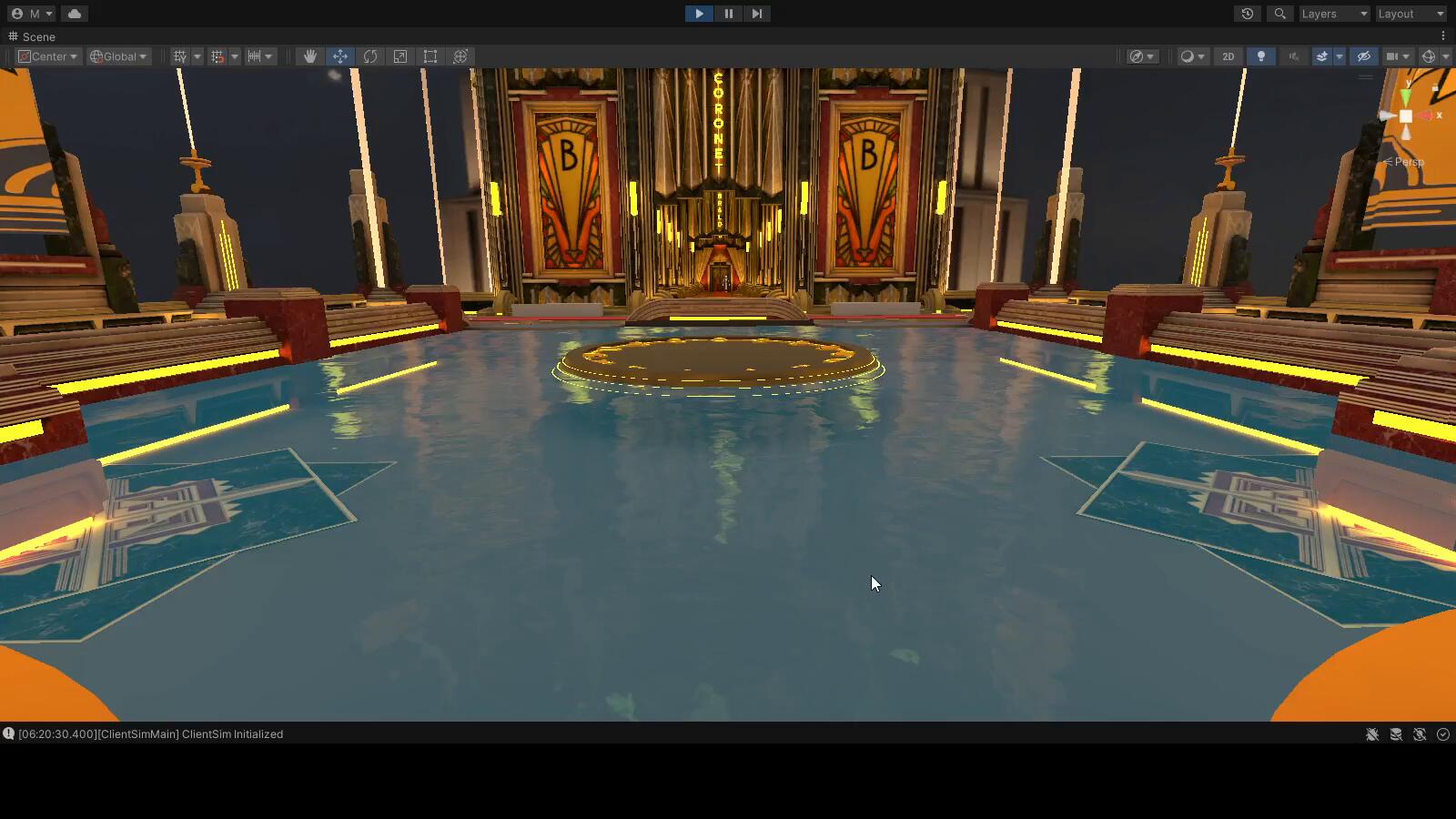
| Water effects are notorious for tanking a world's performance, so finding a lightweight yet beautiful solution was a top priority. This is especially challenging because VRChat relies on the older Built-In Render Pipeline rather than the modern URP, which can make creating optimized water a real developer headache. After a lot of research, I found the perfect balance with a system designed by the incredibly talented creator Starlit Wanderings called >>> Clear Water 2<<< It bypasses those engine limitations beautifully, bringing a natural, calming dynamic to the space without sacrificing our hard-earned frame rates. Under the hood its a simple system of just scrolling UV's where you can control the intensity of the normal map to your liking and the speed. |
| BATCHING |
|---|
| Optimization is an entirely separate art form, and its most crucial step is batching. Imagine carrying 100 groceries inside one by one versus putting them all into a single box. That is exactly what batching does by grouping objects that share the same material so the game engine draws them all in one trip, keeping frame rates high. |
| For The Coronet, this meant violent optimization audits combining meshes and aggressively trimming hidden elements so our intricate Art Deco details run flawlessly. |
| A perfect example of this is the view from the DJ booth, the heaviest spot to render since you see almost the entire world. While the stats currently show a buttery smooth 90 FPS, that number is a trap! An empty world runs great, but the moment you flood the space with complex avatars, the frame rate will tank without proper optimization. |
| This is why aggressive batching is vital. Originally, looking at the facade spiked at an insane 1,100 batches. After heavy cleanup, I chopped that down to a solid 450, and I am confident I can potentially squeeze it down to 350 batches. What makes these results truly incredible is my test setup. VRChat is notoriously CPU heavy, yet I am stress testing this world on an older Intel Core i7-6700K which was released in 2015. Hitting a rock-solid 90+ FPS on a decade old processor proves this foundation is incredibly stable and ready to handle a massive crowd. |

Not optimized Batches

Not optimized Batches

Better Optimized Batches


| Texturing Phase (Iteration 3) |
|---|
| With 98% of the rough blockout geometry officially gone, I was able to bring in a wave of new furniture to beautifully lock in that cozy, premium aesthetic. But the real magic happened under the hood. Following a massive amount of lighting tweaks and a aggressive optimization audit. I managed to slash the world's download size from an already small 45MB down to a tiny 30MB. The entire environment is now seamlessly lit using just a single 4K lightmap, and the GPU VRAM footprint has dropped to a highly comfortable 170MB. This was achieved by carefully curating the scene to use only 37 total textures, with the vast majority locked at a 1024x1024 resolution utilizing specialized compression settings. |
| The performance gains on the processing side are just as dramatic. Whole world is just 390K triangles as of right now, which is nothing for modern hardware to process. Setpass calls have plummeted, maxing out at 45 and sitting at an incredibly low average of 20 to 35. Batches are seeing a similar victory, averaging between 200 and 380 across the map, while the most efficiently designed areas are hitting a staggering 60 to 120 batches. The best part is that this optimization is still ongoing, laying down a rock-solid foundation as we pave the way into the final polishing phase. |

Spawn Lobby

Lounge

Lounge Full

Pool Terrace

The Coronet

The Coronet Main View

The Coronet Second Floor


| Polishing Phase |
|---|
| The final stage of polishing was an absolute revelation. Not only did it completely elevate the overall atmosphere, and brought in optimized systems such as custom shader material for textures, custom optimized poster shuffle system and games into the world but it also led to a technical breakthrough that feels genuinely revolutionary for VRChat. A custom, super-lightweight post-processing solution that is an incredible 100x more optimized than Unity’s default system. |

Spawn Lobby
Lounge

Lounge Full

Pool Terrace

The Coronet

The Coronet Main View

The Coronet Second Floor


| Paintings |
|---|
| One of the most important elements that gives Blind Wolf its soul and integrity is the inclusion of the community Patreon artworks. Placing these paintings throughout the world wasn't just about decorating the space, it was about grounding the space in real community history. |
| These pieces are crafted by the incredibly talented artist SOVKA >>>Twitter<<< >>>Patreon<<< >>>Furaffinity<<<. Her captivating art style is exactly what makes Blind Wolf feel like a living, believable place rather than just another VRChat community. It gives the group a tangible identity that extends far beyond the digital space, blending beautifully into the aesthetic of the environment. |
| Make sure to support Blind Wolf community through >>>Patreon<<< and get your chance to be engraved into its ongoing history. Lastly they have a >>>Ko-Fi<<< if you want to support their future world projects. |
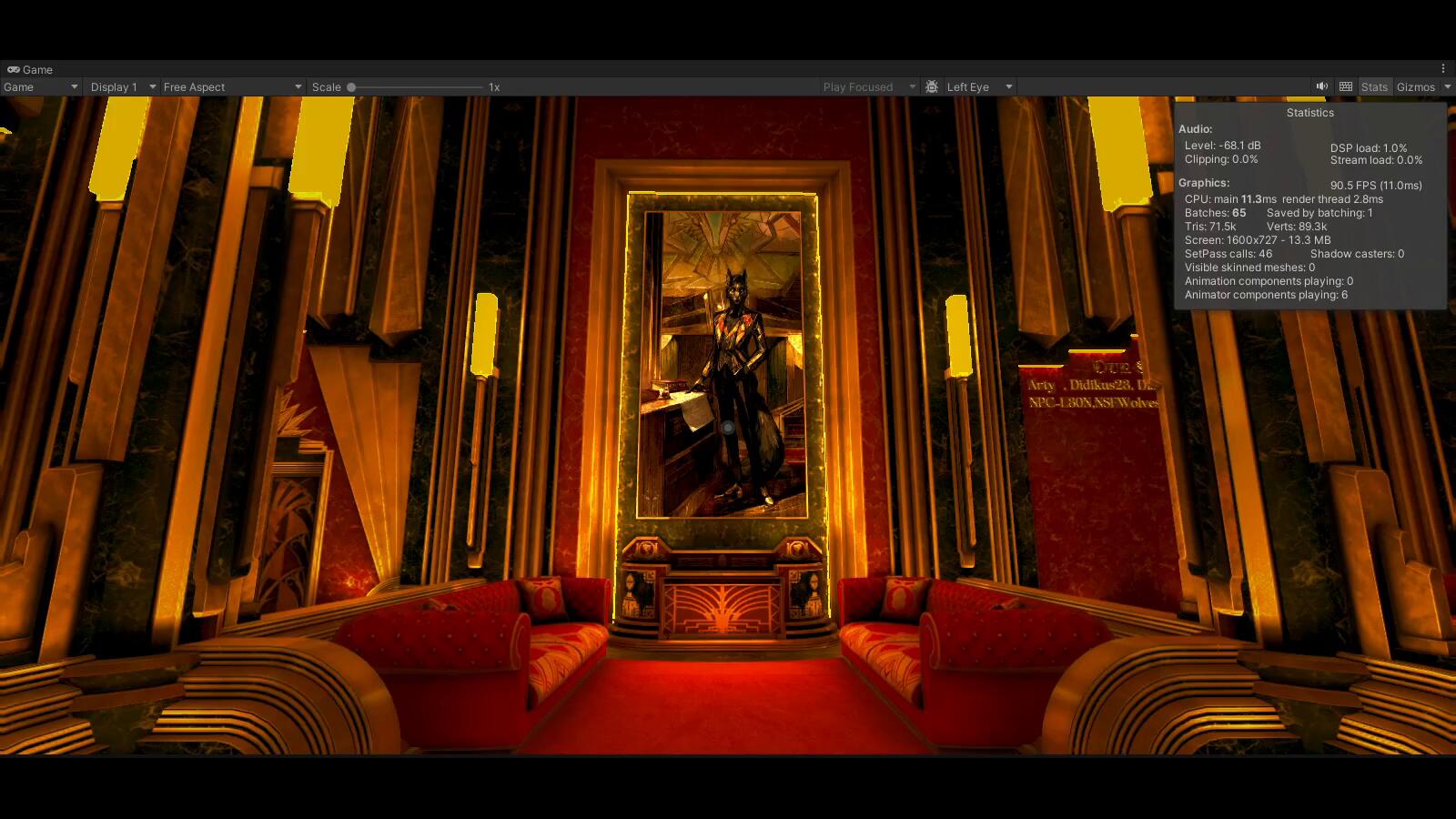
| Just above the fireplace you can see DisZ, JaxtheFox and Unexpected Item. |
| Following up proudly above the Collaboration Posters we have Afevis and Chase. |
| Right next to them above Community board we have RAX and Magmatic. |
| On the second floor in the hallway right on the left we have MajorVictory and on the right Geeknificent. And further after we have Jef and Roebuck. |
| In the lounge area itself we have on the left side Bunny Man and Duo following up on the right Drackonal and Sgt Duck. |
| World Preview |
|---|
| Many creators treat the world thumbnail as an afterthought. Just a mandatory snapshot to finish the upload process. But I will make a bold statement that your thumbnail is 50% of your world's success. |
| You could build the most incredible, highly optimized environment in the history of VRChat, but if you do not have a visual hook that makes people stop scrolling and click, your visitor statistics will be a fraction of what they should be. First impressions drive discovery. Your thumbnail is your world's packaging, and it is exactly what separates the spaces people ignore from the spaces people explore. |
| Do not let hundreds of hours of hard work go unseen just because you rushed the very last step. |
| What is a good thumbnail? |
|---|
| To capture that hook, you have to find the most beautiful, highly selling angle of your environment. It needs to tease the atmosphere and reveal just enough detail to spark curiosity, without giving the entire experience away at a glance. A single world can have multiple selling angles so you just have to choose the one that tells the strongest story. |
| Furthermore, you do not need to reinvent the wheel or spend hours engineering mind blowing custom graphics. You can create an incredibly elegant design simply by repurposing the high-quality assets you have already built for the space. |
| For The Coronet, I decided to go with the exterior facade. It is an epic, imposing angle that immediately sells the monumentality of the space to potential visitors. To frame it, I took a large decal I had already designed, created a clean cutout in the middle, and perfectly centered the building inside it. The rest of the preview is just a static, heavily blurred background shot. That is it. Simple, elegant, and highly effective. |

1. Unedited Screenshot

2. Applied Gaussian Blur

3. Choosen point of interest

Further polishing


World Thumbnail Final Result


Thumbnail in portal

| The circular framing of this design was highly intentional. I wanted the image to align perfectly with the physical contour of VRChat's in game portal, creating the illusion that you are stepping directly into the space rather than just looking at a flat photograph. |
| Achieving this required carefully adjusting the proportions of the cutout so that when VRChat inevitably scales and squishes the image onto the portal, it warps into a seamless, perfect fit. |
| You have to remember that thumbnails do not just live on a 2D menu but also they exist as physical objects dropped into active instances. They need to command attention in a 3D space. To do that effectively, the design cannot be overwhelmed with visual noise. It must carry exactly enough information for a player to instantly recognize its silhouette and atmosphere from across the room. |
| Side note |
|---|
| What I have detailed above is not a definitive recipe for a successful thumbnail. It is simply one approach out of dozens, and an example of how deep you can take the design process. |
| I highly encourage you not to just copy this exact method. Instead, take the philosophy behind it and find your own elegant solutions. While this specific Art Deco, coin-inspired layout worked perfectly for this project, it might fall completely flat for a different aesthetic or genre. |
| There is no universal template for this. Always stay on the hunt for new ideas, brainstorm constantly, and design the visual hook that specifically serves the unique atmosphere of your world. |
| Design Inspiration |
|---|
| The visual framing was heavily inspired by a limited edition physical coins previously created and distributed by the Blind Wolf community. I wanted the thumbnail to honor that piece of their history, which is why the final layout so closely resembles a minted coin. |
| Below are the original physical coins designed by WonderinWendigo that sparked the entire concept: |

BW 2022

BW 2025


| Lightweight Post processing |
|---|
| A proprietary cinematic post processing pipeline with 18 effects, one GPU pass, zero CPU cost, built from scratch exclusively for Rubin's Worldworks commissions. |
| One sphere. One pass. Eighteen effects and adding more. |
| Rewriting post processing is not a novelty in game industry since every game studio does that to adjust and be more flexible to their projects needs and optimization. The concept of rewriting it for VRChat though is a novelty. At least to my memory I haven't personally seen a world that has done that in VRChat or if there is anything that works in a similar way or is even remotely as lightweight with its performance. |
| The Coronet Post Processing is a proprietary system built from scratch by Rubin's Worldworks and is the intellectual property of Rubin's Worldworks that ships as standard with every commission free of charge. The tool is planned to be released to the public for free in future once the tool is fully developed and stable to bring the bar of world creation higher then before and empower other world creators to achieve cinematic results at zero cost. |
| The fundamental insight behind it is architectural. Unity's Post Processing Stack treats each effect as a separate job dispatched from the CPU. This is the source of its performance problem not the effects themselves, but the overhead of repeatedly handing work between the processor and the graphics card. Every pass is a new transaction. Every transaction has a cost. |
| The Coronet stack eliminates that overhead entirely. All eighteen effects run inside a single fragment shader on a single invisible sphere surrounding the world. The CPU dispatches exactly one draw call for sphere and then steps away. Every effect, from color grading to film grain to the invented atmospheric systems unique to this world, runs as arithmetic on the GPU. The CPU never touches it again. |
| 100x more robust |
|---|
| The Coronet post processing is faster than Unity's equivalent system by a factor of approximately one hundred |
| Performance difference? |
|---|
| Numbers in isolation are easy to dismiss. To run at ninety frames per second in VR, every single frame must be produced in roughly eleven milliseconds. That is the entire budget geometry, lighting, avatars, physics, post processing everything. |
| 0.034ms | 4–10ms | 0ms |
|---|---|---|
| Coronet stack with all 18 effects active simultaneously | Unity PP with five standard effects, basic configuration | CPU cost per frame regardless of player count |
| Unity's system consumes four to ten milliseconds running five effects. The Coronet stack runs eighteen effects in 0.034 milliseconds. That is three hundredths of one millisecond which is a number so small it falls below the measurement noise of most profiling tools. |
| More importantly the cost never changes. Whether Coronet has one player or eighty, the stack costs 0.034 milliseconds. It does not know how many people are in the world. It does not know what their avatars look like. It runs after the world has finished rendering, processes the completed image in one operation, and hands it back to the screen. The crowd is invisible to it. |
| Unity PP | Coronet PP | |
|---|---|---|
| GPU TIME PER FRAME | 4-10ms | ~0.034ms |
| CPU TIME PER FRAME | ~1.3ms+ | 0ms |
| FULLSCREEN PASSES | 24-35 | 1 |
| SCALES WITH PLAYERS | YES | NEVER |
| AFFECTED BY AVATARS | YES | NEVER |
| CUSTOM EFFECTS | NONE | 6 INVENTED |
| The result |
|---|
| This single, lightweight tool completely transforms the environment, breathing life into the world and turning it into a living entity. The moment it activates, the shadows become incredibly rich, pulling out a profound sense of depth that makes the entire space feel truly magical. |
| With the post-processing in place, the dramatic lighting and contrasting colors finally pop exactly as intended. To top it all off, I implemented a microscopic fraction of lens distortion in amount of just 0.01. This tiny, almost imperceptible bend in the image wraps the visuals slightly around your view, creating an unbelievably immersive feeling of true physical presence inside the world. And all of this still runs perfectly smooth without a single frame drop. |

Spawn Lobby

Lounge

Lounge Full

Pool Terrace

The Coronet

The Coronet Main View

The Coronet Second Floor


| Optimized post processing > ON |
|---|
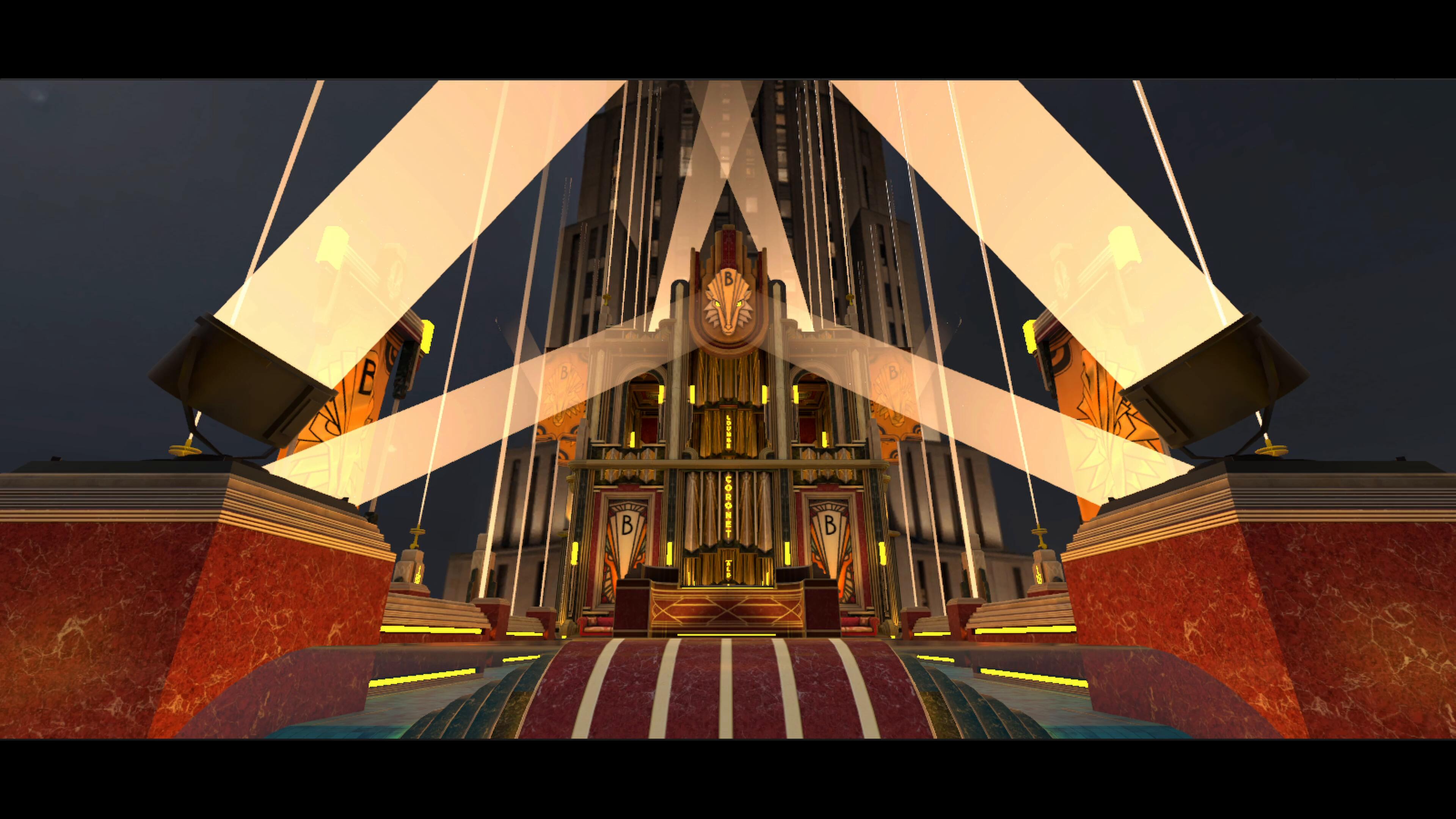
| In the video below, you can see the massive difference this lightweight tool makes across its 18 distinct effects. While some of these adjustments are striking and obvious, others are subtle, barely noticeable tweaks. Yet, when combined, they all work in perfect harmony to create the exact visual masterpiece that The Coronet was truly meant to be. |
| Performance in Action |
|---|
| In the side-by-side comparison video below, you can see the true impact of this lightweight tool in action. It perfectly demonstrates that rendering all of these effects costs exactly 1 batch and 1 setpass call. For a post-processing system pushing this level of visual quality, that efficiency is absolutely phenomenal. |

| If you watch the FPS counter in the corner, it doesn't even flinch. This is solid, visual proof that the method truly works, showing that you don't have to sacrifice your frame rate to achieve a breathtaking, cinematic environment. |
| Custom material shader |
|---|
| Building a Shader That Only Does What It Needs To |
| When you build a world in VRChat, Unity hands you a default shader called Standard. It handles everything from realtime lights, dynamic shadows, fog, mobile devices, consoles, every platform that Unity has ever supported. It is, by design, a universal tool. And like every universal tool, it carries a lot of weight you never asked for, especially for my pipeline. |
| The Coronet uses fully baked lighting. Every shadow, every bounce of warm amber, every gradient across a marble floor and all of it was calculated once by Bakery and frozen into a single 4K lightmap and downsized to 2k before the world shipped. At runtime, none of that needs recomputing. The scene is static. The lights don't move. Standard doesn't know that. It still shows up every frame with its realtime light attenuation code, its shadow sampling routines, its dynamic GI paths, its fog calculations while executing hundreds of instructions per pixel for scenarios that simply do not exist in this world. |
| CoronetBakedLit is the answer to that problem. It is not a general shader. It was written for one pipeline >>> fully baked, zero realtime lights, zero shadow casters, PC-first, Bakery lightmap. Within those constraints it implements physically correct PBR using the same mathematical model as Standard with the same Fresnel response, the same GGX reflection model, the same metallic workflow. What it does not implement is anything outside those constraints. |
| Shader Variants | ALU OPS/PIXEL | Runtime Pass |
|---|---|---|
| 4-6 vs 300-600 in Standard | ~35 vs 150 in Standard | 1 vs 3-5 in Standard |
| Why Variants Matter |
|---|
| Every shader in Unity compiles into multiple variants of different versions of itself for different keyword combinations. Standard compiles between 300 and 600 of these. Every one gets cached in GPU memory when you load a world. CoronetBakedLit compiles 4 to 6 only. One for lightmap on, one for lightmap off, one each for the emission and double-sided toggles. The skip_variants pragma strips fog, shadows, global illumination, spherical harmonics, and vertex light keywords before the compiler ever touches them. The result is a shader cache that sits under 0.3MB versus Standard's 15–30MB. |
| Why passes matter |
|---|
| Unity Standard has a ShadowCaster pass which is a second GPU render pass that runs for every material to compute shadow depths. It fires whether or not your scene has any shadow casters. The Coronet has no shadow casters. That pass was running every frame contributing SetPass calls which would cause GPU state switches that stall the pipeline, a feature producing no output. CoronetBakedLit has no ShadowCaster pass. It has no ForwardAdd pass. One pass runs at runtime which is ForwardBase. That's it. |
| Why ALU ops matter |
|---|
| Standard's fragment shader computes realtime light attenuation on every pixel even when no realtime lights exist. It runs exp2() which is an expensive transcendental GPU function located inside its environment BRDF. CoronetBakedLit replaces that transcendental with a cubic polynomial fit accurate to within 2.5%, imperceptible in baked IBL, that the GPU executes as pure multiply-adds in parallel. The total fragment instruction count drops from roughly 150 operations per pixel to roughly 35. Two texture samples, EnvBRDF polynomial, diffuse combine. That's the entire fragment shader. |
| CoronetBakedLit is specific to The Coronet's pipeline with fully baked, zero realtime lights, PC-first. It is not a general-purpose shader and was never intended to be. The right shader is the one that fits the problem. This one fits this problem exactly. |
| Poster Shuffle Sytem |
|---|
| Community poster boards are everywhere in VRChat worlds. Most implementations use swapped materials, animator controllers, or synced Udon variables. All of them pay costs they don't need to. Here's how The Coronet's poster system works and why it costs almost nothing at runtime. |
| What should not be done |
|---|
| One of the usual approaches to displaying shuffled posters is to have one mesh per poster slot, one material per poster, and Udon swapping out textures or toggling renderer enabled states. That produces multiple draw calls per frame, material property thrashing, and often network sync overhead if the designer wants all players to see the same posters. |
| The animated version is even worse which is an Animator Controller ticking every frame, or an Udon Update() loop driving lerps. Both run continuously regardless of whether anything is actually changing. |
| Metric | Typical World | The Coronet |
|---|---|---|
| Draw calls (posters) | 3–6 per frame | 1 per frame |
| SetPass calls | 3–6 per frame | 1 per frame |
| Network messages | Every shuffle | Zero, ever |
| Udon CPU (idle) | Update() every frame | Zero — event-driven only |
| Udon CPU (animating) | Update() every frame | 20 SetFloat calls over 1s |
| Texture VRAM | 6× separate allocations | 1 Texture2DArray object |
| How does it work? |
|---|
| The key insight is that the three quads are never separate objects at runtime. They're one mesh with vertex data that tells the shader how to behave per face. The GPU never issues a second draw call so it reads the baked slot ID and picks the right poster slice in a single pass. |
| Mesh layer | Shader layer | Udon layer |
|---|---|---|
| Three poster quads baked into a single combined mesh. Slot ID (0, 1, 2) stamped into TEXCOORD2 per vertex at build time. One renderer, one material, one draw call. | Reads slot ID from TEXCOORD2, samples the correct array slice, applies vertical scroll using a progress float driven from outside. No per-frame logic just pure lookup and UV math. | Sleeps between shuffles. On tick it runs Fisher-Yates on 6 indices, writes 7 floats to the material, drives a 1-second animation loop at 60fps, goes back to sleep. |
| Why it was done like this? |
|---|
| For a 60–80 person instance, network sync is the most expensive thing you can do. Sending a synced variable to 80 clients means 80 network messages, 80 deserialization operations, and ownership logic that needs a master client. |
| The Coronet's poster system sends zero network messages. Every client independently computes the same shuffle result using a seed derived from the server clock divided into fixed intervals. At the same moment in server time, every client in the instance is running the same Fisher-Yates with the same seed while at the same time including late joiners, who snap into the current interval immediately. |
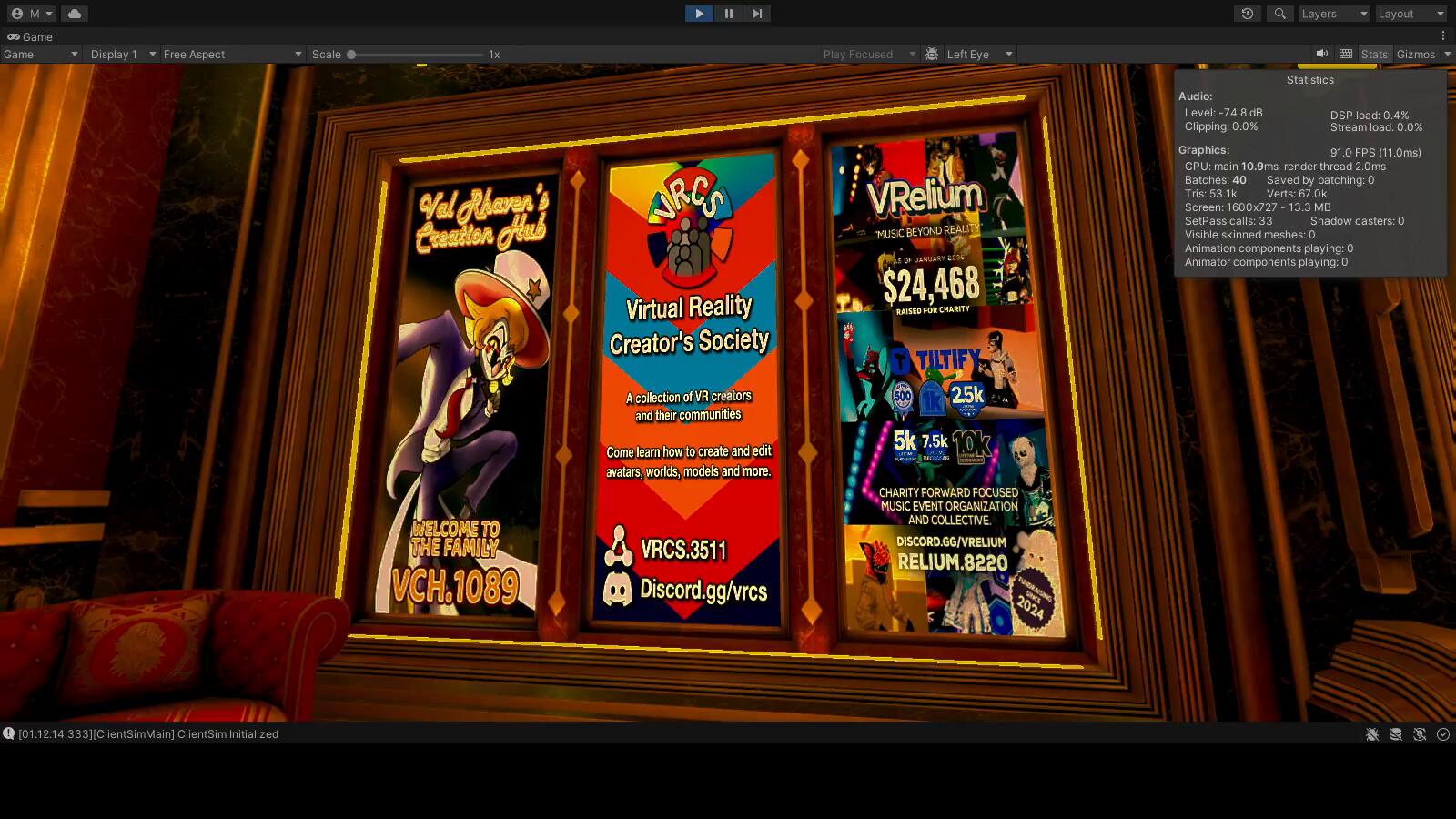
| You can pretty much see that the system works so robust that not CPU or GPU even flinch when scrolling through the posters. Its as lightweight as it can get. |
| How much is the win? |
|---|
| >>>A lot<<< |
| 1 draw call for all 3 poster slots combined | ~2MBVRAM for all 6 posters, DXT1 compressed | 0 network messages, ever, for any player count |
| 0 Udon operations per frame while idle | 20 SetFloat calls total during a 1s transition | 6 integer swaps to reshuffle all 6 posters |
| Custom DJ Light System |
|---|
| As you might recall, we laid down a massive lighting foundation for the scene. To break down the exact scale of it... the environment features 18 dynamic tilt lights capable of sweeping back and forth up to 60 degrees. |
| Supporting those are 10 massive searchlights. While two serve as highly detailed decorative pieces, the remaining eight are fully active. They feature bases that rotate a full 360 degrees, paired with heads that can sweep up to 180 degrees across their radius. |
| My goal was to craft a spectacular, dynamic visual experience. By choreographing these fixtures into a mesmerizing light show worthy of The Coronet, so it injects an infectious energy into the space. To create that perfect, captivating atmosphere that will have people wanting to stay, relax, and just vibe for hours on end. |
| How does it work? |
|---|
| The entire system of 18 tilt lights across three zones, 8 searchlights, and full music reactivity runs on five Animator components and a single Udon script with one Update loop. That's it. |
| The movement itself lives entirely inside pre-authored animation clips. Each fixture group has multiple hand-animated cycles covering different moods and intensities, from slow atmospheric sweeps to high-energy patterns with intentional light holds. Unity's Animator evaluates these clips natively in C# on the main thread, which is orders of magnitude faster than manipulating transforms through script. No per-object Udon, no per-frame rotation writes, no physics. The Animator job system handles everything in one optimised pass per frame. |
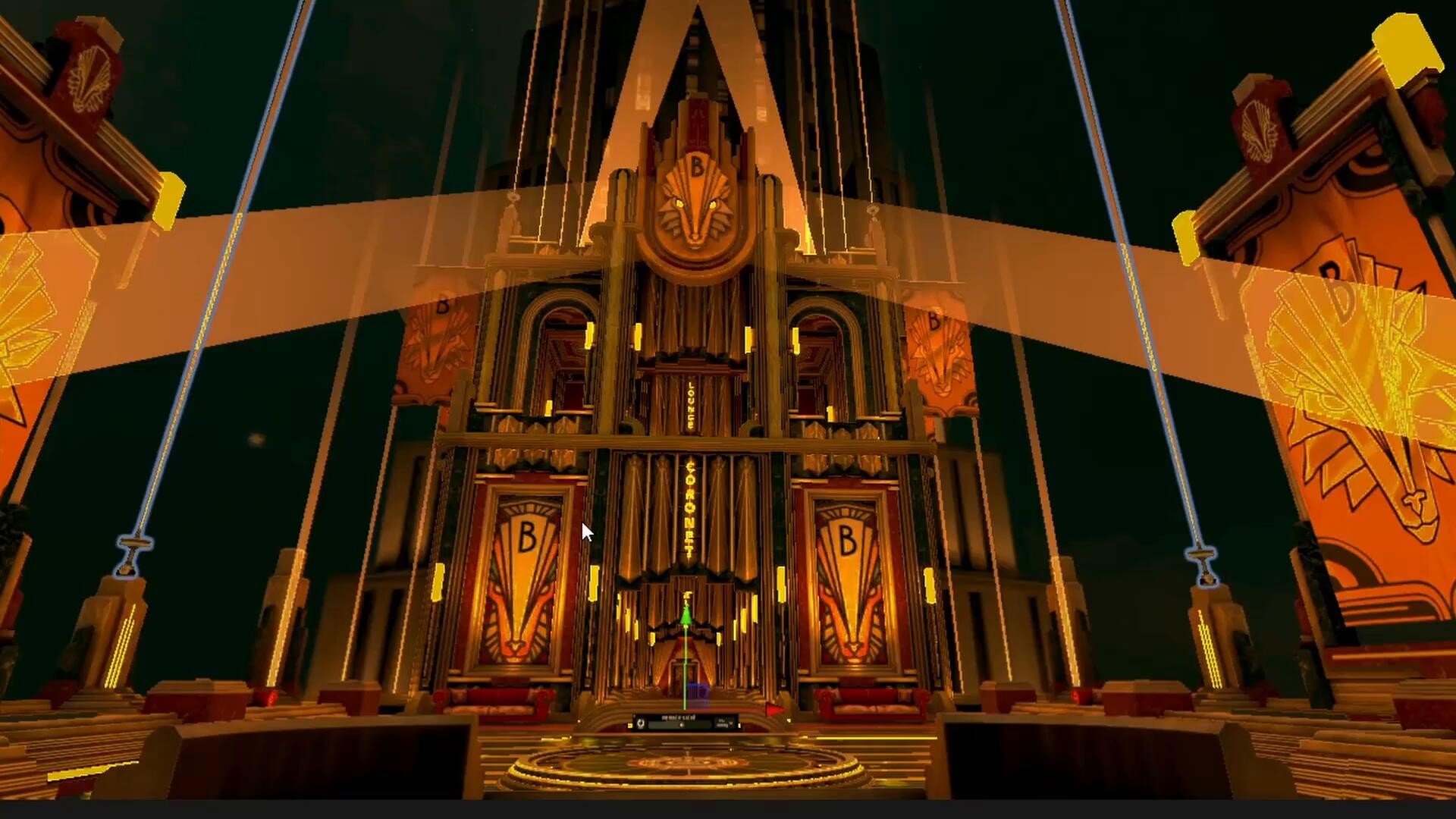
| Music reactivity comes from AudioLink, which processes incoming DJ audio into a texture that shaders and scripts can sample without any expensive CPU-side audio analysis. The Udon script reads three float values from this texture per frame >>> bass, mids, and highs then uses them to modulate each Animator's playback speed. Pit lights respond to bass, terrace to mids, rooftop to highs. The result is three visually distinct groups each hearing a different layer of the music simultaneously. Speed changes are smoothed with asymmetric lerp curves such as fast attack, slow release, so the lights accelerate sharply on drops but fade gracefully during breakdowns. |
| Pattern variety is handled by a shuffle timer per group. Every ten seconds, a new clip crossfades in using Unity's CrossFadeInFixedTime, which blends between animation states at the engine level with zero script involvement during the transition. The clip rotation is random but never repeats consecutively. |
| The choreography layer adds two shared variables such as drop kick and build momentum that both systems read simultaneously. When a drop hits, every light group reacts at the same moment and then tilt lights accelerate, searchlights surge. This shared state is what makes the system feel coordinated rather than like five independent components doing their own thing. |
| For a 60 to 80 person instance, the entire runtime cost is five Animator state machine evaluations per frame, one Update loop performing basic arithmetic on six floats, and five Animator.speed writes. There are no dynamic lights, no per-player scripts, no Udon transform manipulation, and no real-time audio analysis. The performance footprint is effectively invisible compared to the avatar rendering and world geometry that actually drive GPU load in a populated instance. |
| Games & Misc |
|---|
| I also want to take a moment to give a massive shoutout to MajorVictory who is a fellow member of Blind Wolf, a brilliant world creator, and the founder of the >>>VR Creators Society.<<< |
| Adding interactive elements to a world can be incredibly tricky, but he stepped in and helped me seamlessly set up the social games for the space some of which were tweaked and fine tuned by him specifically for the community needs. More importantly, he shared some invaluable technical tips on how to handle these systems behind the scenes so they remain fun and engaging without tanking our hard-earned frame rates. It is collaborative moments like this that make building for this community so rewarding. |
| Beer Pong |
|---|
| It might seem wild that virtual beer pong can bring a powerful PC to its knees, but in VRChat, it is essentially a perfect storm for your CPU. |
| Physics: Calculating fast trajectories and complex collisions (like a bouncing ball entering a cup) eats massive amounts of processing power. |
| Network Syncing: Fast-moving, unpredictable objects must be continuously updated for everyone in the lobby, causing heavy network traffic and stuttering. |
| Scripting: Constant background code checking for scores and triggers drains CPU cycles every single frame if not highly optimized. |
| The Crowd: Drop all this intense math into a social hub full of unoptimized, physics-heavy avatars, and the engine simply suffocates. |
| Which is why it is important to hide your games by default when the world loads up. So people who are not interested to play the games wont suffer from low framerates just because someone wants to play a game. Which is why instead you can have an improvised impostor model of the beer pong table upon clicking on which the real game would appear only for you and your companion if you both click on the trigger to enable it. |
| There is a catch though that once you enable the beer pong table you cannot turn it off due to sync issues that can occur if you do so. Which is why you will have to rejoin the world if you don't want it to affect your hardware. |

Beer Pong Impostor

Actual Game Enabled


| Many people don't realize just how tremendously these games impact performance, but in the video below, I demonstrate the exact cost in raw numbers. |
| Pay close attention to what happens the moment the beer pong table is enabled. The SetPass calls instantly skyrocket past 100, and an additional 200 to 300 batches are immediately dumped onto the renderer and it becomes worse the more player seats you enable. For the standard I set at Rubins Worldworks, that kind of spike is simply unacceptable. |
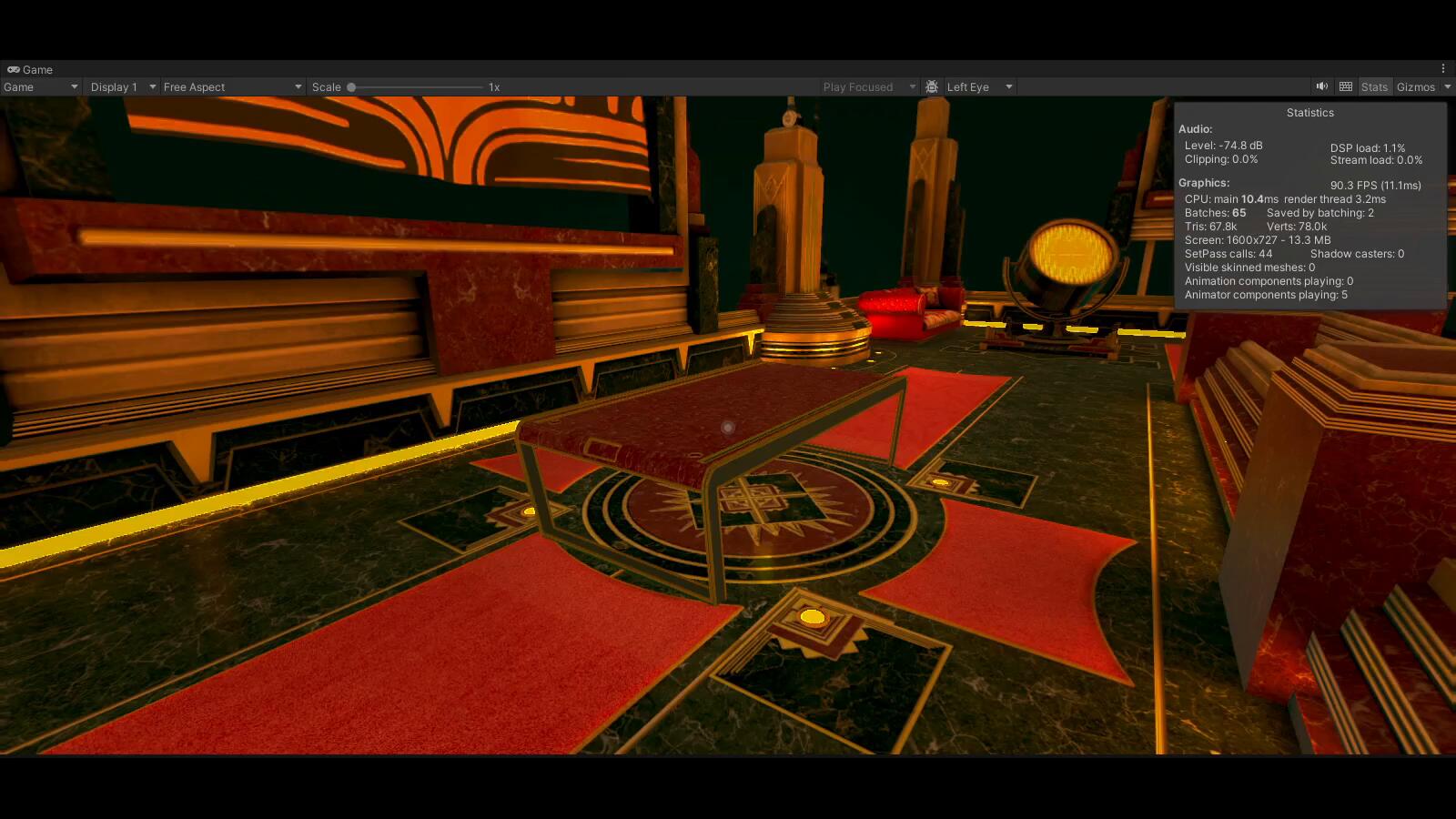
| As a golden rule for superb optimization, you want to aim to keep SetPass calls below 100 and batches roughly around or below 300. While these aren't hard-coded engine limits, they are the targets you must hit to maintain premium quality. The lower these numbers are, the better, especially SetPass calls, which are incredibly heavy on the system. You always have to remember that crowded lobbies mean player avatars will dump massive amounts of their own batches and draw calls on top of your environment. |
| That is exactly why your world must be as "invisible" to the hardware as possible. If the world runs beautifully light, the hardware has the breathing room it needs to handle the players. |
| Drinking Table |
|---|
| A huge thanks again to MajorVictory for stepping in and writing a brilliantly clean and optimized custom script for our drinking game. |
| The game features 32 unique possible entries you can pull, but the real magic is in the performance-saving logic he built into it. Tying perfectly into our philosophy of keeping the world as "invisible" to the hardware as possible, the script automatically completely disables the game's UI the moment a player walks more than 8 meters away. It is a small but incredibly smart detail that ensures the game only uses resources when someone is actually standing right there interacting with it. |
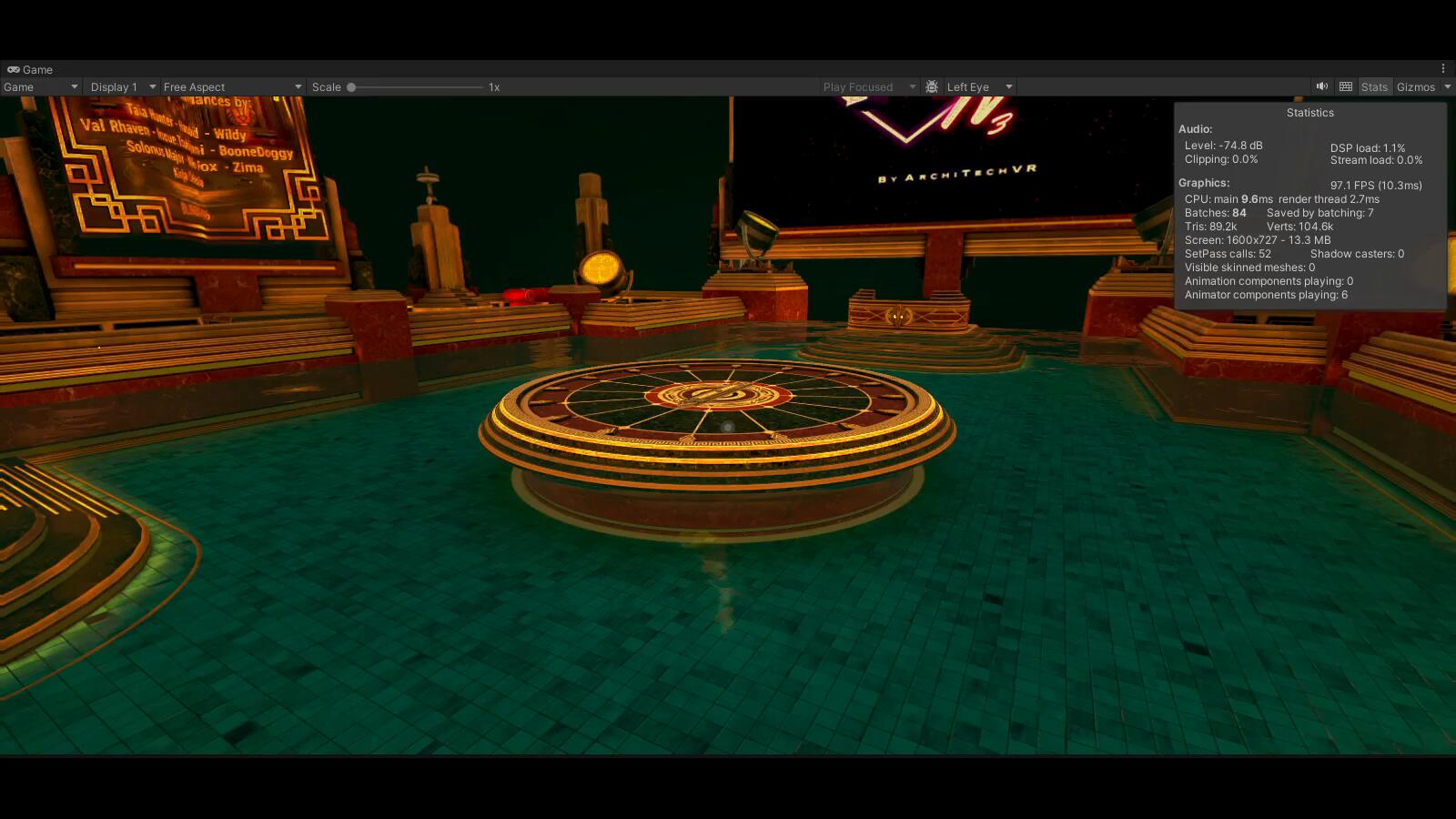
| You can clearly see the numbers jump the second you enter the UI's active zone. It’s a vivid reminder to always optimize your UI and hide anything that doesn't need to be rendered at that exact moment. If it doesn't tank your performance now it will tank it later when you have instance flooded with players. |
| These small culling techniques save a significant amount of performance, and in the high-stakes environment, every frame counts. Think about your user experience since a truly premium world is one that respects the hardware and keeps the experience seamless and fluid from every angle. |
| Billiard Table |
|---|
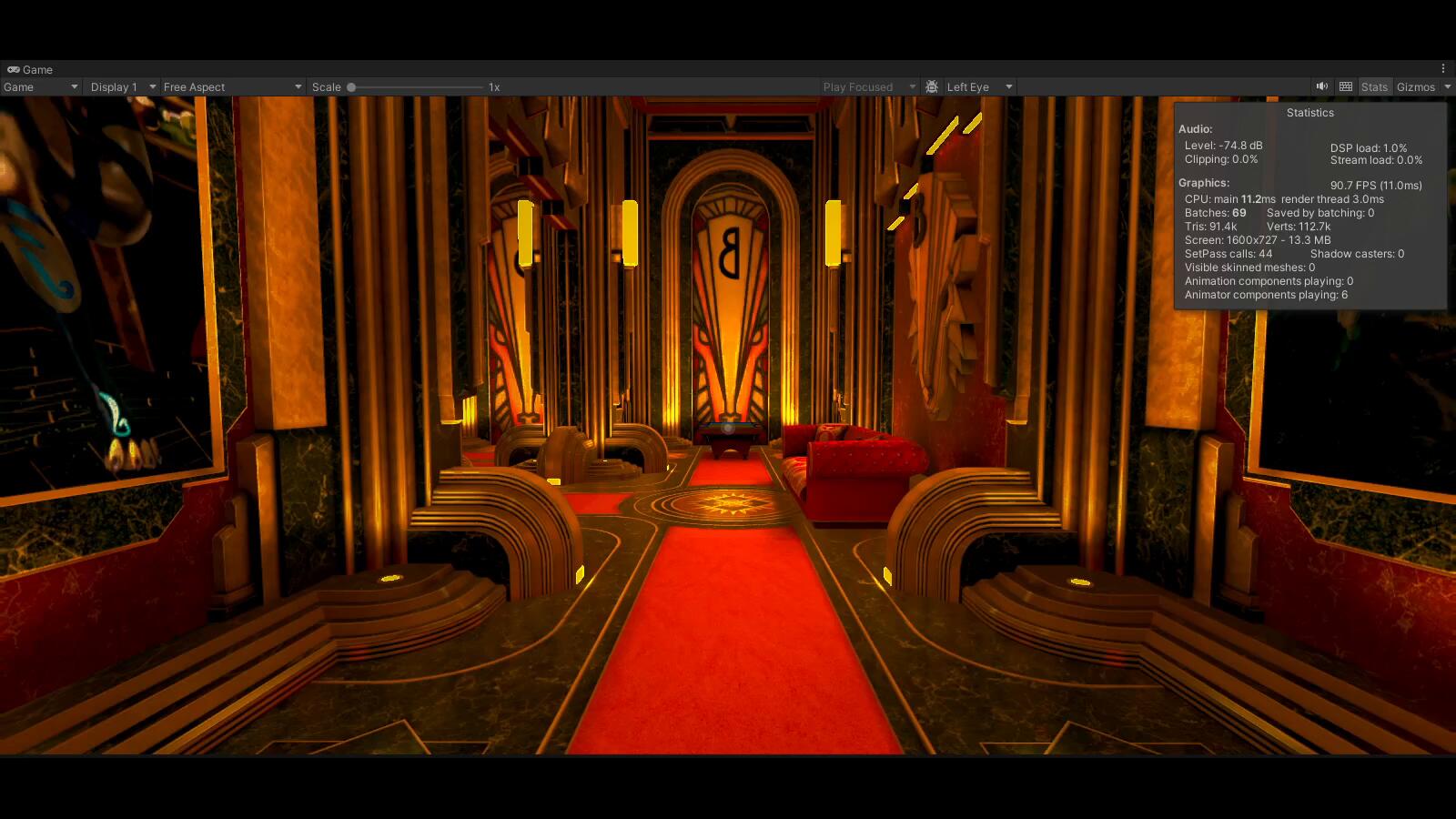
| Just like beer pong, billiards is a massive performance killer. It dumps a staggering amount of batches and SetPass calls onto your rendering load which is essentially the equivalent of an entire optimized world just for one table. It is currently placed in an enclosed space, but imagine the performance disaster of having this in a crowded, open area. |
| Thankfully, when disabled, the table becomes virtually invisible to your hardware. The golden rule here is to always make your games toggleable and strip them down aggressively, from texture resolution to UI. Until better alternatives exist, this is the only way to manage them and even then with better alternatives you still have to make sure to respect peoples hardware and prevent games from rendering on their hardware if they are not playing them. |
| On top of the rendering cost, billiards floods the instance with network ticks. Every time a ball is struck, its physics and position must be continuously synced to every single player. This relentless network traffic causes sudden FPS drops and degrades overall performance. The more interactive systems you stack, the heavier the toll becomes. This is a frustrating reality tied directly to VRChat's rigid Udon architecture. |
| Patreon board |
|---|
| A huge thanks to MajorVictory for saving me a coding headache and setting up our automated Patreon board! |
| It runs completely seamlessly through >>>VRC Linking<<<. When someone subscribes, they receive a Discord role. The VRC Linking bot reads that role and syncs their username to a lightweight, web-hosted JSON file. Whenever an instance of the world loads, VRC String Loading instantly fetches that file and neatly displays the updated supporter list using TextMeshPro. It is a brilliant, zero-maintenance solution that updates in real-time without ever needing to re-upload the world. |

Patreon Board in Editor

Patreon Board in Game


| Misc Dj systems |
|---|
| One final, massive shoutout to MajorVictory for helping me seamlessly set up the voice amplifier and microphone system using the UdonVoiceUtils prefab. He also kindly provided his Viktrola DJ model, which I then enhanced and fully retextured to match our premium aesthetic. |
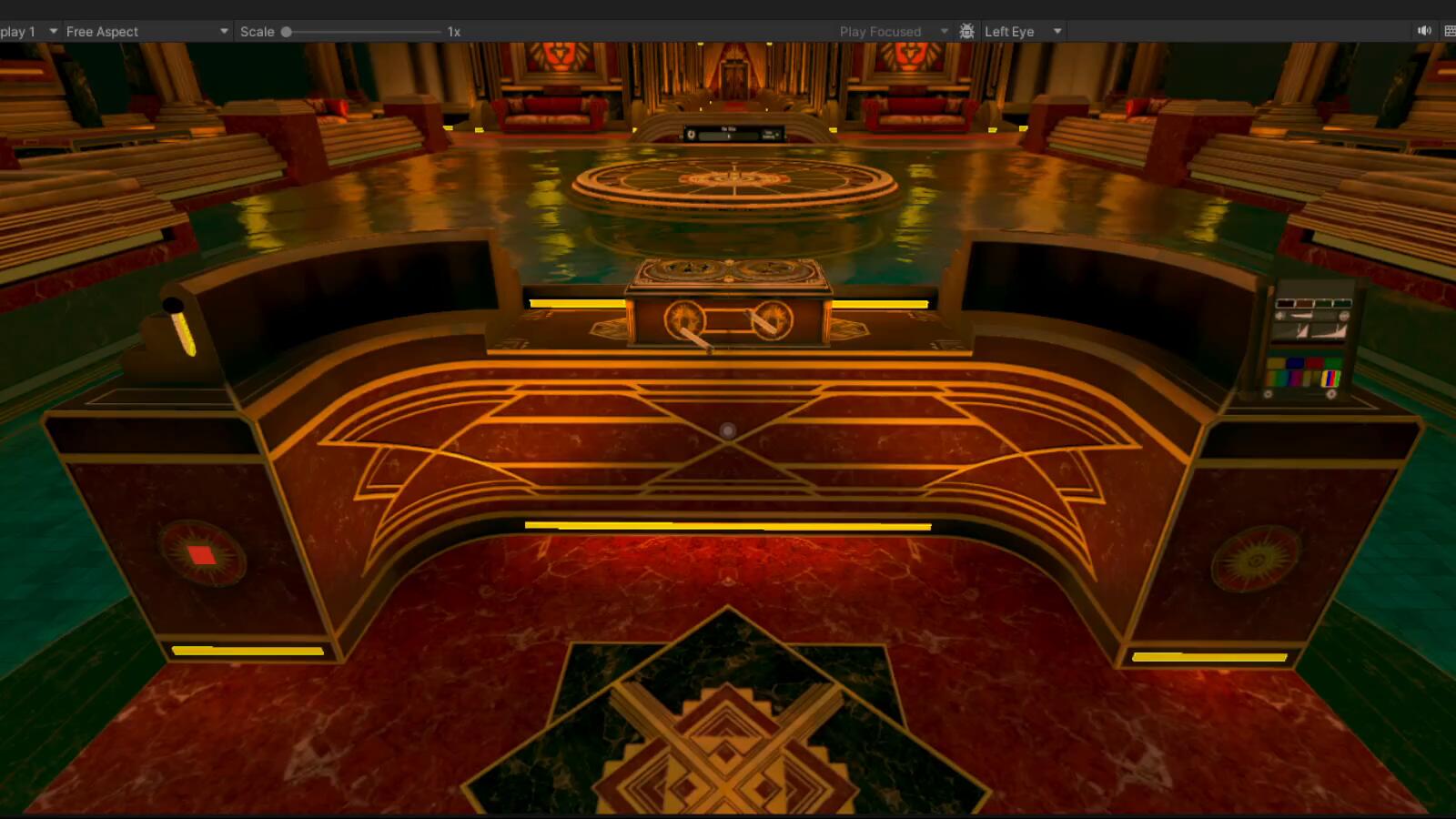
| Here is a fun technical detail about the Viktrola. To keep performance absolutely as tight as possible, there is no Animator component or traditional animation running on the mesh. Just like the flags, all of its movement is driven entirely through a vertex animation shader for maximum optimization. |
| The END |
|---|
| This concludes the technical breakdown of The Coronet, but this devblog was never just about documenting a single world. |
| Every batch saved, every custom shader written, every UI element culled, and every baked lightmap was in service of the argument we started with... You do not have to choose between performance and beauty. |
| The techniques, workflows, and philosophies outlined in these pages are now yours. Take them. Reject the assumption that poor performance is just the inevitable cost of a detailed environment. Stop accepting the tradeoff. |
| Respect your players' hardware enough to optimize ruthlessly, and respect their time enough to make the final result breathtaking. |
| As I said at the beginning, VRChat is a medium, and its future standards are being built right now by the people willing to put in the work. |
| The Coronet is the foundation and the thesis for Rubins Worldworks. It is my contribution to the community. Now it is your turn. |
| Take these tools. Elevate your craft. Build something that makes the next creator look at your world and realize they need to raise their own bar. |
| >>>We get to decide what those worlds look like.<<< |
| >>>Make it count.<<< |
| Project Technical Stats |
|---|
| //////////////////////////////////////////////////////////////////////////////// |
| General Information | |
|---|---|
| Tier | Event Ready Environment |
| Zones | Lobby, Lounge, Terrace, Coronet |
| Size | 30MB |
| Finished | 65 days |
| Technical Stats | |
|---|---|
| Size on GVRAM | 223MB |
| Triangles | 452K |
| Material Count | 59 |
| Batches | 100-250 on average. Heaviest point 350 |
| SetPass Calls | 45-110 average, heaviest spot 120 |
| CPU Render Thread | 2.6ms (lightest spot) - 3.7ms (heaviest spot) |
| PostProcessing | Custom Proprietary |
| FPS at all times (PCVR Quest2) | Capped 90 (Can go up to 150-200 depending on the system) |
Navigation
Club NEVERMORE 18+
| Introduction |
|---|
| Welcome to the dark side of the looking glass. For this project, Rubin Worldworks was tasked with a wild architectural paradox. Merging the brooding, massive scale of classic Gothic design with the surreal, reality-bending geometry of Alice in Wonderland which was all engineered into a premium, high-occupancy club venue. But simply placing a few themed props into a room is not enough. To truly sell this theme, you must orchestrate an entire experience. This space forces you down the rabbit hole, playing with perception, intimate spacing, and forced physical scale, all while running flawlessly under the heavy pressure of a full instance. |
| The Philosophy |
|---|
| Gothic architecture relies on massive stone structures, towering archways, and heavy, dramatic shadows to make the user feel small. Alice in Wonderland demands surrealism and a direct manipulation of reality. In this world, we aren't just relying on the architecture to make you feel tiny, we are actively utilizing VRChat's avatar scaling to physically shrink players, forcing them to interact with the imposing Gothic environment from an entirely new, surreal perspective. |
| In the hands of an amateur, this combination is a complete technical nightmare. Shrinking an avatar alters how they interact with lighting, physics, and other players. My philosophy remains absolute ->>> You cannot lose yourself in a surreal, intimate experience if your headset is stuttering or the lighting breaks. True luxury and sensuality in VR require frictionless design. By engineering custom material pipelines, baking deep global illumination that holds up even when you are inches from the floor, and hand-crafting every asset, we achieved a dark, moody visual depth that costs the GPU absolutely nothing in real-time. Optimization isn't just about code, it is the foundation of a successful experience. |
| Credits |
|---|
| Club NEVERMORE was commissioned by AbigailW and RavensCorpse. |
| References and directional input from AbigailW, RavensCorpse and rest of the Club NEVERMORE upper staff shaped the world it became. |
| This world was built with care for the Club NEVERMORE community by Mr. Rubinshtein |
| Additional references and community support available through the Official Club NEVERMORE Discord. |
| Final Result |
|---|
| Below you will see the result of my hard work that i performed, from beautiful visuals up to the most smallest technical breakdown you can ever find. |
| The Development |
|---|
| Video showcasing every stage of the development and how it came to its conclusion. |

| The Statistics |
|---|
| Video walkthrough showcasing live the backend statistics of the world through unity stats window. Here you will see information about batches, setpass calls, cpu threads and more. |

| Dev Blog Navigation |
|---|
| Below is presented the whole development process with a detailed breakdown of every single process. |
| THE IDEA |
|---|
| Every major project begins with alignment. When you are tasked with adapting a concept as complex and surreal as Alice in Wonderland, the only true limitation is imagination, which is exactly why strict technical and artistic boundaries must be established immediately. |
| To establish a baseline, I initiated a discovery phase with the club's upper management to understand their operational and creative vision. Alongside their layout sketches, they requested two key focal points were a grand throne for management to oversee the venue, and a massive presence of the iconic Cheshire Cat looming behind them. |

Layout Sketch by RavenCorpse

Layout Sketch by RavenCorpse


| While these initial drafts contained strong thematic ideas, they revealed fundamental flaws in spatial design, and the raw requests threatened to balloon into a major technical trap. |
| From an operational standpoint, a standard stage layout created severe bottlenecks for high-occupancy events. Furthermore, modeling a massive, high-fidelity organic character like the Cheshire Cat would be incredibly expensive for player performance and VRAM budgets which was a wasteful expenditure of optimization capital that could be used better elsewhere in the scene. I needed to re-engineer these concepts to be both more surreal and highly optimized. |
| The Beginning |
|---|
| During our creative alignment call, I realized we needed a centerpiece that fundamentally defied traditional club architecture. A standard, elevated square stage felt entirely too ordinary for a Wonderland setting. The geometry needed to be organic, unpredictable, and slightly chaotic. |
| I proposed a surreal twist. What if the stage itself wasn't built, but spilled? |
| The concept started as a fluid, asymmetrical shape on the floor, but rapidly evolved into a massive, experiential set piece. I envisioned a towering, surreal teapot actively pouring its contents onto the ground below. That expanding puddle of "spilled tea" would become the actual performance stage for the dancers. |

Stage Sketch by Scythe

Floor Plan by RavenCorpse


| This wasn't just a visual gimmick, it was a critical architectural breakthrough. The organic shape of the spillage completely broke the rigid, restrictive symmetry of the original sketches. It allowed me to start off with a solid structure from which I could bounce further and explore surrealism. When I delivered the first 3D grey-box iteration utilizing this new layout, it didn't just solve the venue's spatial bottlenecks, it completely shattered the client's expectations of what the space could actually be. |

References gathered at the start of the project from client

| With the conceptual elements locked and a highly curated reference board established from our initial alignment calls, it was time to move from theory into execution. I transitioned directly into the intensive research and structural blockout phase which was the critical engineering step required to drag this surreal vision out of the abstract and anchor it into a functional, physical reality. |
| References for Blockout |
|---|
| To ensure the atmosphere carried genuine weight, I knew that relying on a handful of Pinterest references would not be enough. I paused production to conduct a comprehensive visual study spanning 120 years of Alice in Wonderland media, starting from the very first silent film adaptation in 1903, all the way through 40 years of modern video game interpretations. |
| Movies |
|---|
| Since Lewis Carroll published Alice’s Adventures in Wonderland in 1865 and Through the Looking-Glass in 1871, the narrative has functioned as one of the most culturally malleable properties in the history of storytelling. The text is defined by dream logic, surreal landscapes, and a subversion of physical laws that presents a uniquely porous foundation for adaptation. |
| Unlike rigid mythologies or structurally strict historical dramas, the Wonderland mythos acts as a psychological and cultural mirror. It consistently reflects the technological capabilities, social anxieties, and artistic preoccupations of the era in which it is adapted. |
| In preparing for this project, I undertook a deep dive into the history of these adaptations. In total, there are 27 cinematic interpretations of the work. Most of these, frankly, were not worth the render time. The vast majority of these movies either lazily mimicked one another or served as raw, literal page-by-page retellings that fail to capture the spirit of the surrealism. While some are fascinating artifacts of early cinema, many simply do not hold up to modern standards and would be, for the modern viewer, an exercise in patience. |
| However, this research was essential. It allowed me to identify the few adaptations that actually understood the assignment were those that moved beyond the text and into the atmosphere. I stripped away the clutter and focused exclusively on the visual languages that truly mattered. |
| Below are the curated references that provided the blueprint for the club. |

Classics

Accessories and tricks

Soviet cartoon animation

More tricks and shapes

Whimsical and surreal fairytale

Gothic and Creepy


| DO NOT GOOGLE "ALICE IN WONDERLAND 1976 Musical" I BEG YOU PLEASE |
| Games |
|---|
| With games as well i managed to extract a handful amount of good ideas. Very first game was released in 1985 on Macintosh computer marking the chaotic mayham start that digital media would create. From the most obscure possible ideas all the way to increadibly creative fun games that are still fun to play to this day. |
| Archive |
|---|
| I want to be transparent about my workflow. To map out 120 years of Alice in Wonderland history and categorize it into an accessible archive, I utilized Gemini as my research engine. |
| Some might view this with skepticism, but I view it as an evolution of the research process. Using an AI to organize and cross-reference a massive, fragmented history isn’t a shortcut—it’s a discovery tool. This process allowed me to go beyond the mainstream hits and uncover obscure, niche adaptations of Wonderland that I simply would have missed on my own. |
| This changed the entire project. |
| By discovering these "hidden" entries, I was able to pull much more interesting, granular references that gave this world its specific Gothic-Surrealist edge. The AI helped me locate the data, but the selection was entirely human. I spent hours manually iterating on the archive, tweaking the UI, and verifying the content because I wanted this to be a resource that people would actually enjoy using. |
| I don't believe in hiding the tools I use, but I also want to be clear about the distinction between data processing and curation. |
| In the modern creative landscape, there is a stigma that using AI is a shortcut. I reject that. I used it to handle the tedious heavy lifting of dataset organization so I could focus on the "fun" part: getting lost in the history and finding the unique visual DNA for this club. |
| I hope you enjoy diving into this archive as much as I enjoyed the deep-dive obsession required to build it for you. |
| Blockout (Iteration 1) |
|---|
| Scale is not just a visual metric, it is a psychological tool. When you establish a singular point of interest, like the spilled teapot stage, you must manipulate the surrounding environment to force the guest's focus toward it. |
| The imposing scale of this room is engineered to exert a deliberate, almost oppressive atmospheric pressure. It is meant to feel slightly intimidating, blending the awe of massive Gothic design with the unsettling surrealism of Wonderland. This isn't just a room you casually walk into. By orchestrating this threshold of shrinking the player, forcing them past the guards, and surrounding them with towering architecture, we create an emotional sequence. Guests don't just attend an event, they undergo a repeatable sensory loop that commands their attention and guarantees they will want to return. |
| Aesthetic |
|---|
| Choosing an aesthetic for Alice in Wonderland is an exercise in restraint since there are infinite interpretations, and without a clear direction, the world loses its focus. I evaluated the classic archetypes of the Tea Party, the Garden, the Forest, but ultimately, I anchored the venue in the Queen’s Court. |
| This theme offered the most compelling opportunity for architectural drama. By positioning the Queen’s throne as the venue’s centerpiece, I could orchestrate a space where the feeling of authority is inescapable. The design is intended to make guests feel watched as if you are participating in the fun, but you are always existing under the gaze of the Queen and the Cheshire Cat. |
| Creating the Experience |
|---|
| The journey into this club is designed as an intentional psychological transition. You don't just "enter" the world, you are manipulated by it. |
| The Descent (Shrinking): Before the main club reveals itself, you navigate through a corridor that triggers a world-space scaling event. You enter the room miniaturized. This makes the Gothic architecture, the looming teapot, and the high ceilings feel truly gargantuan and imposing, reinforcing the surrealism of Wonderland. |
| The Approach (Re-scaling): As you walk past the imposing line of Card Guards toward the center of the chessboard floor, your avatar gradually scales up. This is a deliberate design choice as you draw closer to the spilled-teapot stage, you grow into your proper size. This movement creates a visceral feeling of "owning" the space as you reach the focal point. |
| This flow serves a dual purpose. It forces the guest to experience the venue’s scale from two perspectives, the small, surreal outsider and the full-sized, confident guest before they ever settle into a seat. It turns a standard, mundane walk-in into a cinematic narrative event. |

Stage Entry

Queens Stage

Queens Throne

Chessboard View

Stage Overview

Backstage View


| While the core of this phase was structural, you can see in the footage below that I simultaneously began stress-testing custom shaders. In a high-performance environment, you cannot afford to treat material design as an afterthought. I prototype these visual boundaries concurrently with the grey-box phase to establish my technical budget early. I need to know exactly how much GPU overhead I can rely on without breaking scope or derailing the project's momentum. |
| One of these early tests is visible in the Gothic arch windows and the big arch where the teapot and supposed Cheshire cat eyes and mouth are, which currently house a dynamic "void" shader. This is not a random aesthetic choice, it is a deliberate integration of the club’s culture into the architecture itself. |
| These elevated windows are functional VIP spaces reserved specifically for veteran dancers. By utilizing this void effect, we create an ethereal, high-status showcase dedicated exclusively to performers who have earned their place through long-standing contribution to the community. It is a prime example of how we can embed community hierarchy, loyalty, and prestige directly into the physical blueprint of the venue. The void in the big archway is meant to blend the Cheshire Cat smile and eyes inside it as if its a portal from which the cat gazes upon each guest that enters into the space. |
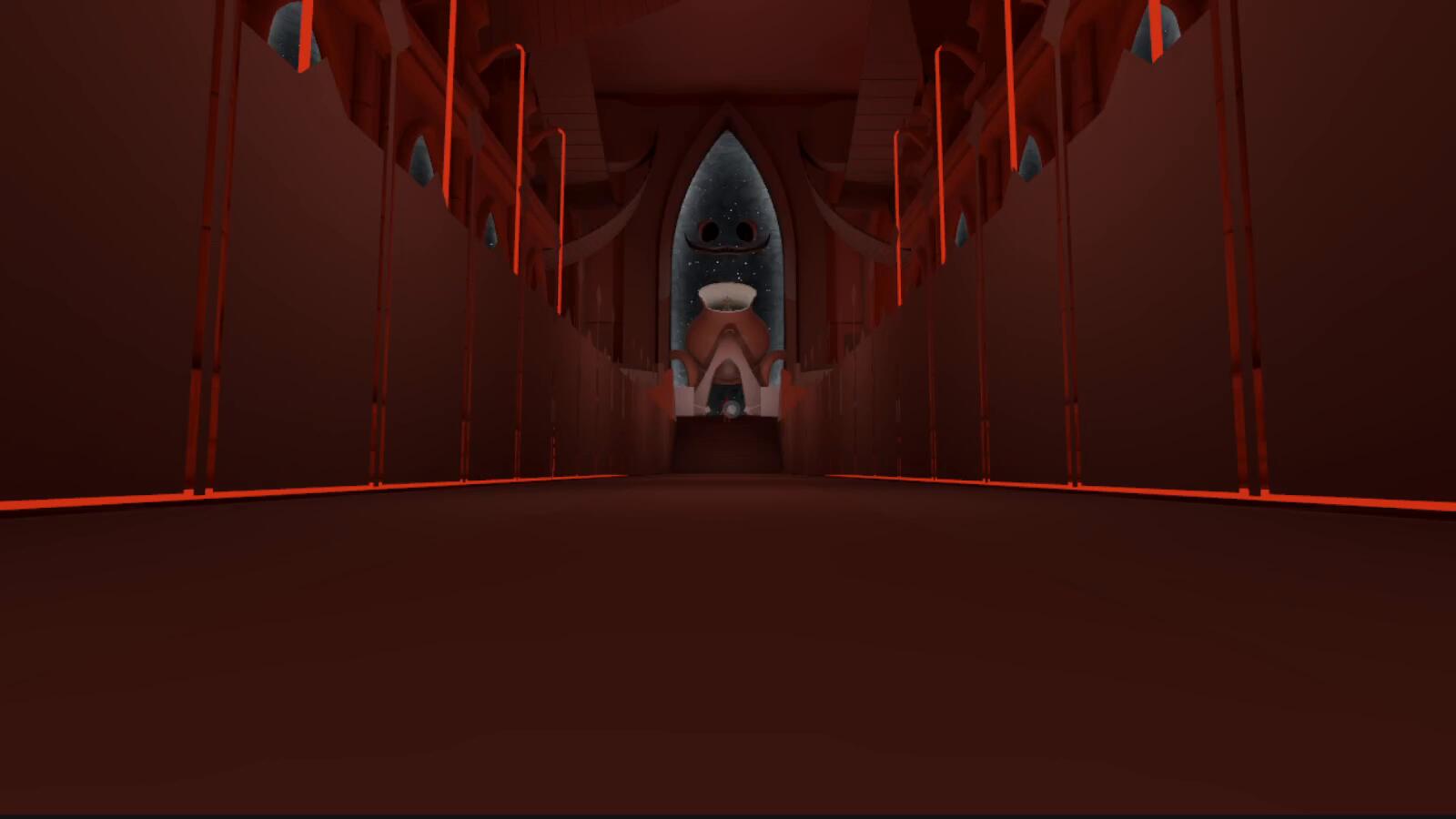
| Blockout (Iteration 2) |
|---|
| The initial grey-box provided a solid foundation, but it felt too rigid and more "architectural" than "dreamlike." It functioned, but it lacked the soul of Wonderland. I realized I needed a complete pivot which made me abandon standard structural straight lines in favor of an aggressively surreal visual language. |
| I overhauled the lighting pipeline and integrated layers of distorted geometry to challenge the physical predictability of the space. The biggest leap, however, came when I decided to delete the ceiling entirely. Instead, the entire world now sits within the heart of a massive, swirling whirlpool which is a direct, atmospheric nod to the chaotic, surreal aesthetic of McGee’s Alice. |
| This change established the world’s true, distorted gravity. By breaking the conventional boundaries, I locked in a visual DNA that feels less like a static club layout and more like a manifestation of pure dream logic. This is no longer just a room, it is a space caught in a perpetual, surreal storm. Every subsequent polish pass will build upon this foundation, ensuring the environment remains jarringly beautiful, deeply immersive, and structurally sound. |

Stage Entry

Queens Stage

Queens Throne

Chessboard View

Stage Overview

Backstage View


| One of the most rewarding aspects of this phase was deconstructing the Gothic vernacular. My objective was simple yet demanding ---> transform traditional, rigid Gothic architecture into something surreal while preserving a silhouette familiar enough to feel "grounded." |
| I began, as any modular design process does, with the fundamental archway. The beauty of modular design is that it functions like a puzzle system of repeatable components that can be manipulated to create organic, impossible shapes. I didn't want to rely on unique, "hero" assets that would bloat the project's memory budget, I wanted an evolution of the pattern itself. |
| I treated the archway as a living variable. I began experimenting with how these modules could interlock, shift, and distort. By radically mutating the standard Gothic profile, I didn't just create a new set of shapes but I triggered a natural, architectural evolution. |
| The results below illustrate this transition of moving from a predictable, traditional arch to a warped, surrealist expression that still feels architecturally honest. This modular logic is the key to maintaining a massive, complex scale while ensuring the world remains optimized and easy to manage as the layout grows. |

Archway Module
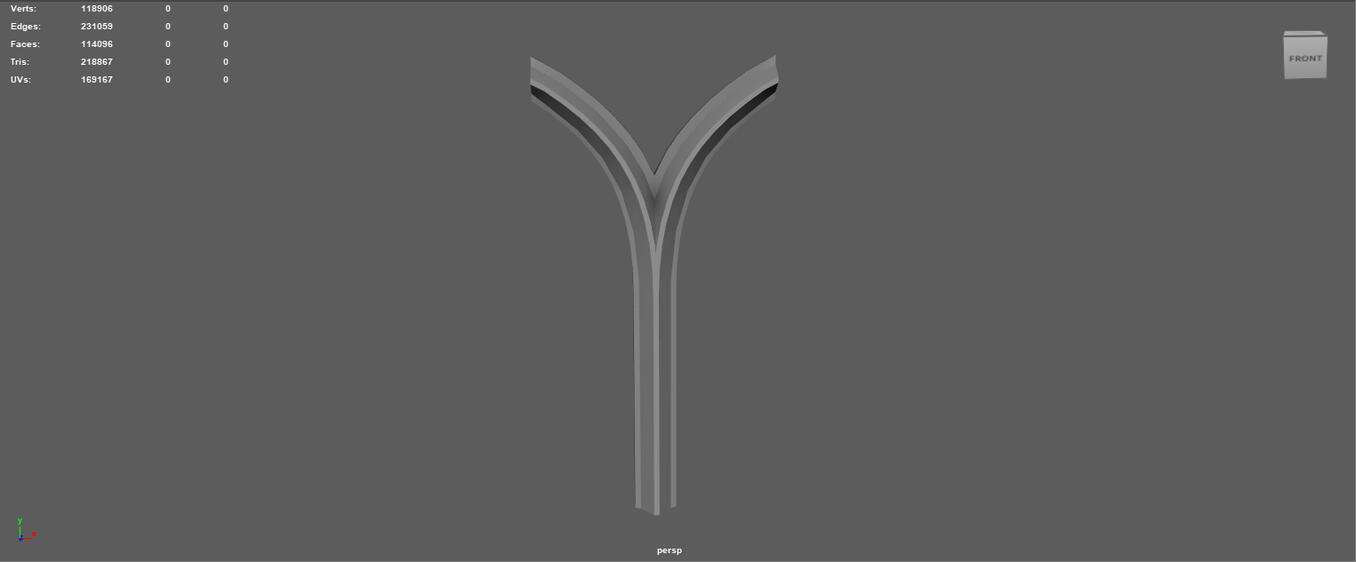
Archway Module Piece
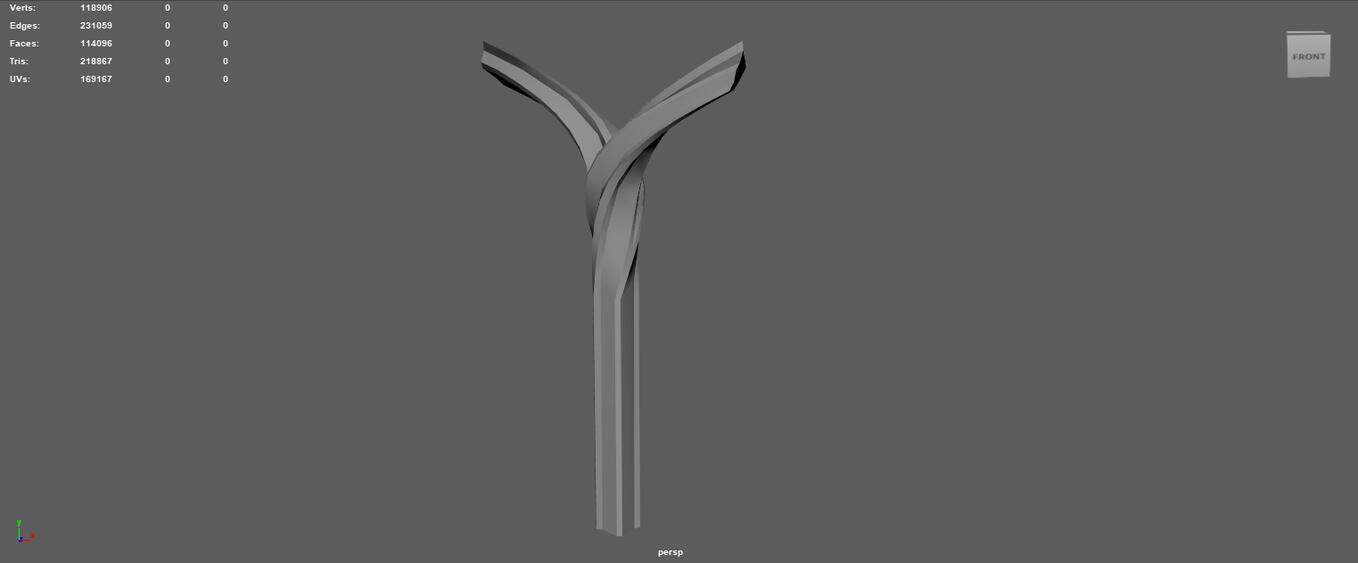
Final Iteration


| I kept tweaking the silhouette until the geometry just clicked. The result? A double-sided archway that carries both the heavy weight of Gothic tradition and the chaotic, whimsical pulse of Wonderland. |
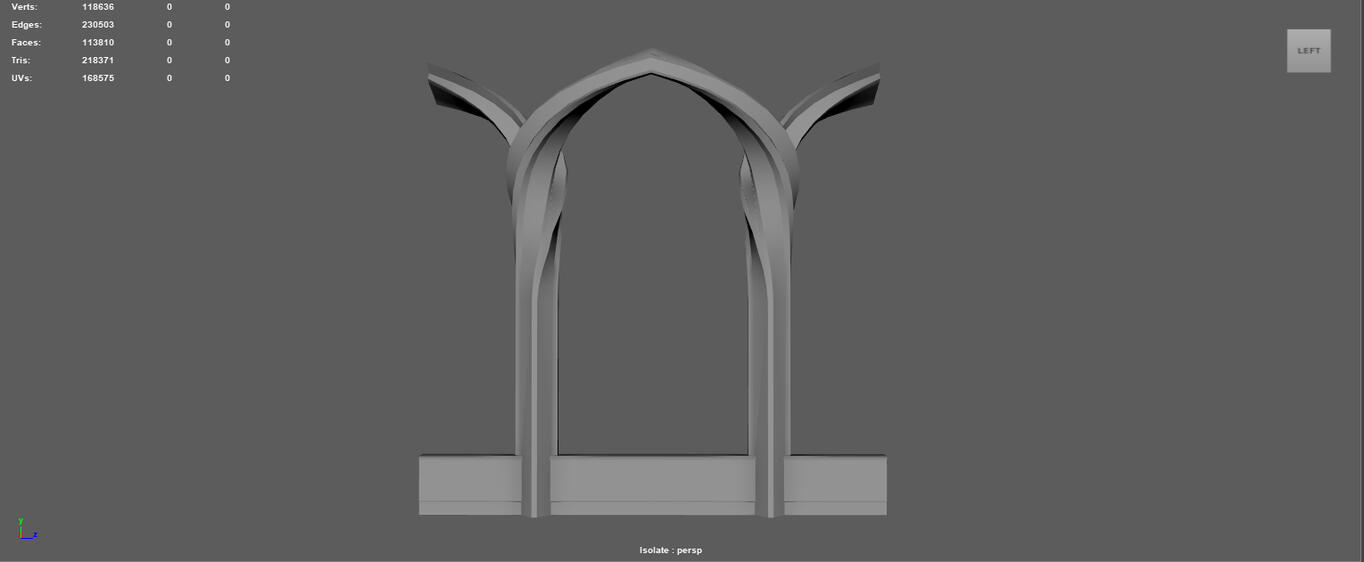
Module Front
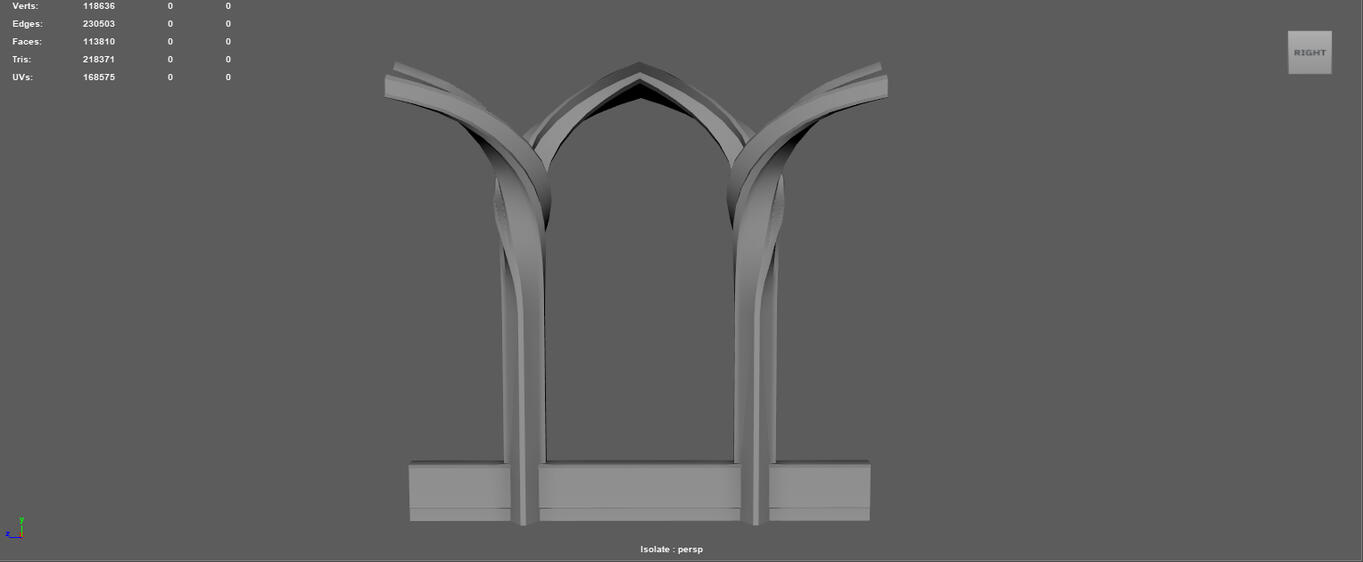
Module Back


| But the real magic isn’t just in one arch, it’s in the system. By using clever mirroring, rotation, and radial duplication, I turned a single master shape into an entire architectural library. This is how you build at scale without nuking your performance budget. |
| No "hero" assets, no wasted polys, just a cohesive system that keeps the world’s visual DNA locked tight. As this club grows more complex, this modular logic ensures it stays sharp, consistent, and above all smooth as glass. |
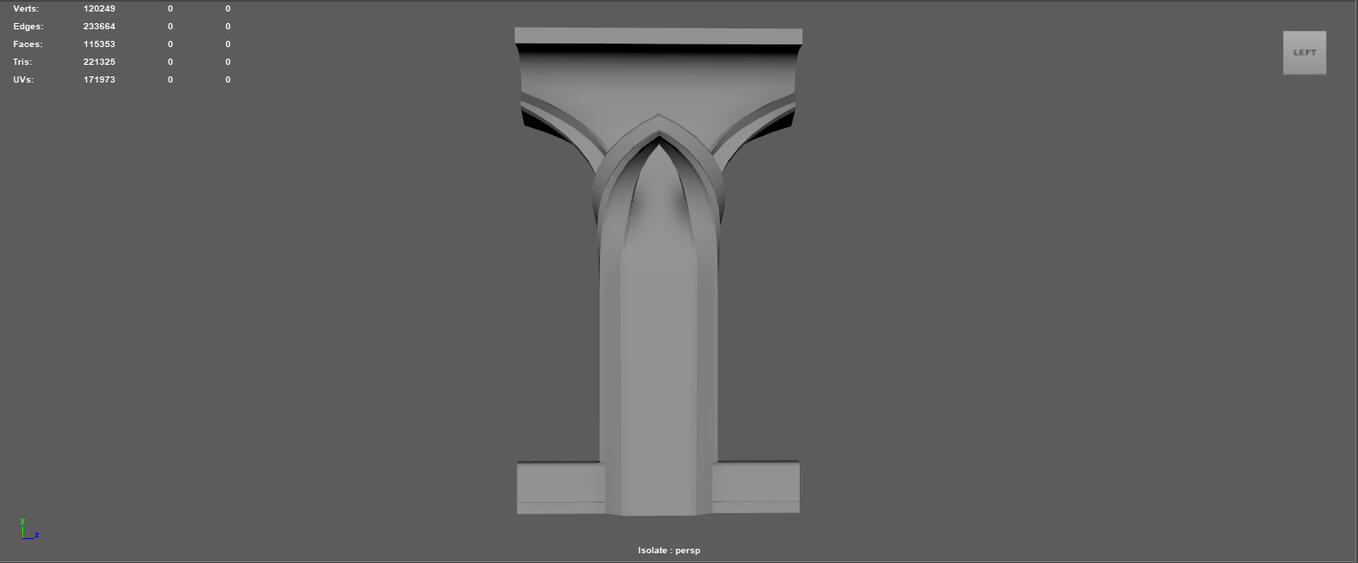
Module Straight Variant
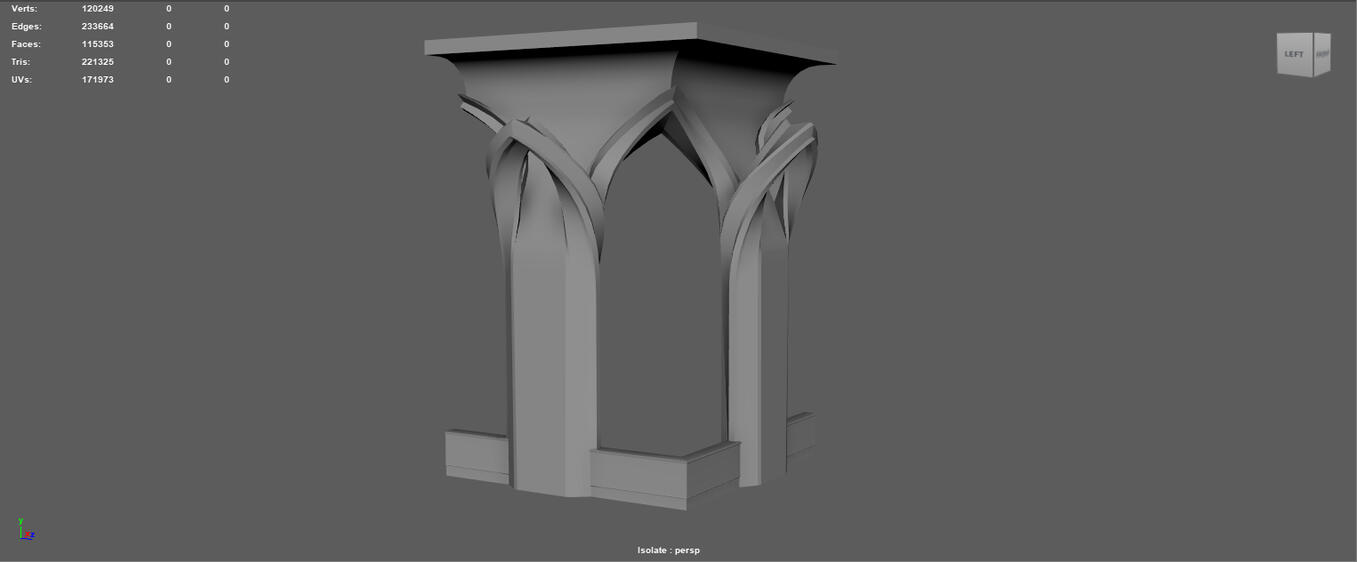
Module Corner Variant 1
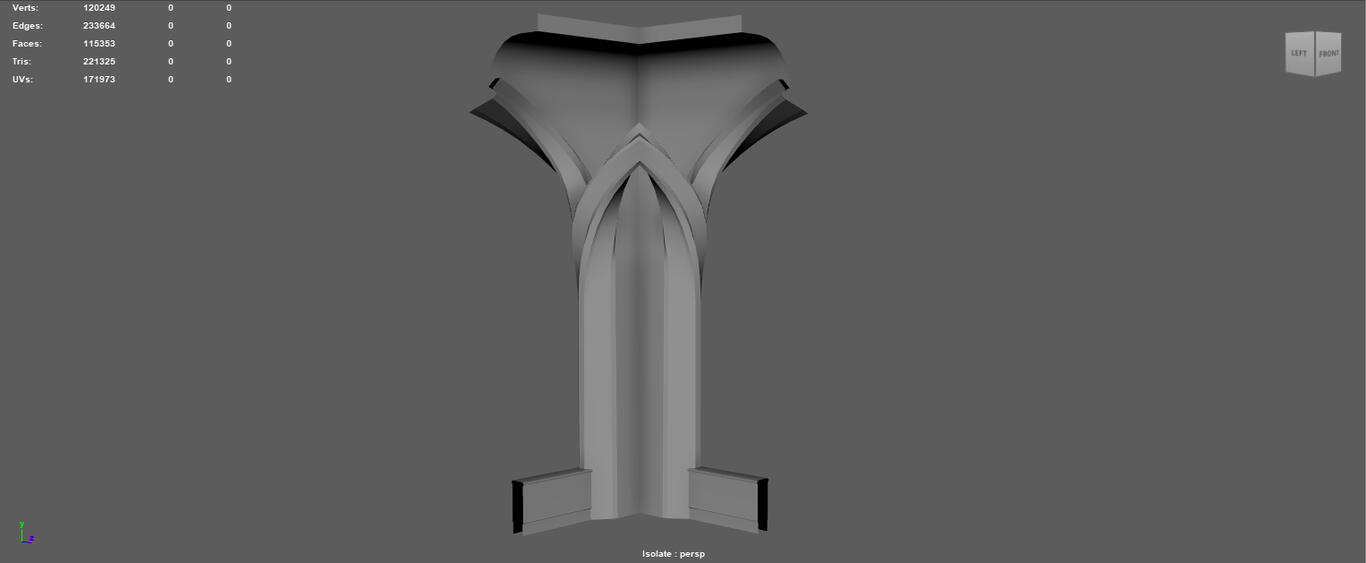
Module Corner Variant 2


| The difference between first iteration and this one is night and day. Once I dialed in the lighting, the space finally caught that elusive, vibrant elegance I was chasing. |
| Visually, I’ve split the main area into a high-contrast duel of a warm, inviting glow which would change later during development at the threshold that violently clashes with a piercing, ethereal white deeper in the club. It creates an eerie, almost uncomfortable tension the moment you step inside which is exactly the kind of atmosphere that makes a venue feel alive. |
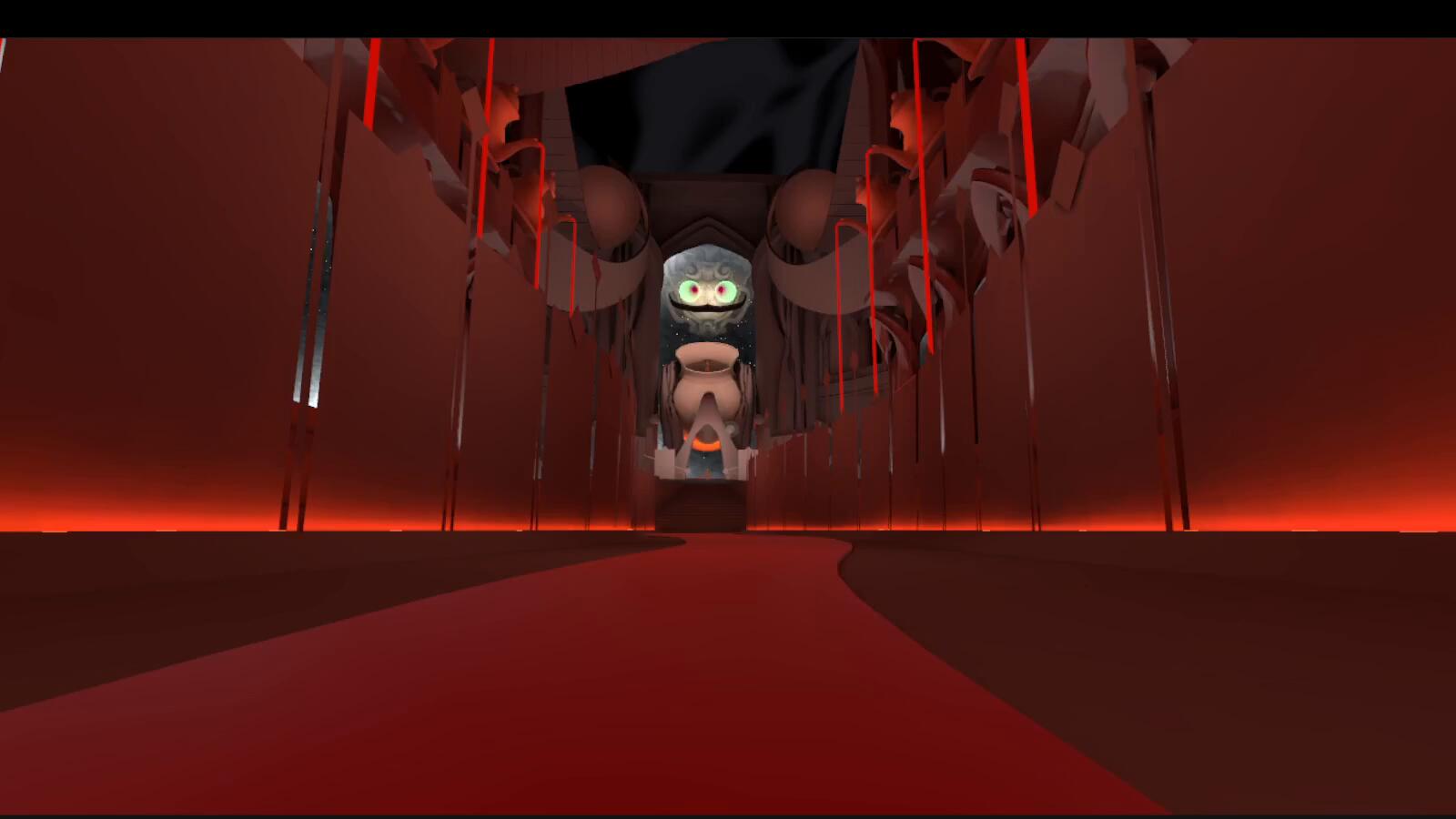
| Blockout (Iteration 3) |
|---|
| To set the stage, I made a brand-new spawn location to act as the psychological threshold into the club. The entry corridor is designed with walls aggressively tilted inward, forcing your perspective toward a tiny, impossible door. As you walk down this hall, your avatar physically shrinks so you can actually fit through the doorway. It’s a classic Wonderland mechanic that immediately shatters your sense of reality before you even step foot on the main floor. |
| Once inside, the design kept evolving. I knew I could push the surrealism even further. The blessing and curse of this theme is the sheer scale of possibility where for every brilliant concept that survives, a dozen are ruthlessly scrapped. The ultimate challenge was engineering a space that feels deeply dreamlike, yet functions perfectly as a high-end, navigable club. |
| To bridge that gap, I leaned heavily into something unexpected: massive, flowing fabric. Armed with Marvelous Designer, I started experimenting with textiles to drape across the environment, introducing a soft, chaotic elegance that violently contrasts the hard Gothic architecture. |
| As you can see below, this is still very much a blockout phase. The drapes and ribbons you see here are structural placeholders to test the silhouette and flow of the room. However, I intend for this fabric to be a massive visual selling point for the venue. These early simulations are just the baseline, and I’ll be aggressively dialing in the high-fidelity material physics once we hit the texturing phase. |

Spawn

Stage Entry

Queens Stage

Queens Throne

Chessboard View

Stage Overview

Backstage View


| Marvelous Designer |
|---|
| For those outside the development pipeline, Marvelous Designer is the industry-standard cloth simulation engine. In traditional game development, it is almost exclusively used for character apparel such as dresses, pants, shoes, and anything wearable. While some artists prefer to hand-sculpt static clothing in software like ZBrush, Marvelous handles actual, physics-based fabric simulation, making it the undisputed heavyweight of the discipline. |
| Within the VRChat ecosystem, it remains a highly niche tool. Some top-tier avatar creators rely on it heavily, but the vast majority of the player base don't even know it exists. And I am not going to even mention world builders because the use case of is even less if not non existent amongst. |
| So, what is a character-clothing tool doing in an architectural blockout? |
|---|
| I am actively looking for a new use-case for it in world creation. Standard 3D modeling tools are too rigid for the chaotic, flowing elegance this Wonderland venue requires. By bringing environmental textiles such as massive curtains, sprawling carpets, and structural draping into Marvelous Designer, I can simulate intricate, organic shapes governed by actual physics rather than manual guesswork. |
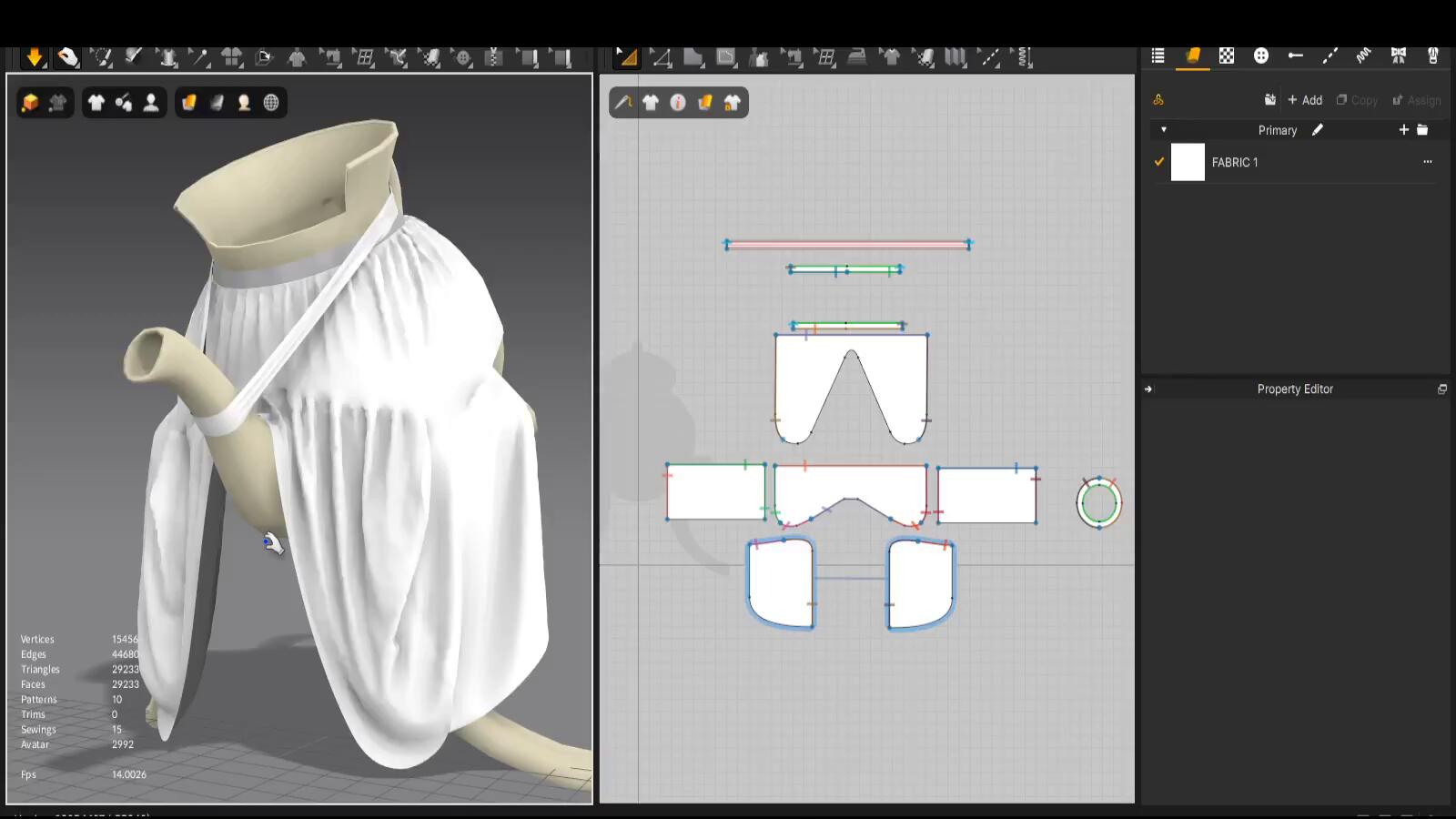
| As demonstrated in the footage above, the Marvelous Designer workflow is fluid and entirely physics-driven. While this software is a relatively recent addition to my technical pipeline, its impact on the world’s visual fidelity is already undeniable. Even in these early, rapid-prototyping stages, it delivers a level of organic drape and tension that traditional manual modeling simply cannot match. |
| But creating a beautiful shape is only half the job, it still has to perform. |
| Crucially, Marvelous Designer allows for an optimized, quad-ready export. However, I don't rely on automated outputs alone. I push all simulated meshes through a manual cleanup phase in my primary 3D software to guarantee maximum efficiency. |
| Because this specific fabric serves as a major visual centerpiece for the room, I deliberately allocated it a higher geometry budget by strictly capping the mesh at 6,000 triangles. This is the exact discipline required for high-end VRChat world-building. Delivering luxurious, striking detail exactly where the player’s eye is drawn, without ever sacrificing the venue’s framerate. |
| Texturing Phase (Iteration 1) |
|---|
| The texturing phase was, without a doubt, the most grueling stage of the entire project. Finding a perfectly balanced aesthetic was a relentless process of trial and error. After cycling through numerous dead-end solutions, I realized I needed to stop over-engineering the micro-details and trust the process. I locked in a strict color palette and shifted to a more instinctual, hands-on approach, allowing the materials to organically dictate the final vision as I worked down the pipeline. |
| Color Theory |
|---|
| I anchored the space in a stark, high-contrast triad: Black, Red, and White. |
| While this is a classic combination, the execution was highly technical. The true challenge lay in how I utilized Grey. I didn't want grey to act as a traditional supporting shadow or base color. Instead, I applied it to behave almost like a desaturating "foam" washing over the environment. |
| This deliberate, atmospheric dulling served a very specific purpose, it created an eerie, muted canvas that forced the aggressive Reds to violently pop. Meanwhile, the stark Blacks and Whites cut through the haze to provide a sharp, supportive vibrancy to the architecture. It is a calculated manipulation of contrast, designed to make the environment feel simultaneously muted and aggressively alive. |
| The Post-Processing Paradox: Monitor vs Lens |
|---|
| One of the most time-consuming hurdles in this entire build was dialing in the post-processing. Achieving that specific, muted-yet-vibrant aesthetic is notoriously difficult in VR development due to the hardware gap, what looks perfectly color-graded on a flat desktop monitor rarely translates identically through the lenses of a VR headset. |
| To bypass the grueling, repetitive loop of tweaking values on a monitor and waiting for a test upload, I shifted my workflow entirely. I worked through Virtual Desktop and operated Unity while wearing the headset. This allowed me to manipulate the post-processing stack in real-time, viewing the raw color data exactly as the player would experience it through the VR lenses. |
| It is no surprise that you often step into VRChat worlds with blown-out, extreme contrast or bloom that actively strains your eyes. That happens when developers optimize for the monitor and ignore the headset. **This immersive calibration process of editing the world from inside the world is non-negotiable, ensuring the final environment is as visually striking as it is comfortable to inhabit. |

Spawn

Stage Entry

Queens Stage

Queens Throne

Chessboard View

Stage Overview

Backstage View


| Motion Over Stills |
|---|
| While screenshots capture the geometry, the video below demonstrates the actual atmosphere. The leap from a static blockout to a living environment is absolute. We are blending the severe curves of Gothic architecture with a melancholic, cold color palette, yet the space still invites a distinct joy of exploration. It hums with a very specific, surreal energy that can only truly be felt when navigating through it. |
| The Checkerboard |
|---|
| A massive amount of visual heavy lifting is accomplished by the checkerboard textures. Without them, the environment would be visually exhausting. They act as a critical grounding mechanism, tempering and diffusing the raw, aggressive contrast between the stark blacks and piercing reds. This ensures the space feels striking without causing eye fatigue for the guests. |
| Structural Dichotomy: Reality vs Dream |
|---|
| The entire layout adheres to a strict design philosophy: the environment must physically guide the guest. The architecture naturally funnels players along whimsical, winding paths that inevitably pull them toward the core destination such as the central stage. |
| If you observe the geometry closely, you will notice a deliberate contrast in the design language: |
| The Perimeter (Structure): The outer walls maintain a rigid, linear Gothic design. They serve as the psychological boundary, anchoring the room and holding the chaos in. |
| The Core (Surrealism): As you move inward toward the paths, the stage, and the future seating areas, the rules of reality begin to break down. The shapes become less defined, highly fluid, and whimsical. |
| In future updates, this transition from the rigid architectural boundaries on the outside to the chaotic, melted dreamscape at the center will be even more aggressive and immediately apparent from the second you spawn. |
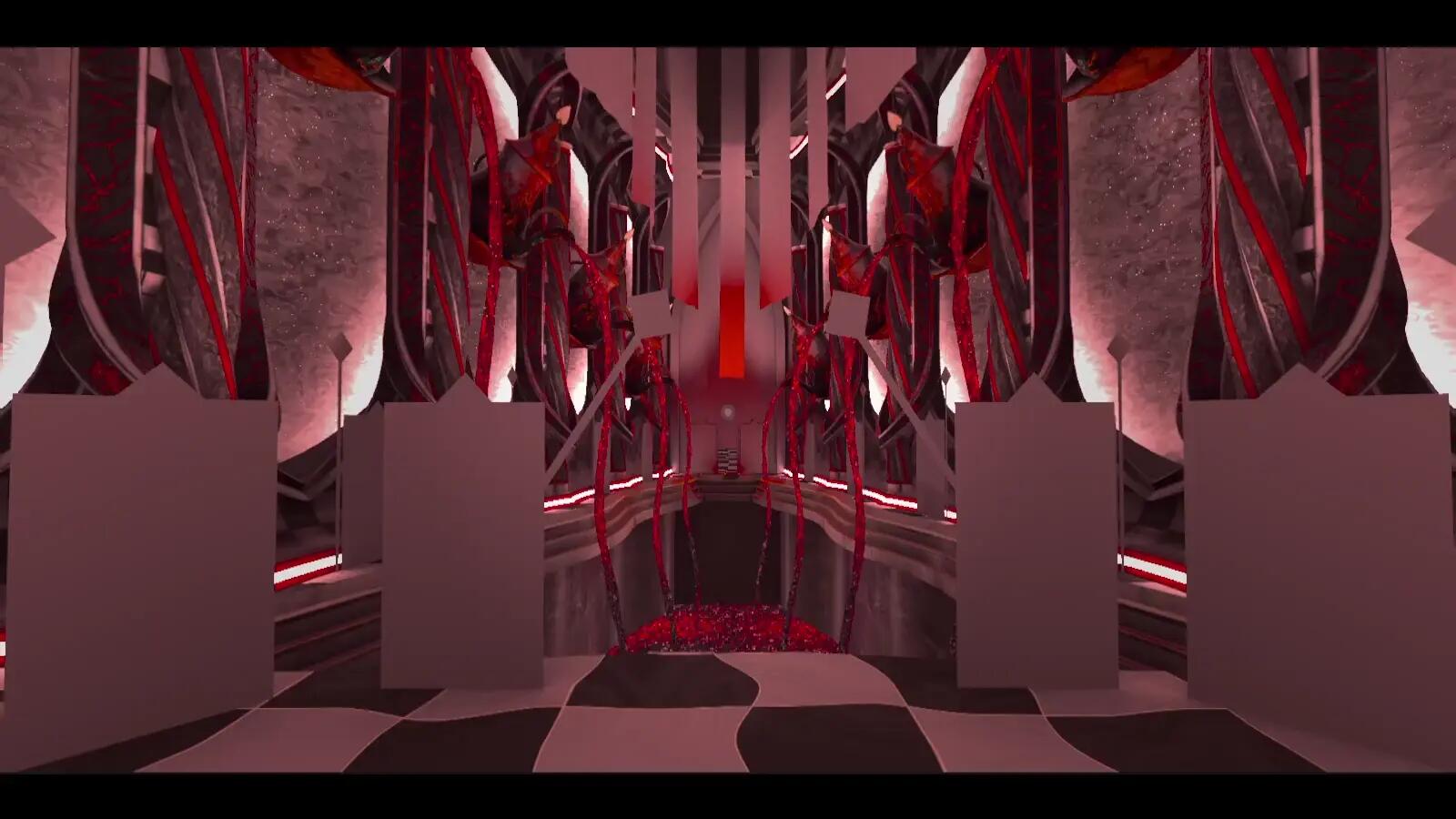
| Texturing Phase (Iteration 2) |
|---|
| Once the visual DNA and color palette were locked in, the texturing pipeline accelerated exponentially. This is exactly where our early investment in a modular architectural system paid off. Because the foundational puzzle pieces were already made, applying the finalized art style across the remaining layout became a rapid, frictionless process. |
| The greybox phase is now officially dead. The vast majority of our core art direction hurdles have been taken care of, and the aesthetic is no longer an experiment and it is a finalized, structural framework. We are now moving into the final texturing iteration, which will serve strictly as a high-fidelity polish pass to cement the club's ultimate look and feel. |
| Expansion and Resource Management |
|---|
| With the main floor solidified, development now shifts to the venue's peripheral spaces such as the VIP suites and Staff quarters. |
| From a technical standpoint, these exclusive areas will aggressively recycle the modular asset library and textures established in the main club. This is a deliberate optimization mandate. By repurposing our existing geometry and material arrays, we can massively expand the venue’s footprint and provide distinct, high-status rooms without inflating the world's overall memory budget. It ensures the environment continues to grow in scale and utility while maintaining the ruthless performance standards expected of a Rubin Worldworks venue. |
| Architecture as a Threat |
|---|
| The spatial design of the main club isn’t just aesthetic, it’s deliberately oppressive. The stage acts as the absolute focal point, but it is completely encircled by towering, menacing geometry. Tucked into the architecture of the four corners, I engineered structural compositions of card houses manned by Card Guards. |
| Their positioning is highly calculated so they are eternally gazing down at the center stage. When you are on that dancefloor, you are meant to feel the inescapable weight of being watched by the Queen’s court. The environment doesn't just surround you, it actively looms over you. |
| The 3-5-7 Rule |
|---|
| Beneath this surreal chaos lies strict architectural mathematics. To maintain visual harmony, I aggressively applied the 3-5-7 rule of composition across the environment's detailing. |
| If you dissect those same four corners, the asset grouping is entirely intentional. Each corner houses exactly three teapots: one massive, central teapot lodged violently into the Gothic framework, flanked symmetrically by two supporting teapots pouring streams of blood. |
| This is a tiered visual hierarchy. It creates a fractal effect for the guest which means that the longer you inhabit the space the deeper you analyze the geometry, the more you realize that every ounce of Wonderland's madness is governed by absolute structural discipline. |

Spawn

Stage Entry

Queens Stage

Queens Throne

Chessboard View

Stage Overview

Backstage View


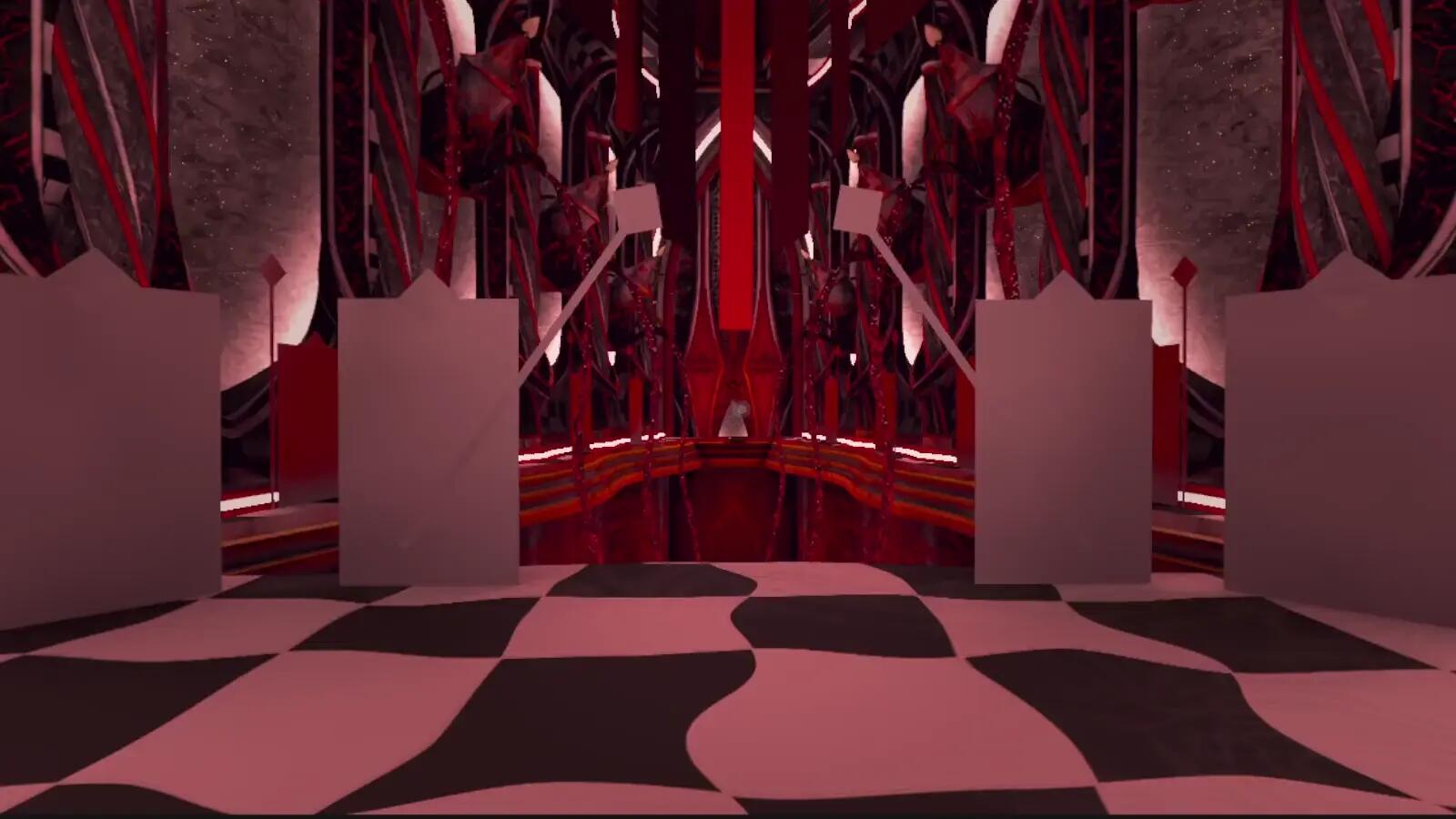
Navigation
Blind Wolf : Miami
| Introduction |
|---|
| Welcome to the dark side of the looking glass. For this project, Rubin Worldworks was tasked with a wild architectural paradox. Merging the brooding, massive scale of classic Gothic design with the surreal, reality-bending geometry of Alice in Wonderland which was all engineered into a premium, high-occupancy club venue. But simply placing a few themed props into a room is not enough. To truly sell this theme, you must orchestrate an entire experience. This space forces you down the rabbit hole, playing with perception, intimate spacing, and forced physical scale, all while running flawlessly under the heavy pressure of a full instance. |
| Credits |
|---|
| Blind Wolf : Miami was commissioned by Disz for Blind Wolf. |
| References and directional input from Disz, WonderingWendigo, JaxFox, Xanaecor and the rest of the Blind Wolf upper staff shaped the world it became. |
| This world was built with care for the Blind Wolf community by Mr. Rubinshtein |
| Additional references and community support available through the Official Blind Wolf Discord. |
| Final Result |
|---|
| Below you will see the result of my hard work that i performed, from beautiful visuals up to the most smallest technical breakdown you can ever find. |
| The Development |
|---|
| Video showcasing every stage of the development and how it came to its conclusion. |

| The Statistics |
|---|
| Video walkthrough showcasing live the backend statistics of the world through unity stats window. Here you will see information about batches, setpass calls, cpu threads and more. |

| Dev Blog Navigation |
|---|
| Below is presented the whole development process with a detailed breakdown of every single process. |
| THE IDEA |
|---|
| This project represents a massive structural and stylistic evolution. We are engineering a vertical experience split across three distinct floors, with each level boasting its own heavily curated visual identity. But the true hook of this venue lies in how we are reimagining the core aesthetic. |
| If you experienced our previous venue, The Coronet, you know we leaned heavily into the imposing, monolithic weight of New York governmental Art Deco. This new project is a deliberate, aggressive pivot away from that. We are leaving the heavy brass and rigid stone behind to focus entirely on Streamline Moderne. |

The Coronet Main View

The Coronet Second Floor


| Drawing direct architectural inspiration from the iconic shores of Miami, this space will prioritize a completely different side of the Art Deco spectrum: |
Aerodynamic Geometry: Replacing harsh, monumental angles with sweeping, elegant curves.
Coastal Vibrancy: Moving away from dark, metropolitan shadows into a sleeker, more atmospheric palette.
Horizontal Flow: Engineering a layout that feels fast, modern, and undeniably luxurious.
| The Beginning |
|---|
| This project received a massive momentum shift thanks to Disz. By providing meticulously sketched layouts and defining the critical spatial angles, Disz established a rock-solid blueprint. This structural foundation freed me to focus entirely on the creative engineering and refining the intricate architectural details, defining the Streamline Art Deco curves, and locking in the exact flow of the space. |
| The venue is engineered as a massive, three-story vertical experience, with each level serving a distinct psychological and social purpose: |
| Floor One: Social Venue |
|---|
| The ground level is the high-energy heart of the community, designed for constant interaction and exploration. |
The Lobby & Main Hall: Guests arrive in a marble-floored Lobby featuring a "Buy a Brick" wall and dedicated community spaces. This flows into the Main Hall, centered around a rotunda of art slots and a primary spinny table with wraparound couches—a refined nod to the classic Blind Wolf layout.
Entertainment Hubs: The space branches into a dedicated Game Room (featuring raised pool tables and card gaming) and a live performance stage flanked by a bar.
Exclusive & Staff Zones: The floor also houses a wood-furnished Staff Room with a private Directors' office, as well as the Parlor Room VIP Lounge—an intimate space featuring a smaller conversation table and a balcony overlooking the main stage.

First Floor Layout by Disz


View of the VIP rooms behind the table

Stage View in front of the table


Left View table leading to game room

Game Room rough view


Right view of the bar from the table

| Floor Two: The Private Suits |
|---|
| Accessible via dual elevators, the Second Level shifts the atmosphere from bustling socialization to complete, optimized privacy. |
VIP & Patreon Suites: This floor strips away unnecessary empty space to provide direct access to four private VIP and Patreon rooms.
Bespoke Amenities: These suites are designed for private gatherings, featuring their own streaming screens, bed areas, and private dance platforms with sponable poles, ensuring an exclusive hospitality experience.

Second Floor Layout by Disz

| Floor Three: The Miami Rooftop |
|---|
| The top floor is where the Streamline Art Deco aesthetic truly peaks, delivering a vibrant, coastal climax to the venue. |
The DJ Stage: A massive primary stage backed by a striking, custom Art Deco chevron video screen and sweeping atmospheric searchlights.
Aquatic & Social Hubs: The roof is anchored by a central pool radiating blue light, alongside raised beer pong platforms and hot tubs built directly into the side lounges.
Atmosphere: Bathed in soft teal and blue audio-linked neon, this level balances high-energy dance platforms with elevated side retreats for quieter socializing.

Third Floor Layout by Disz


General View of rooftop

Closeup stage view


Top view of themed building

Rough sketch of that building


Observational terrace

Bar view at the back of the terrace


Early sketch that was scraped

Side sketch of the sign


| By breaking the world into these three distinct zones, the venue ensures that no matter what kind of experience a guest is seeking, the architecture actively accommodates them. |
| References for Blockout |
|---|
| Managing three distinct architectural identities within a single venue requires an exceptionally heavy, meticulously curated reference board. Because the Streamline Art Deco aesthetic for the Rooftop was already the most refined and visually defined, I made a calculated structural decision to build this world top-down. |
| Rather than pausing production to wait for the entire building's blueprints to be finalized, we established a staggered, parallel pipeline. While I immediately broke ground on the Rooftop's 3D blockout, Disz focused on finalizing the spatial sketches for the Second Floor. By the time I move down to engineer the VIP suites, Disz will be locking in the final blueprints for the First Floor. |
| This leapfrog workflow ensures zero development downtime. It keeps the project’s momentum aggressive and allows us to tackle the distinct styles one floor at a time without ever bottlenecking the creative process. |
| Research for the rooftop |
|---|
| ⇩⇩⇩⇩⇩⇩⇩⇩⇩⇩⇩⇩⇩⇩⇩⇩⇩⇩⇩⇩⇩⇩⇩⇩⇩⇩⇩⇩⇩⇩⇩⇩⇩⇩⇩⇩⇩⇩⇩⇩⇩⇩⇩⇩⇩⇩⇩⇩⇩⇩⇩⇩⇩⇩⇩⇩⇩⇩⇩⇩⇩⇩⇩⇩⇩⇩⇩⇩⇩⇩⇩⇩⇩⇩⇩⇩⇩⇩⇩⇩ |
| The Archivist archiving the nation |
|---|
| My research process caught a massive early break when I stumbled across an extensive database of American roadside architecture at >>> RoadArch.com <<< |
| The site is entirely managed by Debra Jane Seltzer, an archivist who has spent over two decades documenting buildings, vintage signs, and statues from the 1920s through the 1970s. She has logged more than 500,000 miles driving across 48 states to single-handedly photograph and record the history of these landmarks. Impressively, she travels exclusively with her four terriers. |
| Running a historical database of this magnitude and maintaining it entirely ad-free is a monumental undertaking. Seltzer’s lifelong obsession with commercial architecture directly accelerated my development timeline by providing exactly the raw visual data I needed. |
| Please take a moment to support the historian who helped make my research possible. You can read more about Debra Jane Seltzer's mission >>> here <<< and directly support her travel and preservation expenses through her >>> PayPal donation link <<< |
| Miami Rooftop |
|---|
| Finding this archive was a game-changer. By providing a comprehensive, categorized list of U.S. landmarks, it essentially handed me a roadmap. Instead of blindly searching for generic "Miami Art Deco," I suddenly had the exact historical names of the buildings I needed to target. This drastically streamlined the initial research phase and immediately locked in our architectural direction. |
| Once I had my targets, I conducted an exhaustive deep dive into Miami's architectural history, pulling from both those iconic landmarks and more obscure local venues. |
| This wasn't just a casual search for "cool vibes" since it required a strict, dual-lighting research approach: |
The Night Canvas: Because our Rooftop is set during a classic, vibrant Miami night, I needed extensive nighttime photography to study how aggressive neon strips bleed into the atmosphere and illuminate architectural details.
The Day Geometry: Conversely, I also required harsh, midday reference shots. Neon masks structural reality, so to truly understand the sweeping curves and aerodynamic shapes of these buildings, I had to see how sunlight naturally hits and reflects off the geometry.
| Click on images to enlarge them |


| This initial board is just the foundation. Over the course of development, this reference library will inevitably explode into a massive archive. At Rubins Worldworks, I operate on a golden rule >>> There is no such thing as too many references. |
| The more visual data I collect, the faster the iteration pipeline becomes. It allows me to synthesize decades of historical architecture into entirely unique, structurally sound shapes without ever losing that authentic Miami DNA. |
| Blockout Rooftop (Iteration 1) |
|---|
| Thanks to the meticulous layout sketches provided during pre-production, the rooftop blockout hit the ground running. I quickly established the spatial metrics and locked in the proportions for the entire footprint. |
| However, I didn't wait for final meshes to start testing the atmosphere. I immediately began integrating raw neon lighting into the greybox. In Streamline Art Deco, the lighting is the architecture; the neon strips and the structural curves must be engineered together to ensure the space feels cohesive and intimate. By testing the neon early, I can guarantee that the structural geometry perfectly catches and wraps the light. |
| The Miami Gradient |
|---|
| For this specific setup, I wanted to do something highly conceptual: I designed the rooftop to be a literal, geographical representation of Miami itself. |
| I executed this entirely through a deliberate lighting gradient that splits the venue into two distinct atmospheric zones: |
The Atlantic (East): One side of the building is heavily influenced by cool, oceanic lighting, representing the deep waters and atmospheric breeze of the Atlantic Ocean.
The Biscayne (West): On the opposing side, the lighting shifts to rich, warm, golden hues, designed to emulate the iconic Miami sunsets and the heat of the Biscayne sand.

Stage View

Pool View

Atlantic View

Biscayne View

Bar View

Pavilion View

Atlantic Terrace


| By anchoring the venue between these two geographical color palettes, I essentially created a micro-climate on the rooftop. When these two lighting systems meet in the center of the club, they yield absolute, beautiful control over the mood of the environment, grounding the Art Deco architecture directly into its natural habitat. |

| Blockout Rooftop (Iteration 2) |
|---|
| The second iteration of the rooftop blockout moved aggressively fast. In just one week, the environment transitioned from a basic layout into a living, breathing atmosphere. By leaning heavily into the reference archive and pushing the limits of those aerodynamic Art Deco curves, the architectural composition became significantly more elaborate than initially projected. |
| During the first pass, the center of the rooftop felt uncomfortably naked. A massive, flat footprint in VR can quickly feel isolating. To fix this, I directed heavy focus toward the central pool area, building it up to serve as the structural and social anchor of the floor. It completely eliminates that empty void, giving the surrounding lounges and dance platforms a deliberate focal point to gravitate toward. |
| Historical INspiration |
|---|
| To elevate the elegance of the space, I needed to define its verticality using authentic Miami silhouettes. I utilized two specific historical landmarks to achieve this grand look: |
The Elevators: I topped the elevator shafts with marked spires so guests can instantly orient themselves. The signage and structural flair were directly pulled from Miami's Edwards IMAX Theatre, delivering a striking, monumental aesthetic.
The Bar Tower: The bar needed to feel distinguished. To achieve this, I engineered a meticulous, 1:1 recreation of the iconic Ritz Plaza spire. Crowned with custom lighting at the apex, it acts as a luxurious, glowing beacon for the venue.

Stage View

Pool View

Atlantic View

Biscayne View

Bar View

Pavilion View

Atlantic Terrace


| To tie these new structural updates together, I implemented a dedicated proprietary built post-processing stack specifically tailored for this update. Building on the lighting gradient established earlier, this pass instantly grounds the environment, ensuring the neon architecture feels deeply atmospheric and immersive right out of the gate. |

| Breakdown - Bar Spire |
|---|
| As you can see in the latest visual updates, the surrounding architecture is rapidly locking into place. The exhaustive reference gathering we conducted earlier is paying massive dividends here, allowing us to translate raw historical data into defined, sweeping Streamline curves with absolute confidence. |
| The bar area has expanded from a functional placeholder into a genuinely grand, monumental structure. Amplified by the new lighting setup, it now operates as a glowing beacon for the entire venue. |
| This grandeur serves a strict, calculated purpose: maintaining spatial equilibrium. The rooftop footprint carries an immense amount of structural weight at its edges, dominated by the two massive elevator signs on the flanks and the heavy, imposing DJ stage at the far end. By elevating the bar into a brilliantly lit, central anchor, it acts as a crucial architectural counterweight. It prevents the environment from feeling visually lopsided, perfectly distributing the mass and ensuring the layout feels cohesive and deliberately engineered. |

Ritz Plaza Spire Reference


Bar Spire Front

Bar Spire Below


| Breakdown - Elevator Signs |
|---|
| If there is one specific reference that completely defined the visual trajectory of this project, it is the Edwards IMAX Theatre sign. What truly captivated me was its aggressive, elaborate use of neon. This single image fundamentally deepened my appreciation for what Streamline Moderne can achieve. Its highly expressive silhouette became the aesthetic anchor for the entire rooftop. I found myself deconstructing its distinct shape and actively reusing those motifs across surrounding architectural elements. It provided exactly the emphasis I needed to unify the rooftop and lock in its final, neon-drenched direction. |

Ritz Plaza Spire Reference


Altantic Elevator

Biscayne Elevator


| Breakdown - Pool |
|---|
| As demonstrated in the screenshots below, the visual transformation of the environment is absolute. We extracted the core structural motifs from that initial Edwards IMAX reference, re-engineered them into standalone architectural elements, and integrated them directly into the stage's perimeter. This deliberate adaptation paid massive dividends, instantly unifying the aesthetic across the rooftop. |
| Beyond just looking grand, these structures serve a strict, functional purpose in our visual hierarchy. By arranging them to frame the far end of the venue, they create an inescapable focal point. Every illuminated curve, neon strip, and towering silhouette now actively funnels the guest's eye perfectly to the dead center of the composition, ensuring the DJ holds absolute visual command over the entire space. |

Version 1 Pool

Version 2 Pool


| Breakdown - More about the Pool |
|---|
| Viewed from an aerial perspective, the intricate geometry of the pool area becomes immediately apparent. Rather than dropping in a standard aquatic footprint, I designed a highly distinguished, illuminated perimeter featuring dynamic water flowing seamlessly beneath glass walkways. |
| Also I made a dedicated, inset socializing zone directly into the center of the pool. Guests can gather around a central table which is fully surrounded by the aquatic aesthetic that is allowing for intimate conversation while remaining entirely connected to the music and energy of the venue. |
| This approach deliberately marries form and function. It transforms the pool from a passive visual centerpiece into a highly active social anchor. Not only does it create a stunning, symmetrical composition in the dead center of the rooftop, but it exponentially increases the functional, playable footprint of the environment. |

Pool View

| This layout is specifically made to solve a fundamental challenge in VRChat event spaces such as accommodating conflicting player energies. The architecture naturally caters to two distinct demographics simultaneously. High-energy guests can stand at the perimeter to engage directly with the DJ, while those seeking a low-energy experience can retreat into the sunken pool lounge for calm, insulated conversation. |
| Beyond aesthetics, this design plays a crucial role in instance UX (User Experience). By structurally pulling both demographics toward a shared central axis, we create a high-density social focal point. This eliminates the sprawling, disconnected feeling that often plagues large VR venues. Instead of wandering aimlessly, players can instantly scan the room and locate their friends the moment they step off the elevator. It is a deliberate manipulation of crowd flow, ensuring the environment feels vibrant, deeply connected, and effortlessly navigable at all times. |

Pool View

| Blockout Rooftop (Iteration 3) |
|---|
| To be written |
Spawn
Stage Entry
Queens Stage
Queens Throne
Chessboard View
Stage Overview
Backstage View


| Research for second floor |
|---|
| ⇩⇩⇩⇩⇩⇩⇩⇩⇩⇩⇩⇩⇩⇩⇩⇩⇩⇩⇩⇩⇩⇩⇩⇩⇩⇩⇩⇩⇩⇩⇩⇩⇩⇩⇩⇩⇩⇩⇩⇩⇩⇩⇩⇩⇩⇩⇩⇩⇩⇩⇩⇩⇩⇩⇩⇩⇩⇩⇩⇩⇩⇩⇩⇩⇩⇩⇩⇩⇩⇩⇩⇩⇩⇩⇩⇩⇩⇩⇩⇩ |
| Second Floor |
|---|
| To be written |
| Click on images to enlarge them |
Early sketch that was scraped
Side sketch of the sign


| Research for first floor |
|---|
| ⇩⇩⇩⇩⇩⇩⇩⇩⇩⇩⇩⇩⇩⇩⇩⇩⇩⇩⇩⇩⇩⇩⇩⇩⇩⇩⇩⇩⇩⇩⇩⇩⇩⇩⇩⇩⇩⇩⇩⇩⇩⇩⇩⇩⇩⇩⇩⇩⇩⇩⇩⇩⇩⇩⇩⇩⇩⇩⇩⇩⇩⇩⇩⇩⇩⇩⇩⇩⇩⇩⇩⇩⇩⇩⇩⇩⇩⇩⇩⇩ |
| First Floor |
|---|
| To be written |
| Click on images to enlarge them |
Early sketch that was scraped
Side sketch of the sign


| Blockout Second floor (Iteration 1) |
|---|
| To be written |
Spawn
Stage Entry
Queens Stage
Queens Throne
Chessboard View
Stage Overview
Backstage View


| Blockout FIRST FLOOR (Iteration 1) |
|---|
| To be written |
Spawn
Stage Entry
Queens Stage
Queens Throne
Chessboard View
Stage Overview
Backstage View


Navigation

The Jungle Trophy Awards

Fez Hat for WonderinWendigo

Fez Collection for Eye of Veritas

Whiskey Glass for Disz
Open Slot
Open Slot
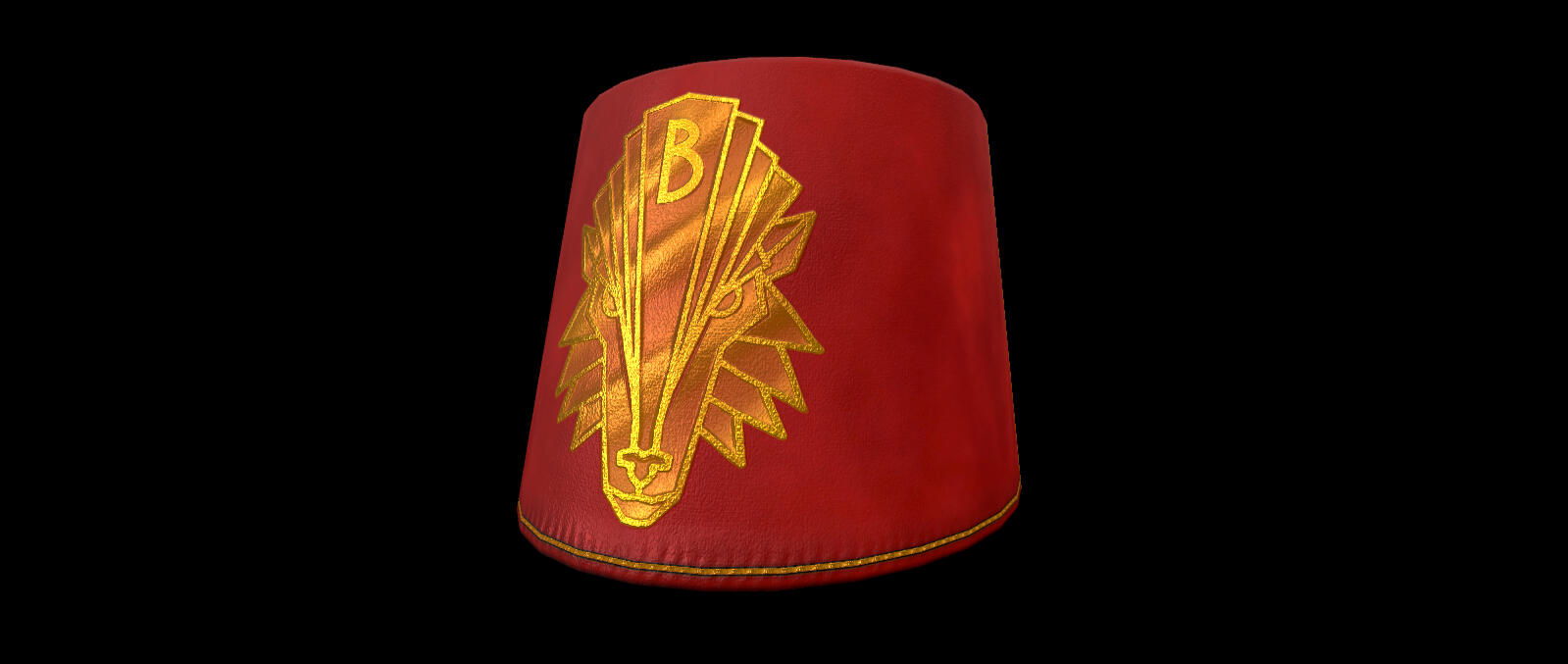
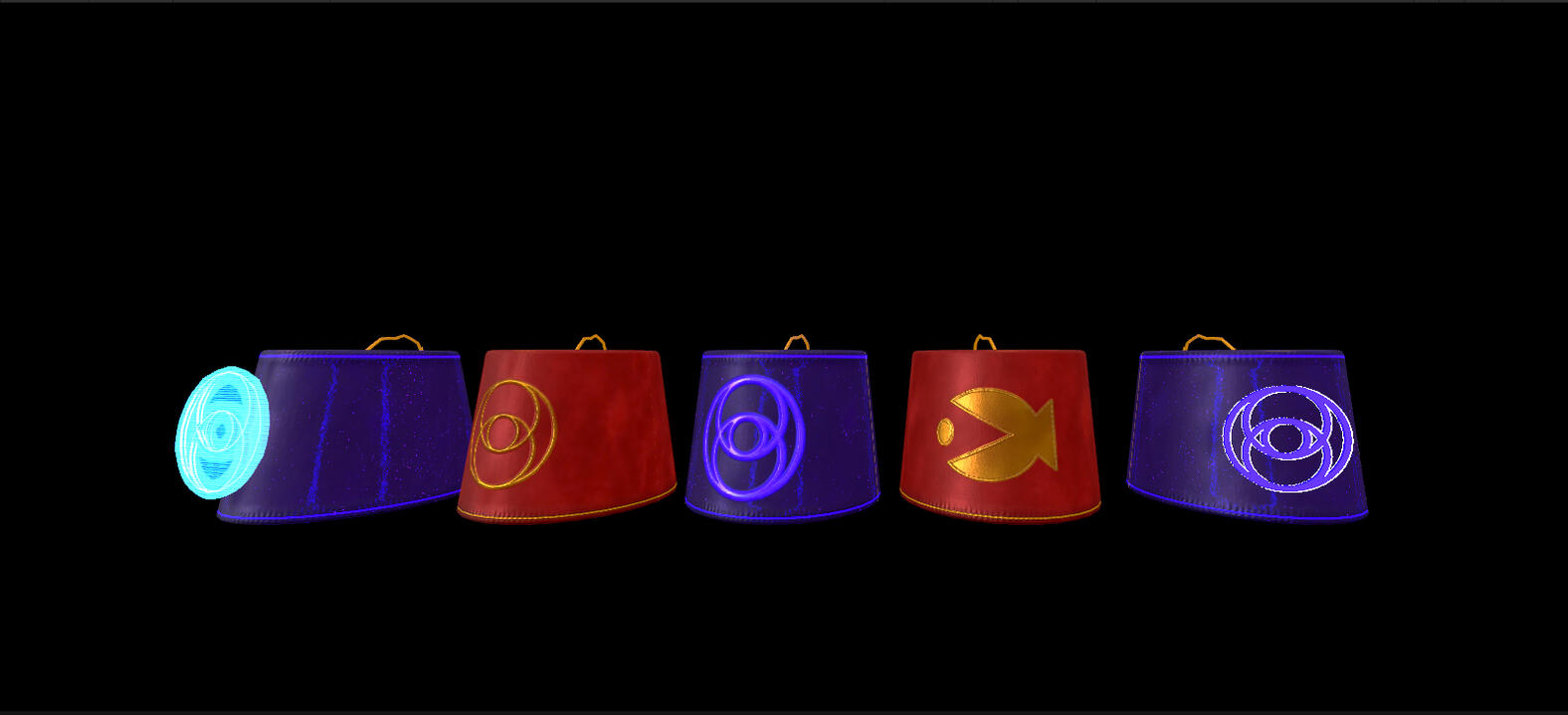
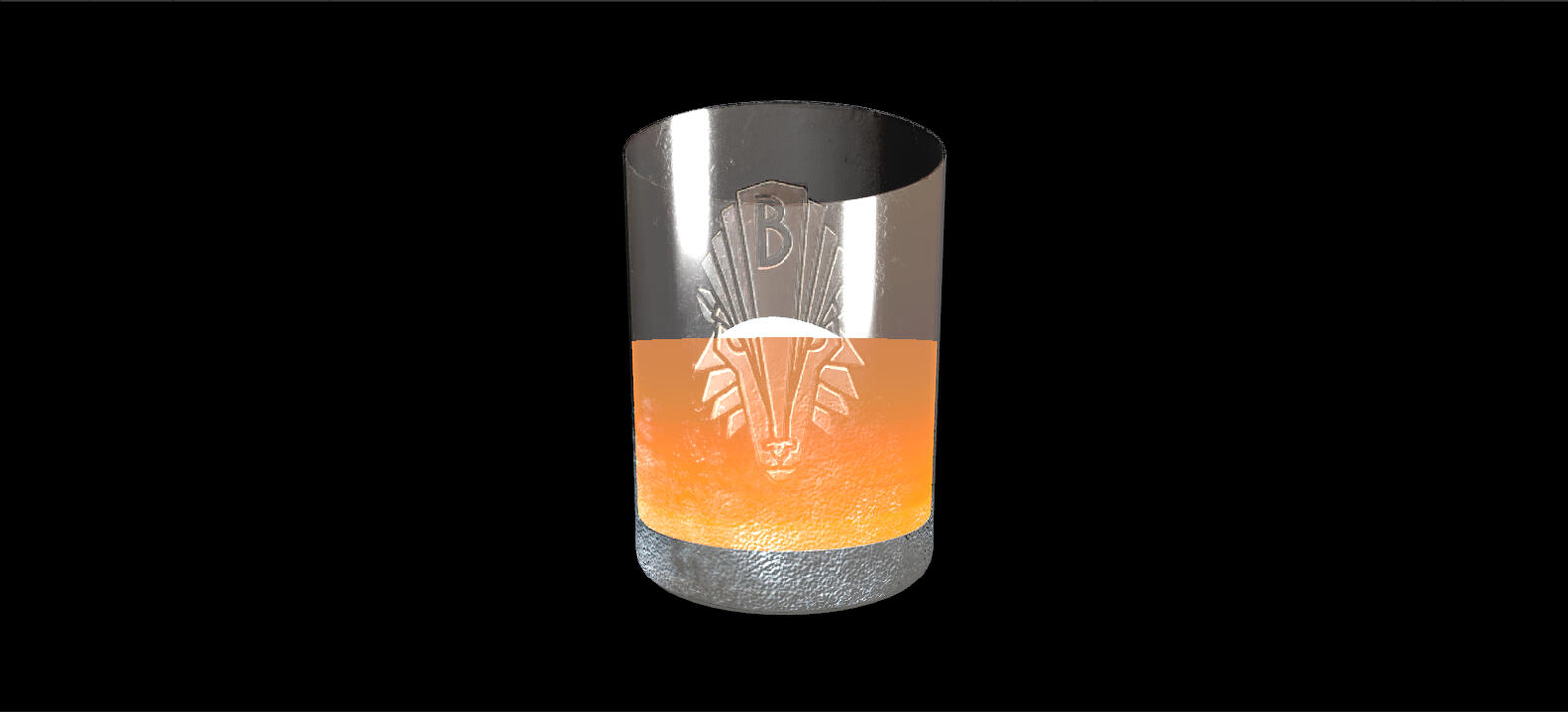


Navigation
Jungle Awards
“NSFW CONTENT — 18+ ONLY”
“Contains artistic nudity and suggestive text.”
Commission for wolf0Turntable showcase of a set of 12 silly awards for The Jungle furry lapdancing club. Designed in just 3-5 days. Ask me for the link if interested to see.
Navigation
| Fez hat for WonderinWendigo |
|---|
| Commission for WonderinWendigo, co-owner of Blind Wolf community. |
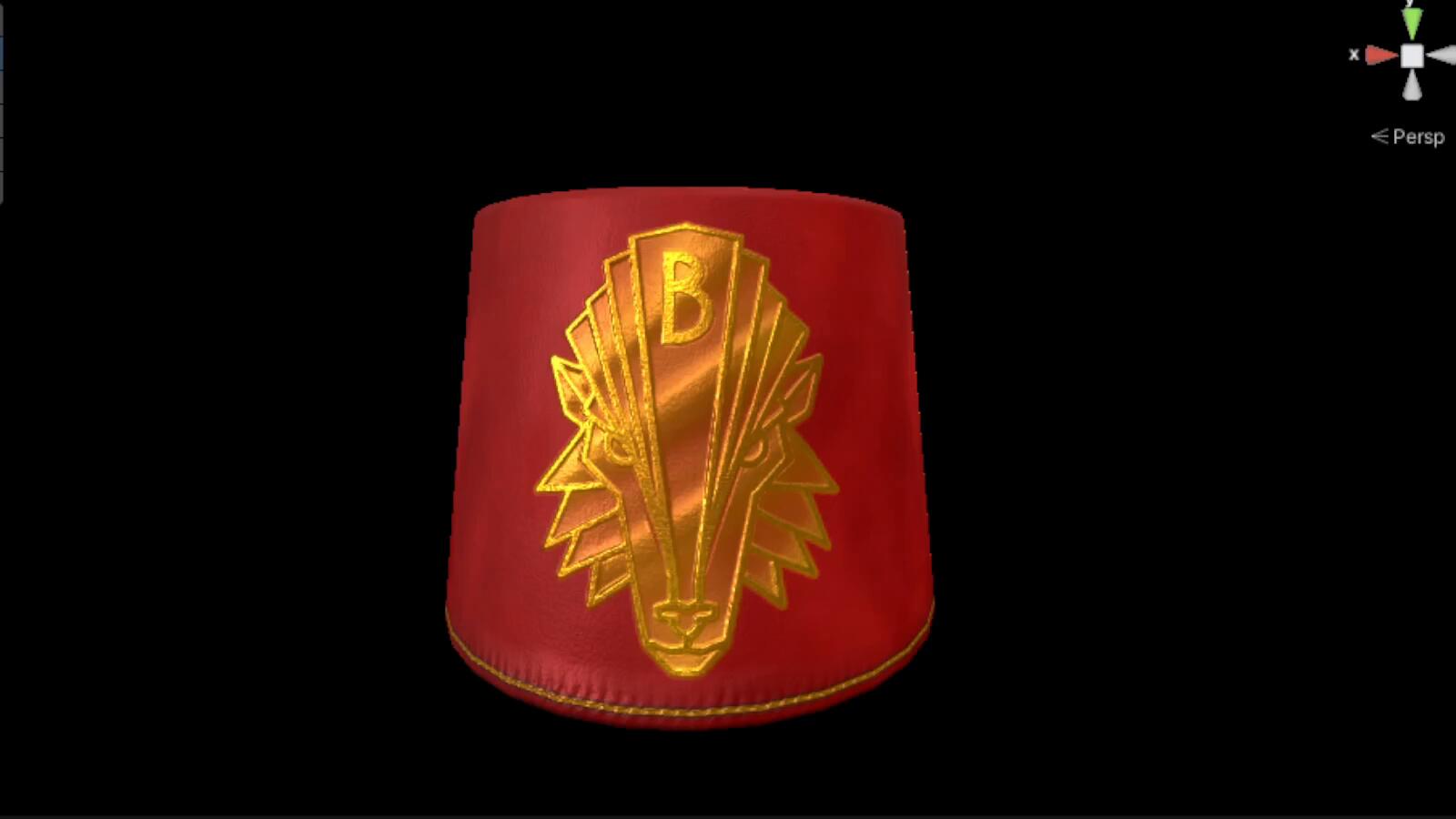

Fez Wireframe

Fez Hat UV's and Textures


| Technical Stats | |
|---|---|
| Triangles | 896 |
| Bones | 3 |
| Material Set | 1 |
| Base Color | 512x512 (Downscaled in Unity) |
| Metallic | 512x512 (Downscaled in Unity) |
| Normal | 1024x1024 (Downscaled in Unity) |
| Completion time | 5 hours |
Navigation
| 5 Fez Hats for Eye of Veritas |
|---|
| Commission for Geeknificent, founder of Eye of Veritas community. Collection of 5 fez hats with different styles. |
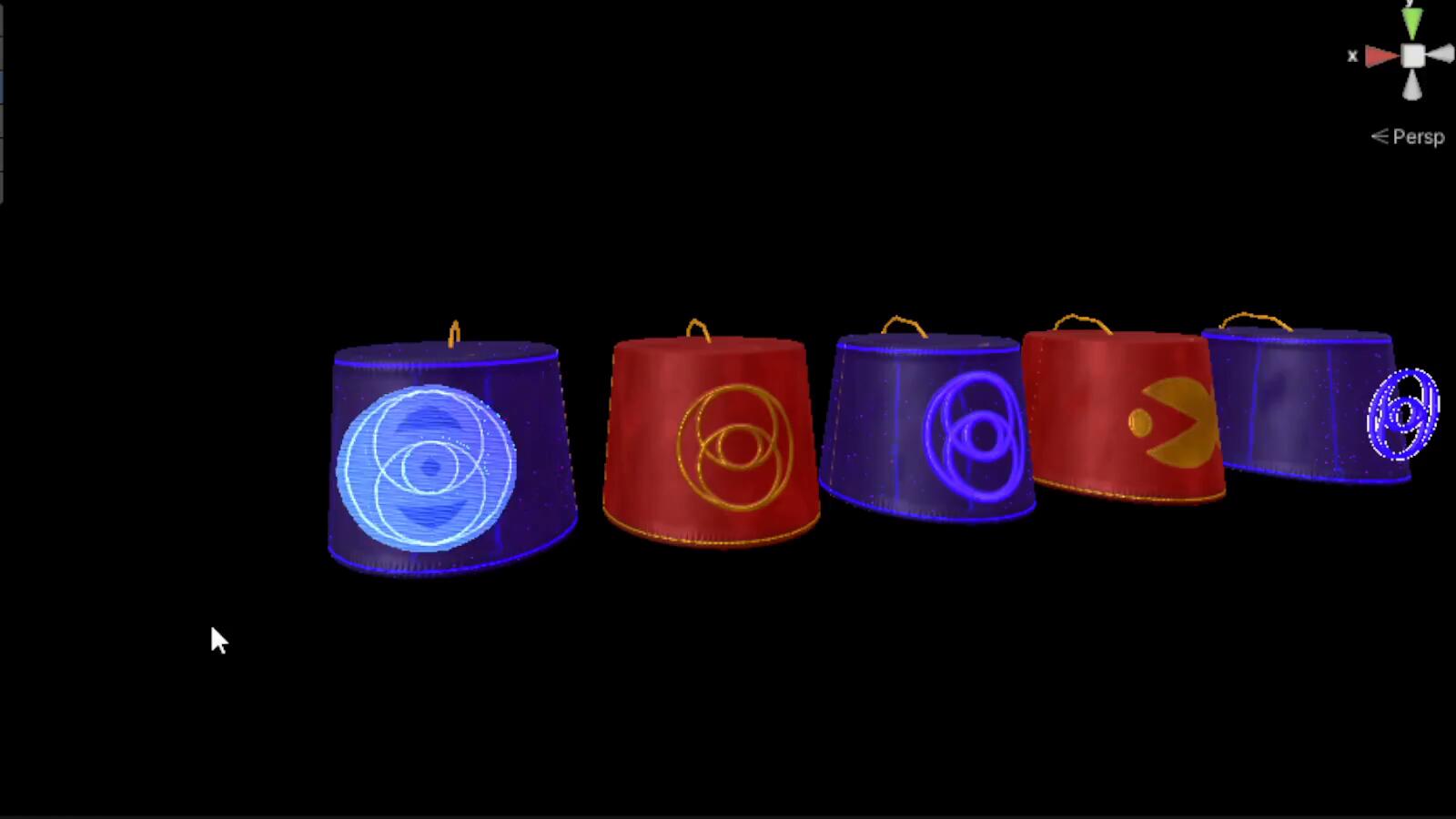
Fez Wireframe

Fez Hat UV's and Textures


| Technical Stats | |
|---|---|
| Triangles | 896 (each, logos on some of them 100 triangles) |
| Bones | 3 |
| Material Set | Per hat 1 |
| Base Color | 512x512 (Downscaled in Unity, some are lower on resolution) |
| Metallic | 512x512 (Downscaled in Unity, some are lower on resolution) |
| Normal | 1024x1024 (Downscaled in Unity, some are lower on resolution) |
| Completion time | 2 - 3 days |
Navigation
| Whiskey Glass for DisZ |
|---|
| Commission for Disz, founder and owner of Blind Wolf. |
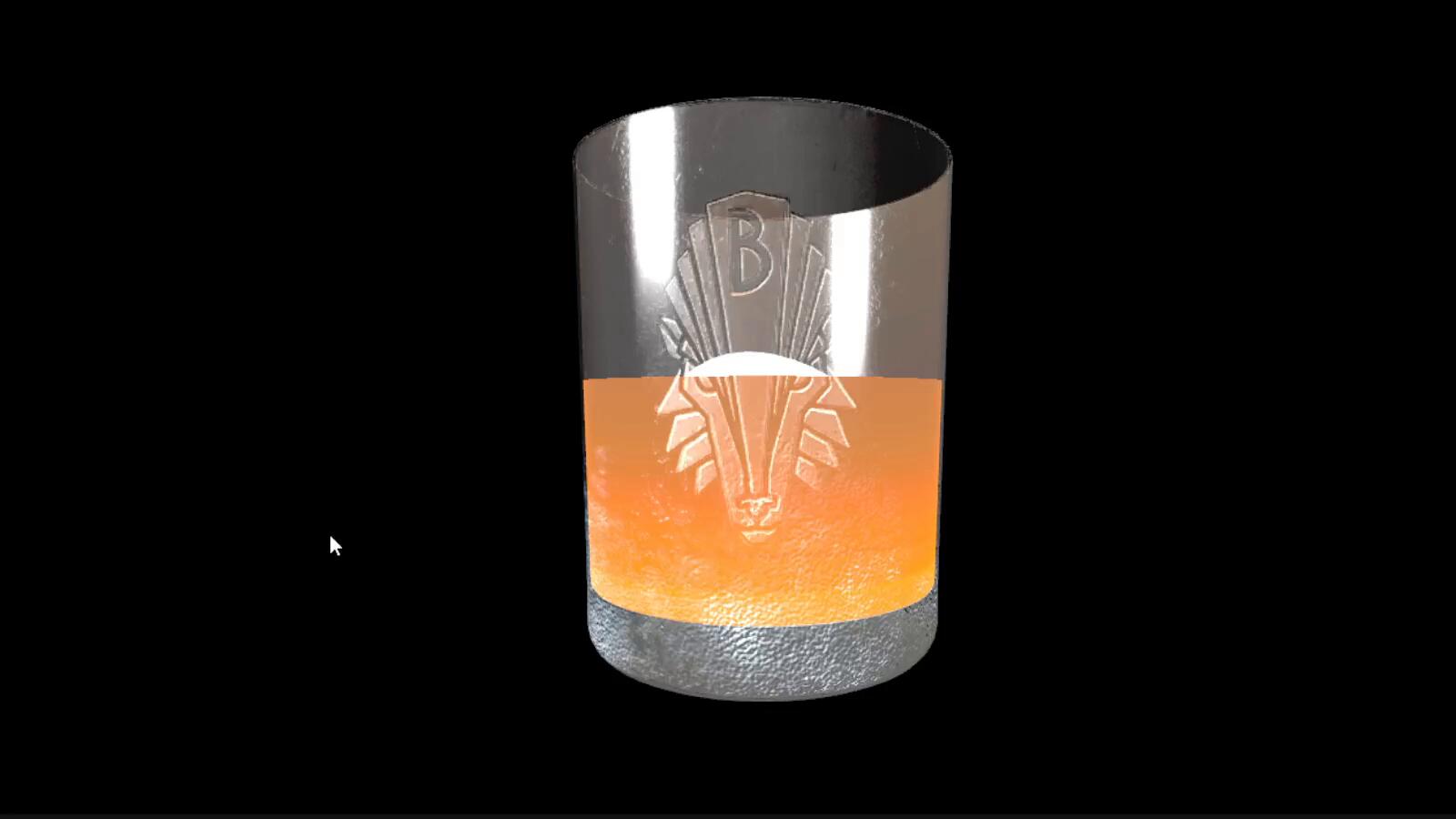
| Texturing |
|---|
| Glass was made using Poiyomi shader and there have been 2 custom shaders written. One for the ice so it can neatly move around the glass and as well shader of the liquid which upon tilting reduces the amount of liquid. Since the asset will be viewed from close distances I had to get generous with polycount for the necessary effects to give good results. |

Fez Wireframe

| Technical Stats | |
|---|---|
| Triangles | 3171 |
| Bones | 0 |
| Material Set | 3 |
| Base Color | 1024x1024 (Downscaled in Unity for Glass itself) |
| Metallic | 512x512 (Downscaled in Unity for Glass itself) |
| Normal | 1024x1024 (Downscaled in Unity for Glass itself) |
| Custom Shaders | Yes, 2 of them, one on liquid and another on ice |
| Completion time | 3 days |
Navigation

Personal projct

Coming Soon

Navigation
Cthulhu Cathedral
One of the biggest projects i worked on so far. Everything is made and designed by me except VFX and sounds.
Personal project not for sale made with Unity 6
Creation Showcase
This is the same approach i am using while creating VRC Worlds.

Navigation
My skills in asset creation and optimization.

Emperor's Seal

Skateboard

Sauer Bar Pistol

Empty Slot

Navigation
Final Render

Navigation
Final Render


Wireframe


Navigation
Final Render


Wireframe


World Creation Pricelist
Advisory service
Technical consultation
| Not sure what's wrong with your world or what your next build actually needs? Get direct expert answers in one focused session, plus a written action report you can use immediately. |
Covers: Performance diagnosis, optimization strategy, scripting architecture, asset pipeline review, general project health check for whatever you need most
Deliverable: One-hour Discord session followed by a written report with findings, prioritized recommendations, and a clear action list
Best for: Builders stuck on a specific problem, world owners debugging performance before a big event, or anyone wanting an expert second opinion before a full commission
Commission credit: Book a full world build within 30 days and this fee is deducted from the total
| 1 hr session + written report |
Performance service
Optimization
| Your world exists but it just doesn't run the way it should? I diagnose every bottleneck from the inside, fix it, and deliver a full written audit of every change made and the reasoning behind it. |
Full audit scope: Batch count, SetPass calls, VRAM usage, draw call reduction via mesh optimization and material batching, lightmap quality, hierarchy cleanup, collider efficiency
Deliverable: Optimized world at peak FPS plus a written audit report you can reference for all future development decisions
Access required: Full Unity project source files — this cannot be done from a published world alone
Not included: Visual redesigns or new asset creation (available as add-ons below)
| Average Completion |
|---|
| 3-5 days |
Single-room build
Private showcase world
| One room, built to the highest standard. Perfect for private residences, photography studios, branded community spaces, and anyone who wants something intimate but genuinely exceptional. |
Scope: High-detail single-room environment. Luxury apartment, sci-fi lab, boutique studio, private residence, content creator backdrop, or themed hangout space
Includes: Custom Bakery lighting bake, unique PBR materials built from scratch, cinematic atmosphere, basic interactives such as toggles, mirrors, ambient audio zones
Optimized for: Up to 20 concurrent users on mid-range hardware
Not included: Multi-zone layout or advanced scripting systems (see Event-Ready Environment)
| Average Completion |
|---|
| 14-21 days |
Event-ready Venue
Community Event Venue
| A multi-zone world engineered to perform under real event conditions. Holds 40+ people, runs at 90 FPS, and still looks like somewhere worth spending the night. |
Scope: 2–4 connected zones with professional level design built event-ready from the ground up
Scripting included: Video players, toggle systems, teleporters, mirrors, lighting triggers, spawn management
Atmosphere: Particle FX, ambient audio zones, optimized prop placement, full Bakery lighting bake across all zones
Advanced scripting: VIP room locks, custom game logic, privacy mechanics, complex Udon systems are available as add-on
Built for: Communities, clubs, event venues, anniversary worlds, and any space that needs to hold up under real pressure
| Average Completion |
|---|
| 30-45 days |
Ongoing support
Community retainer
| Your world shipped and now you need someone in your corner for everything that comes after. A dedicated monthly partnership for communities who treat their VRChat presence seriously. |
| Maintenance $150/monthly |
|---|
| Bug fixes, small prop swaps, lighting tweaks, 2 hrs dedicated support per month |
| Active support $300/monthly |
|---|
| Everything in Maintenance plus new scripting additions, zone updates, event prep, priority response |
| Full partnership $550/monthly |
|---|
| Ongoing world development, new zones, full scripting support, monthly performance review, first-in-queue priority |
| Minimum commitment: 3 months retainer relationships work best with continuity on both sides |
World Add-ons
World add-ons List
| Extend any world commission with the following services. Scoped items are quoted and agreed in writing before work begins. |
| Advanced UdonSharp scripting |
|---|
| VIP locks, password zones, game mechanics, leaderboards, custom UI panels, proximity triggers, complex player interaction systems basically anything beyond basic toggles. QUOTED PER SCOPE |
| Additional zones |
|---|
| Extra connected zones beyond the base scope of the Event-Ready Environment, each built and optimized to the same standard as the rest of the world. QUOTED PER SCOPE |
| Lightmap rebake |
|---|
| World geometry is fine but lightmaps are broken, muddy, or unlit. I rebake the entire scene in Bakery with correct settings and UV setups — no full audit required. FROM $150 |
| World thumbnail render |
|---|
| A custom promotional render for your VRChat world page, composed and exported specifically for the VRChat thumbnail format. First impressions drive discovery. FROM $80 |
| Post-launch revisions |
|---|
| Layout changes, new props, lighting adjustments, or scripting additions after the commission has been delivered and signed off. QUOTED PER SCOPE |
| Rush delivery |
|---|
| Your commission is prioritized above the active queue. Subject to current availability. +50% surcharge |
| Additional revision rounds |
|---|
| Extra feedback and change rounds beyond what's included in the base tier. QUOTED PER SCOPE |
| Quest optimization |
|---|
| Mobile-ready builds for standalone Quest users — actively in development as a future standard service. COMING SOON |
3D Asset Creation Pricelist
Standalone service
Custom material design
| You have the mesh and you just need it to look right. A complete, production-quality PBR texture set built specifically for your asset and matched to your world's visual style. |
Deliverable: Full PBR set with albedo, normal, roughness/metallic, and emissive maps where applicable and Unity-ready
Workflow: Substance Painter proper bake setup, material masking, hand-authored detail
Good for: Builders who model their own assets but struggle with materials, or anyone retexturing store-bought assets for a custom aesthetic
Requirement: Clean UV-unwrapped mesh. UV unwrapping available as an add-on if your mesh isn't ready
| Average Completion |
|---|
| 1-2 days |
Entry tier
Scene prop
| A single static object which is modeled, textured, and optimized. If it sits in a scene and doesn't need to deform or animate, this is the tier. |
Examples: Food items, simple furniture, decorative objects, signage, display cases, bottles, barrels, custom shelving, wall fixtures
Includes: Full PBR texture set, Unity prefab with proper LOD and optimized collider
Complexity ceiling: Single-mesh or simple multi-part static objects with no rigging or dynamic elements
| Average Completion |
|---|
| 1-2 days |
Top tier
Signature prop collection
| A cohesive family of props designed as a system for unified style, shared materials, consistent detail level throughout. Your world gets a look no one else has. |
Examples: Themed clutter sets (bar top, library corner, lab bench), modular architecture kits (panels, trim, columns), furniture suites, seasonal decoration packs
Pack size: 5–8 unique assets built as a unified set and are shared atlased textures where possible to actively minimize draw calls
Includes: All PBR texture sets, all Unity prefabs organized and labeled, LODs, colliders, and a short implementation guide for clean placement
| Average Completion |
|---|
| 1-2 weeks |
Asset Add-ons
World asset add-ons
| Extend any environment asset commission with the following options. |
| Additional color variants |
|---|
| Extra texture colorways — same geometry, fresh full PBR set per variant. Efficient when ordered alongside the base commission. +$40 per variant |
| UV unwrapping |
|---|
| Clean UV layout for your existing mesh before a texture commission. Required if your current UVs are unsuitable for PBR baking. +$50 per asset |
| Basic interactivity |
|---|
| On/off toggle, pickup behaviour, or simple animator-driven state change added to any delivered prop. +$75 per prop |
| Rush delivery |
|---|
| A custom promotional render for your VRChat world page, composed and exported specifically for the VRChat thumbnail format. First impressions drive discovery. FROM $80 |
| Post-launch revisions |
|---|
| Layout changes, new props, lighting adjustments, or scripting additions after the commission has been delivered and signed off. QUOTED PER SCOPE |
| Rush delivery |
|---|
| Your commission is prioritized above the active queue. Subject to availability. +50% surcharge |
| Additional revision rounds |
|---|
| Extra feedback rounds beyond what's included in the base tier. +$50 per round |
Avatar assets Pricelist
Entry tier
Wearable accessory
| Single-piece wearables and small attachments. Rigid or minimally fitted, if it doesn't need to deform with the body, it lives here. |
Examples: Jewelry (rings, earrings, necklaces, bracelets), footwear, hats, bags and pouches, simple undergarments, tails, horns, decorative body attachments
Includes: Full PBR textures, Unity prefab with correct bone attachment, VRChat ready package
Complexity ceiling: Single-piece or minimal part items without any body deformation or multi-layer outfits
| Average Completion |
|---|
| 2-5 days |
Terms of Service
| A Note Before You Read |
|---|
| These terms exist to protect both of us. My goal as a creator is to build you something genuinely excellent and these terms ensure I can do that without compromise, on every project, for every client. Most of what's written here will never come up in a normal, healthy working relationship. But when something goes wrong, and in any creative industry it sometimes does, these terms make sure we both know exactly where we stand. |
| I also want to address something that's become a real problem in the VRChat community that some artists are taking money upfront and disappearing. I don't work that way. You will never be asked to pay me a single penny before you've seen real progress. I begin every project by building out a blockout. A tangible first look at the space made entirely at my own expense and risk. Only once you've seen it, reviewed it, and decided you're happy to move forward will I ask for any payment. That payment is then your confirmation that we're aligned, that you trust the work, and that you're committing to the project together with me. |
| I believe the VRChats creative space deserves better standards. This is my commitment to that. |
| Please read through this before committing to a commission. If you have any questions about anything here, just ask. I'm always happy to clarify. |
| Your Rights as My Client |
|---|
| Before we get into the legal detail, here is what you are entitled to expect from me — unconditionally, on every project. |
| You will never pay before you've seen real work. I build the Blockout (Iteration 1) first, at my own risk. Your first payment comes after you've reviewed it and decided to move forward. |
| You will always know what you're paying for. No hidden fees, no surprise invoices. If something is going to cost extra, I will tell you before I start — not after. |
| You will hear from me. I commit to responding to all project-related messages within 2 business days during active production. You will never be left wondering if I've gone quiet. |
| You will get honest estimates. If a timeline is at risk, I'll tell you early — not at the deadline. If a scope change will cost more than you expect, I'll say so upfront. |
| You will receive a performance report with your world. Every delivery includes documented benchmarks — frame time, VRAM, draw calls, and SetPass calls — so you know exactly what you received and why it performs the way it does. |
| You will be treated with respect. I take every project seriously regardless of budget or community size. You will always get my full professional effort. |
| You can ask questions about anything in this document. If something here is unclear or feels unfair, talk to me. I'd rather have that conversation upfront than have confusion later. |
| This is my standard. Every client, every time. |
Navigation
| Section 1 — What You're Getting |
|---|
| 1.1 Performance Standard |
| Every world I deliver is built for stability, visual quality, and high framerates even in busy, high occupancy instances. My workflow centers on draw call reduction, texture atlasing, professional lightmap baking, and GPU frame time efficiency. |
| This performance guarantee applies to the world as delivered. I am not responsible for frame rate drops or instability caused by unoptimized assets, scripts, avatars, or any other changes made to the world after it leaves my hands. |
| 1.2 Technical Quality |
| All geometry, materials, and textures are built to industry standard budgets of the highest visual quality achievable within a performance responsible footprint. No shortcuts that create long-term technical debt. |
| 1.3 Platform Dependency |
| Worlds are built and tested against the VRChat SDK3 version current at the time of delivery, on a compatible version of Unity. I am not responsible for broken functionality, visual issues, or failed uploads caused by VRChat SDK updates, Unity version changes, or platform policy changes that occur after delivery. |
| If a platform update breaks something post delivery and you need it fixed, that work is available at my standard support rate (see Section 4). |
| 1.4 Deliverables |
| You receive exactly what is outlined in the approved project brief — no more, no less. Standard deliverables are: |
| Assets: Optimized FBX files with clean UVs and full PBR texture sets. |
| Worlds: A clean, organized Unity project fully configured for VRChat SDK3, with professional light baking and occlusion culling. |
| Anything not listed in the approved brief is out of scope. Adding new deliverables mid project is possible but will be quoted and agreed upon in writing first. |
| Source files (.spp, .blend, .psd, etc.) are not included by default. They are available for a +40% add-on fee, which must be agreed upon in writing before work begins. Source files will not be provided retroactively after project completion. |
Navigation
| Section 2 — Pricing & Payment |
|---|
| 2.1 Quote Validity |
| All quotes are based on your approved design brief and are valid for 30 days from the date issued. Quotes are void if the project scope changes materially after acceptance. |
| 2.2 How Payment Works — A Trust-First Approach |
| I do not ask for any payment before you have seen real results. Here is exactly how it works: |
| >>>Step 1 — I build the blockout at my own risk. |
| After we agree on the brief, I invest my own time in research, reference gathering, and building a full spatial Blockout (Iteration 1) of your world. You pay nothing at this stage. This is my commitment to you and proof that I am serious, capable, and not going anywhere. |
| >>>Step 2 — You review the blockout. |
| Once the Blockout (Iteration 1) is ready, I upload it and we review it together. Take your time. Ask questions. Request adjustments if needed. Only when you are genuinely happy with the direction do we move forward. |
| >>>Step 3 — First installment confirms the agreement. |
| When you are satisfied with the Blockout (Iteration 1) and ready to proceed, you pay the first installment that we agree upon. This payment is your confirmation that you've seen the work, you trust the direction, and you are committing to the project. It also serves as your formal acceptance of these Terms of Service and by paying, you confirm you have read and agreed to everything in this document. |
| This first installment is non-refundable from the point of payment. It covers the professional time already invested in the blockout, research, and setup of work that has already been completed and delivered to you before you paid a penny. |
| >>>Step 4 — Final installment on delivery. |
| The installments are going to be paid throughout the development of the project in a manner that we both agree to. Project files and deliverables are transferred only after last payment from the agreed sum has ben initiated. I reserve the right to withhold all files until this is confirmed. |
| 2.3 Pre-Payment Abandonment |
| Because I begin work before any payment is made, I take on real risk during the blockout phase. If you become unresponsive, disengage without notice, or decline to proceed without reasonable cause after the Blockout (Iteration 1) has been delivered, I reserve the right to decline future commissions from you. The blockout work and all associated materials remain my property in full. |
| 2.4 Late Payment |
| If the final balance is not received within 14 days of the final preview being delivered, I reserve the right to either suspend the project until payment is made, or cancel the commission entirely by retaining the deposit and all completed work. No files will be released in either scenario until the balance is cleared. |
| 2.5 Payment Method & Currency |
| All payments are in USD via PayPal. I am not responsible for fees or losses caused by your payment processor or currency conversion. |
| 2.6 Hourly Rate |
| Work outside the original project scope, including technical support, post-delivery fixes, and major changes are billed at $55 USD/hour, rounded to the nearest 30 minutes. I will always confirm the scope and get your written approval before starting any hourly work. |
Navigation
| Section 3 — How We Work Together |
|---|
| 3.1 The Production Pipeline |
| Every project moves through three phases: |
| Blockout / Layout — Space planning, geometry proxy, initial asset placement. (After Blockout (Iteration 1 you have to pay the first installment)) |
| Texturing / Lighting — Materials, UVs, light baking, atmosphere and mood. |
| Final Polish / Optimization — Performance pass, draw call reduction, final QA. |
| The flow is simple: I show you real work first. You pay when you're happy. We proceed together from there. |
| Your written approval is required at the end of Phase 1 before Phase 2 begins, and at the end of Phase 2 before Phase 3 begins. Written approval only. Verbal sign-offs are not binding and will not be acted upon. |
| 3.2 Your Point of Contact |
| To keep the process clean and prevent conflicting instructions, all communication, approvals, and revision requests must come from a single designated contact on your side, established at the start of the project. |
| I will not act on feedback, instructions, or requests from other members of your community or organization regardless of their role. Community polls, group votes, or collective feedback do not constitute an official revision request and will not be treated as one. |
| 3.3 Revisions |
| Two (2) minor revision rounds are included at no extra charge during the WIP stage. |
| Minor revisions: Color adjustments, small prop repositioning, minor texture tweaks, lighting fine-tuning. |
| Major revisions: Layout changes, new geometry after blockout approval, significant retexturing, feature additions. These are billed at the hourly rate. |
| All revision requests must be submitted as a single consolidated list per round. Sending changes one at a time after a pass has been completed counts as a new revision round. Please take the time to gather all your feedback before submitting. |
| 3.4 Timeline |
| An estimated delivery window is included with every quote. The formal production clock starts on the day your first installment is received on, after Blockout (Iteration 1) approval. The Blockout (Iteration 1) itself is completed on a best-effort basis before that point. I make every effort to meet the delivery estimate, but it is not a hard contractual guarantee since timelines can shift due to scope changes, your response times, or circumstances outside my control. |
| I am not responsible for delays caused by your unavailability, late approvals, or slow turnaround on required materials. |
| 3.5 If You Go Quiet |
| If I don't hear from you for 21 consecutive days without prior notice after the first installment has been paid, I will consider the commission abandoned. At that point: |
| >>>All completed work becomes my property. |
| >>>Your deposit is retained in full. |
| >>>No deliverables will be owed. |
| >>>If you come back after that window, restarting the project will require a new deposit and a new timeline. |
| 3.6 If You Cancel |
| If you need to cancel after the first installment has been paid and the work has begun: |
| >>>Your first installment is non-refundable in all cases. |
| >>>An additional kill fee of 25% of the total project value is owed to cover work completed beyond the blockout phase. |
| >>>No partial files, WIP assets, or project materials will be handed over upon cancellation. |
| 3.7 If I Cancel |
| I reserve the right to cancel a commission at any time in response to misconduct, abusive communication, misrepresentation of scope, or a violation of these Terms. In that case, I retain the first installment for completed work and may issue a partial refund at my discretion based on how much was finished. |
Navigation
| Section 4 — Post-Delivery Support & Maintenance |
|---|
| 4.1 Ongoing Support |
| I stand behind my work after delivery. Commissioning a world from me means you have access to my ongoing support — you're not left to figure things out alone once the files land in your inbox. |
| 4.2 What's Free |
| Small, straightforward edits after delivery are included at no charge. This covers things like: |
| >>>Swapping a texture or material color. |
| >>>Adjusting a light value or baked probe. |
| >>>Minor prop repositioning that doesn't require re-baking. |
| >>>Fixing a minor bug that was present in the original delivery. |
| Free support edits are handled on a reasonable goodwill basis. I determine whether an edit qualifies as minor — if I think it's going to take meaningful time, I'll tell you upfront before proceeding. |
| 4.3 What's Billed |
| Edits that require significant time, re-baking, new assets, new scripting, or scope expansion are billed at the standard $55 USD/hour rate. Before I start any paid support work, I will give you an honest time estimate and you'll confirm in writing that you want to proceed. No surprise invoices. |
| Examples of billed work: |
| >>>Adding new rooms, geometry, or features. |
| >>>Full lightmap re-bakes triggered by layout changes. |
| >>>Integrating new third-party assets or Udon systems. |
| >>>SDK migration or Unity version upgrades. |
| >>>Fixing issues introduced by changes made by you or a third party after delivery. |
| 4.4 Support Availability |
| Support is provided on a best-effort basis around my active production schedule. I do not offer guaranteed response times or SLA windows. Urgent requests during busy production periods may be queued. |
| 4.5 Scope of Support |
| Post-delivery support covers the world as originally delivered. Support does not extend to modifications made by the Client or any third party after delivery. If changes have been made to the project files by someone else, I reserve the right to quote a diagnosis fee before agreeing to any further work. |
Navigation
| Section 5 — Your Rights to the Work |
|---|
| Here's what you own, what you can do with it, and where the lines are. I've been thorough here because this is a digital platform with a lot of grey areas — clarity benefits both of us. |
| 5.1 Your License |
| Once the project is fully paid for, you receive a limited, non-exclusive, non-transferable license to use the delivered world and assets within VRChat and for non-commercial promotional purposes — streams, videos, screenshots, community promotion. That's the scope of your rights unless we agree otherwise in writing. |
| Commercial use of any deliverable requires my explicit written approval before that use begins. |
| 5.2 What Counts as Commercial Use in VRChat |
| To be specific, commercial use includes — but is not limited to: |
| >>>Charging admission to events held in your world (ticket sales, paid entry). |
| >>>Using the world as a venue for sponsored events or brand activations. |
| >>>Monetizing streams or videos where the world is a primary featured asset. |
| >>>Licensing or sublicensing the world to other communities or parties. |
| >>>Using the world or any of its assets in a product you sell or profit from. |
| If you're unsure whether something counts, just ask me. I'd rather have that conversation upfront than after the fact. |
| 5.3 No Resale or Sublicensing |
| You may not sell, sublicense, transfer, or otherwise monetize the delivered world or assets as a standalone product — including selling it to another community as a commissioned world, flipping it as a pre-built, or bundling it into a paid package. The license you receive is for your own use only. |
| 5.4 My Proprietary Tools & Code |
| Custom scripts, shaders, editor tools, and technical systems I build and embed in your project ("Background IP") remain my intellectual property. You receive a license to use them only within the delivered world and its associated VRChat upload. You may not: |
| >>>Extract, copy, or isolate any custom tools from the project files. |
| >>>Reverse-engineer, decompile, or repurpose any custom code or shaders. |
| >>>Use Background IP in any other world, avatar, project, or commission. |
| >>>Share the project files in a way that enables a third party to do any of the above. |
| >>>These restrictions apply to the Unity project in its entirety and survive delivery permanently. |
| 5.5 Third-Party Access |
| If you share the project files with another developer, collaborator, or contractor, you are fully responsible for ensuring they are aware of and bound by the same restrictions in Section 5.4. Any unauthorized use of my proprietary tools by a third party you've given access to is your liability, not theirs. |
| 5.6 No Derivative Works |
| You may not create, commission, or permit derivative works based on my deliverables — including remixed, reskinned, extended, or substantially rebuilt versions — without my explicit written permission and a separate written agreement. This applies whether the derivative work is for your own use or produced by another developer on your behalf. |
| 5.7 World Cloning & Substantially Similar Works |
| Commissioning a reconstruction of my work is prohibited, whether done by you, a third party you hire, or anyone acting on your behalf. This includes reference-based rebuilds, visual imitations, or any world that is substantially similar in layout, aesthetic, or design to a deliverable I've produced for you. "Substantially similar" will be evaluated on the merits of each case. |
| 5.8 Asset Extraction & World Ripping |
| Extracting assets from an uploaded VRChat world — through tools such as AssetRipper, UABE, or any equivalent software — is a breach of these Terms and an infringement of my intellectual property rights. You agree not to conduct, permit, facilitate, or commission such extraction by yourself or any third party. If extraction is enabled by your actions — including sharing project files or allowing unauthorized access to your instances — you accept full liability. |
| 5.9 Avatar & Cross-Project Asset Use |
| Custom environmental props, architectural elements, and assets created for your world may not be extracted, adapted, or repurposed for use on avatars, in other worlds, or in any other project — whether by you or a third party with access to your files. |
| 5.10 World Re-upload & Platform Transfer |
| The delivered world may only be uploaded to the specific VRChat Group or account agreed upon at the start of the commission. Re-uploading to a different Group, world listing, account, or platform requires my written consent. Each unauthorized re-upload is a separate violation of these Terms. |
| 5.11 Prohibition on AI & Machine Learning Use |
| The delivered world, all associated assets, project files, textures, screenshots, WIP previews, and any material derived from or substantially based on my work may not be used in whole or in part to train, fine-tune, benchmark, or contribute to any artificial intelligence system, machine learning model, generative model, or dataset of any kind, whether commercial or non-commercial, public or private. |
| This prohibition applies to you directly, to any third party you share files with, and to any automated system you operate or authorize. It survives delivery of the project files permanently. |
| 5.12 Community Ownership Changes |
| The usage rights granted here belong to the named Client entity as it exists at the time of delivery. If your community or organization undergoes a change of ownership, leadership transfer, merger, or dissolution, the new controlling party does not automatically inherit these rights. They must contact me and enter into a new written agreement before continuing to use, host, or distribute the world. Using the world without that agreement constitutes a breach of these Terms. |
| 5.13 Lapsed & Dissolved Communities |
| If the commissioning community becomes inactive, disbands, or ceases to exist as an active VRChat presence, the usage license lapses. Former members may not continue to host, maintain, or re-upload the world individually or collectively under any informal arrangement. |
| 5.14 World Privacy & Instance Access |
| After delivery, you are in full control of your world's visibility settings (Public, Friends+, Friends, Private). That choice is yours to make — but so is the responsibility for the exposure it creates. I strongly recommend keeping custom worlds restricted until you are confident in your community's access controls. I am not liable for asset exposure, ripping, or cloning that results from your world being set to public or from inadequate instance access management. |
| 5.15 Instance & Group Access Control |
| You are responsible for maintaining reasonable access controls over your VRChat Group and world instances. Permitting unknown or untrusted users into instances specifically to document, capture, or reproduce my work — intentionally or negligently — is your liability. |
Navigation
| Section 6 — Credit & Attribution |
|---|
| 6.1 Credit Requirement |
| You agree to maintain clear creator credit to Mr. Rubinshtein / Rubin's Worldworks in the VRChat world description for the full duration the world is publicly accessible. Credit must: |
| Use the exact name: Mr. Rubinshtein / Rubin's Worldworks |
| >>>Be clearly legible and not buried, obscured, or formatted to minimize visibility. |
| >>>Remain in place for as long as the world is hosted publicly. |
| >>>Removing, hiding, or misattributing credit without my written consent is a breach of these Terms. |
| 6.2 World Listing Integrity |
| The world's name, description, thumbnail, and tags must accurately represent the delivered product and must not be altered in a way that misrepresents the world's authorship, origin, or content. You may update these for legitimate operational reasons, but changes that remove or distort the association with my work are not permitted. |
| 6.3 My Right to Remove Credit |
| If the world is significantly modified after delivery in a way that degrades the visual quality, breaks the aesthetic, or no longer accurately represents my work, I reserve the right to request that credit to Rubin's Worldworks be removed from the listing until the world is restored or the association is corrected. This protects both my reputation and the integrity of my portfolio. |
| 6.4 Portfolio & Public Reference |
| I retain the right to use the completed world in my professional portfolio, on social media, and in promotional materials, including demonstrations of technical and visual systems built for your project. I will not disclose confidential community-specific details without your permission. |
| 6.5 Testimonials |
| Unless you request confidentiality in writing before the project begins, I may use positive feedback or testimonials from our working relationship in my marketing materials, without needing separate permission each time. |
Navigation
| Section 7 — WIP Previews & Confidentiality |
|---|
| 7.1 WIP Preview Usage |
| Work-in-progress previews and watermarked final previews are shared with you for internal review and approval purposes only. You may not: |
| >>>Share WIP previews publicly on social media, Discord, or any community channel before the world has been officially delivered and announced. |
| >>>Use WIP screenshots or clips to represent the final product. |
| >>>Share WIP content with any third party — including other developers — without my written permission. |
| Leaking or misusing WIP previews is a breach of these Terms and may damage both our reputations. |
| 7.2 Confidentiality of Process |
| Details of my technical approach, workflow, tools, and systems shared with you during the commission are confidential. If you are simultaneously working with another world developer, you may not share or communicate my methods, systems, or WIP assets with them directly or indirectly. |
| 7.3 Mutual Confidentiality |
| We both agree to keep non-public information shared during the commission confidential, including unreleased designs, community plans, technical systems, and business details. This applies to both parties and survives the end of the project. |
Navigation
| Section 8 — Independence & Non-Exclusivity |
|---|
| 8.1 I Am an Independent Contractor |
| I operate as an independent contractor. Nothing in this agreement creates an employment relationship, partnership, agency, or joint venture between us. I retain full professional autonomy over my schedule, process, tools, and business. |
| For the avoidance of doubt, commercial service tier names such as including "Full Partnership" are descriptive product labels only and do not imply, create, or constitute any form of legal partnership, joint venture, employment, or agency relationship between the Creator and the Client. |
| 8.2 I Work with Multiple Clients |
| No commission gives you exclusive access to my time, availability, or professional relationships. I work with multiple clients at once and reserve the right to take on any commission from any party at my own discretion, including parties whose communities, interests, or aesthetics may overlap with yours. |
| 8.3 If You Want Exclusivity |
| If you need me to agree not to work with specific parties or within a specific niche for a defined period, that can be arranged, but it requires a separately negotiated exclusivity retainer, agreed upon in a written addendum before work begins. No exclusivity obligation exists without that signed agreement. |
| 8.4 My Right to Decline |
| I reserve the right to decline any commission inquiry from any party, for any reason, without obligation to explain. I also reserve the right to permanently decline future commissions from anyone who has violated these Terms, acted in bad faith, or engaged in misconduct. |
Navigation
| Section 9 — Non-Disparagement |
|---|
| 9.1 Let's Keep It Professional |
| Both of us agree not to make false, misleading, defamatory, or maliciously negative statements about each other in Discord servers, VRChat communities, social media, forums, or anywhere else during or after our working relationship. |
| 9.2 Serious Breaches |
| A coordinated reputational attack, harassment campaign, or deliberate spread of false information about me or my business is a material breach of this agreement. I will pursue appropriate remedies, including recovery of damages caused to my business. |
Navigation
| Section 10 — Non-Solicitation |
|---|
| During any active commission and for 12 months after delivery, you agree not to directly solicit, recruit, or hire any contractor, collaborator, or sub-contractor I introduced to you during our project — without my written consent. |
| Section 11 — Your Responsibilities |
|---|
| 11.1 Accuracy of Your Brief |
| You're responsible for providing a complete and accurate brief before work begins. Significant changes after blockout approval are treated as major revisions and billed accordingly. |
| 11.2 Assets You Provide |
| If you supply assets, textures, audio, or other content for inclusion in the project, you confirm you hold all rights and licenses for that material. I am not liable for any copyright issues arising from content you provide. I reserve the right to refuse any asset that is technically unsuitable, legally questionable, or incompatible with the project's performance targets. |
| 11.3 VRChat Platform Compliance |
| You are solely responsible for ensuring your world complies with VRChat's Community Guidelines and Terms of Service. I am not liable for worlds being removed, flagged, age-gated, or restricted by VRChat after delivery. |
| Section 12 — Proof of Delivery & Acceptance |
|---|
| Formal delivery is defined as the moment I send you a message containing the final download link or file transfer. If you have not raised any issues or disputes within 7 days of that delivery message, the project is considered accepted in full. Claims raised after that window may not be eligible for remediation under the original project agreement. |
| Section 13 — Right of Integrity |
|---|
| I assert my moral right as the creator to object to any modification, distortion, or treatment of my work that damages my reputation. If the world is significantly altered after delivery in a way that degrades quality or misrepresents my work under my name, I reserve the right to request that credit to Rubin's Worldworks be removed from the listing. This right is separate from and in addition to my other rights under these Terms. |
| Section 14 — Limitation of Liability |
|---|
| My total liability to you under this agreement is limited to the total fees paid for the commission. I am not liable for indirect, incidental, or consequential damages of any kind — including VRChat platform changes, instance instability, data loss, community disputes, world removal by the platform, or any reputational impact arising from the use of my work. |
| Section 15 — Force Majeure |
|---|
| I am not liable for delays caused by circumstances outside my reasonable control — illness, family emergency, natural disaster, power or internet outages, VRChat or Unity platform outages, or other unforeseeable events. I will notify you promptly if something like this affects your project. |
| Section 16 — General |
|---|
| 17.1 Entire Agreement |
| These Terms, together with the approved project brief and any written addenda signed by both of us, form the complete agreement between us. They replace anything discussed verbally or informally prior to the deposit being paid. |
| 17.2 Amendments |
| I may update these Terms over time. Any updates will be communicated to active clients. The version in effect on the day your deposit is paid governs your commission from start to finish. |
| 17.3 Severability |
| If any clause here is found unenforceable under applicable law, it will be adjusted to the minimum extent necessary, or removed if adjustment isn't possible. Everything else stays in force. |
| Section 17 — Retainer Agreements |
|---|
| This section applies exclusively to clients on a monthly retainer tier (Maintenance, Active Support, or Full Partnership). All other sections of these Terms apply in addition to what's written here. |
| 17.1 Minimum Commitment |
| All retainer agreements require a minimum commitment of 3 months. Work begins on the first day of the first billing cycle. Retainer fees are paid monthly in advance, before each cycle begins. |
| 17.2 Continuation & Cancellation |
| After the minimum term is complete, the retainer continues on a month to month basis automatically until either party gives written notice. Cancellation notice must be submitted at least 14 days before the next billing cycle begins. Notice given inside that window means the next month is still owed and will be the final cycle. |
| 17.3 No Mid-Cycle Refunds |
| Retainer fees cover reserved time and availability and not just hours logged. If you cancel, pause, or reduce scope mid-cycle for any reason, the fee for that cycle is non-refundable. No partial refunds are issued for unused days or unused support hours within a billing period. |
| 17.4 Hours Expiry |
| Any included support hours that are not used within their billing cycle expire at the end of that cycle. Hours do not roll over, accumulate, or carry forward into the next month. This keeps workload predictable and fair on both sides. |
| 17.5 Scope of Each Tier |
| Each retainer tier has a defined scope as outlined in my pricelist. Work that falls outside that scope regardless of relationship length or history will be scoped and quoted separately before it begins. The ongoing nature of a retainer relationship does not expand the included scope of the tier you are on. |
| 17.6 In-Progress Work on Cancellation |
| If a retainer is cancelled while active development work is underway, such as a new zone, scripting system, or major update, the following applies: |
| >>>Work completed and deliverable at the point of cancellation will be provided. |
| >>>Work that is not yet in a deliverable state will not be transferred as partial files. |
| >>>If completing the in-progress work would extend meaningfully beyond the final paid cycle, continued work may be quoted as a standalone commission. |
| 17.7 Pause Policy |
| You may pause your retainer once per 12-month period for up to one calendar month, with a minimum of 14 days written notice before the pause begins. Paused months do not count toward the minimum commitment. More than one pause per year or pauses requested with less than 14 days notice are not guaranteed and are approved at my discretion. |
| 17.8 Rate Lock |
| Your retainer rate is locked for the full duration of any active committed term. If my pricing changes, the new rate takes effect at the start of the next agreed term and not mid-commitment. You will always be notified of any rate changes before your current term ends. |
| 17.9 Priority Queue |
| Full Partnership clients receive first-in-queue scheduling priority. This means your work is scheduled ahead of any new non-retainer commissions that arrive after your retainer begins. It does not mean your work supersedes commitments I made to other clients before your retainer started. I will always be transparent with you about my current schedule. |
| 17.10 Communication |
| Retainer clients are welcome to reach out regularly which is the point. To keep things sustainable and professional for both of us, all retainer communication should go through Discord. I will respond within 2 business days during active production periods. Retainer access is not 24/7 on-call availability, it is dedicated, prioritized, professional partnership. |
| 17.11 Retainer Addendum |
| Before any retainer begins, both parties will sign a short Retainer Addendum confirming the chosen tier, start date, billing cycle, and any project-specific details. The Addendum and these Terms together form the complete agreement for retainer engagements. In the event of any conflict between the Addendum and these Terms, the Addendum takes precedence for retainer-specific matters only. |
| Section 18 — Spirit of This Agreement |
|---|
| These Terms are written in good faith and are intended to be read in good faith. |
| Every clause here exists for a clear and honest reason to protect the integrity of the work, the working relationship, and both parties involved. |
| Any attempt to exploit technical ambiguities, find loopholes, or act against the clear and obvious intent of any clause in this document while remaining narrowly compliant with its literal wording will be treated as a material breach of this agreement in its entirety. The intent of every section governs, not just its precise wording. |
| If something in these Terms is genuinely unclear, the right response is to ask me. I will always clarify in good faith. Uncertainty is not a license to act unilaterally. |
| This agreement works because both parties choose to operate with integrity. |
| That is the standard I hold myself to, and it is the standard I extend to every client. |
Navigation
| Glossary — Words You Might Not Know |
|---|
| This document uses some technical and industry terms that aren't common knowledge. Here's what they mean in plain language. |
| Blockout |
|---|
| The first physical draft of your world. No textures, no lighting, no detail, just the raw spatial layout built in Unity so we can both walk through the space and confirm the scale, flow, and structure feel right before any real production begins. |
| Lightmap / Light Baking |
|---|
| The process of pre-calculating how light falls across every surface in the world and saving that information as a texture. Baked lighting looks far better than real-time lighting and costs almost nothing to render and it's one of the primary reasons well-built VRChat worlds perform smoothly even in busy instances. |
| Draw Calls |
|---|
| Every time your GPU needs to render a separate object, that's a draw call. The more draw calls a world generates per frame, the harder your hardware works. Keeping this number low is one of the most important parts of world optimization. |
| SetPass Calls |
|---|
| A more specific type of draw call that happens when the GPU needs to switch to a different material or shader. Even more expensive than a regular draw call. Reducing SetPass calls is a core part of my optimization workflow. |
| VRAM (Video RAM) |
|---|
| The memory on your graphics card. Textures, meshes, and shaders all consume VRAM. A world that uses too much VRAM will cause stutters, crashes, or failed loads especially for users on mid-range or lower-end hardware. |
| SDK (Software Development Kit) |
|---|
| In this context, the VRChat SDK is the set of tools Udon adds to Unity that allows worlds to be uploaded and run on the VRChat platform. When I reference the SDK version, I mean the specific version of these tools the world was built against at the time of delivery. |
| WIP (Work In Progress) |
|---|
| Any version of the world shared with you before final delivery. WIP previews are for review and approval purposes only, they are not the finished product and should not be shared publicly. |
| Source Files |
|---|
| The original, fully editable project files from the software used to create assets such as for example, .spp files from Substance Painter, .blend files from Blender, or .psd files from Photoshop. These are not included in a standard delivery. They are the raw materials behind what you receive. |
| Background IP (Intellectual Property) |
|---|
| Custom tools, shaders, scripts, and systems I build specifically for the technical pipeline of your project. These remain my intellectual property even after delivery. You receive a license to use them within your world, but not to extract, repurpose, or share them. |
| PBR (Physically Based Rendering) |
|---|
| A standard approach to texturing that simulates how light interacts with real-world surfaces. PBR textures include multiple maps color, roughness, metalness, and normals that together produce realistic, consistent materials under any lighting condition. |
| Occlusion Culling |
|---|
| A Unity optimization technique that tells the engine to stop rendering objects the camera cannot currently see. In a well-built world, rooms you aren't in simply aren't being rendered which significantly reduces the workload on your hardware. |
| By paying the first installment after blockout approval, you confirm that you have read, understood, and agreed to every section of this document. This payment serves as the binding record of our agreement. |
| Rubin's Worldworks | Mr. Rubinshtein — Professional VRChat World & Asset Creation |
| Thank you for taking the time to read this. Commissioning me is an act of trust that you're handing someone your community's home and asking them to build something worthy of it. I don't take that lightly, and I never will. |
| — Mr. Rubinshtein |
Navigation
Contact
Contact & Commissions
| Let’s Build Something Exceptional. |
|---|
| I take on a strictly limited number of projects to ensure every environment receives uncompromising technical and artistic focus. When you commission Rubin Worldworks, you aren't just buying a world, you are investing in event-grade stability, cinematic lighting, and a flawless, premium quality player experience. |
| THE RUBINS WORLDWORKS GUARANTEE |
|---|
| The VRChat commission space is notorious for ghosting and under-delivery. I do not operate that way. You will never pay before you see tangible work. I build the initial structural blockout first, at my own risk. Your first installment is only required after you have walked through the grey-box in VR and officially approved the direction. |
| THE INTAKE TEMPLATE |
|---|
| To ensure a fast, accurate quote and skip the endless back-and-forth, please copy this template and include it in your first message: |
| Project Title: (e.g., "Neon District Lounge" or "Luxury Penthouse") |
| Service Tier: (Private Showcase / Event-Ready Venue / Optimization Audit / Custom Asset) |
| Visual References: (Link to a Moodboard, Pinterest, or Drive. Note: Projects without visual references incur a $100 research & design fee.) |
| Technical Requirements: (e.g., Expected player capacity, video players, VIP door toggles, specific lighting moods) |
| Target Launch Date: (When is your ideal deadline?) |
| Budget Allocation: (Helps me scale the level of custom 3D modeling to your needs. |
| INITIATE CONTACT |
|---|
| All official commission requests and technical consultations are handled directly through the Rubin Worldworks Discord to ensure organized communication. |
| Join Rubins Worldworks discord below to commission and once inside, please open a dedicated ticket or DM Mr.Rubinshtein directly with your completed Intake Template. I typically review and respond to new briefs within 24–48 hours, Monday–Friday). |