Art reveals your desires.

Rubins Worldworks
Senior Environment Artist | 7 Years Game Industry Experience
Creating Memories you want to revisit
I am currently offering Introductory Rates to build my VRChat portfolio. Get industry-standard quality at a limited-time price.
THE PROFESSIONAL STANDARD
I bring over 7 years of professional game industry experience to VRChat. I don't just build environments, I create memories you want to revisit with a professional level technical optimization.
| Why choose a professional for your VRChat project? |
|---|
| Performance Architecture: Optimized for 40+ players. By utilizing advanced draw-call batching, texture atlasing, and efficient light-baking workflows, I ensure your world runs at high frame rates on both PC and Quest. |
| High-Fidelity Visuals: Specialized in PBR workflows. From custom-sculpted assets to cinematic lighting, I create atmospheres that feel grounded, expensive, and unique to your brand. |
| Professional Reliability: I treat every commission like a studio contract. You get a clear production timeline, transparent communication, and files delivered to industry standards. No ghosting, no missed deadlines. |
ABOUT ME
| Rubins Worldworks is where I bring 7 years of my commercial game industry experience to VRChat. I don't just make things look professional, I engineer them to stay that way. Performance isn't an afterthought, it's the foundation. |
| My goal is to set a practical standard for what is possible on VRC. Stability and high-fidelity art belong in the same space. I want my worlds serve as a benchmark that you don't have to sacrifice frames for beauty. |
My stores

Donate
Navigation
Professional Standards
With 7+ years of industry experience, I don't just "build worlds"—I engineer environments. Below are the technical benchmarks I apply to every project to ensure your commission is a masterpiece of both art and optimization.
| Visual Excellence |
|---|
| Physical Based Rendering (PBR): I utilize industry-standard material workflows. Every surface—from weathered leather to polished marble—reacts realistically to light and environmental reflections. |
| Professional Lighting Pipeline: I use advanced light-baking techniques (Bakery/Unity) to create soft shadows, ambient occlusion, and global illumination. This provides superb quality atmosphere with zero impact on real-time performance. |
| Environmental Storytelling: Every scene is composed with professional level-design principles, focusing on spatial flow, focal points, and immersive details that make a world feel "alive." |
| Technical Optimization (The "No-Lag" Guarantee) |
|---|
| Draw-Call Efficiency: By utilizing Texture Atlasing and Static Batching, I significantly reduce the number of draw calls. This allows your world to maintain high FPS even in instances with 40+ players. |
| Geometry & Topology: Every asset is hand made. I eliminate redundant polygons and "ghost" geometry, ensuring a clean, lightweight scene that loads fast. |
| VRAM Management: I aggressively manage texture memory. By correctly scaling and compressing textures (balancing 2K/4K hero assets with 512/1K props), I prevent "Out of Memory" crashes for users on mid-range hardware. |
| Avatar & Interaction Ready |
|---|
| Global Illumination Probes: I strategically place light and reflection probes so that your avatars and dynamic objects pick up the world’s lighting and reflections perfectly as you move. |
| Clean Project Hierarchy: My deliverables feature organized, labeled, and nested Unity hierarchies. If you decide to add your own features later, the project is a professional foundation that is easy to navigate. |
| Collision Engineering: I use primitive colliders (Box/Capsule) instead of complex mesh colliders. This keeps physics calculations low and movement feeling smooth and responsive. |
Navigation
My works

Environments


Props & Assets

Commissions

Worlds


Assets

Navigation

Club Lucky Lynx 18+ (Finished)

Mysterious World (Reveal Later)
Open Slot


Navigation
Club Lucky Lynx 18+
| Commission for katana276 & ceasar_draakovich |
|---|
| Step into the elegant nightlife of the 1930's New Orleans French Quarter. A luxurious and excellent performing sanctuary designed for the furry community to relax and unwind. |
| Feedback and reviews available via Discord |
| Final Result |
|---|
| Below you will see the result of my hard work that i performed, from beautiful visuals up to the most smallest technical breakdown you can ever find. |

| The Development |
|---|
| Video showcasing every stage of the development and how it came to its conclusion. |

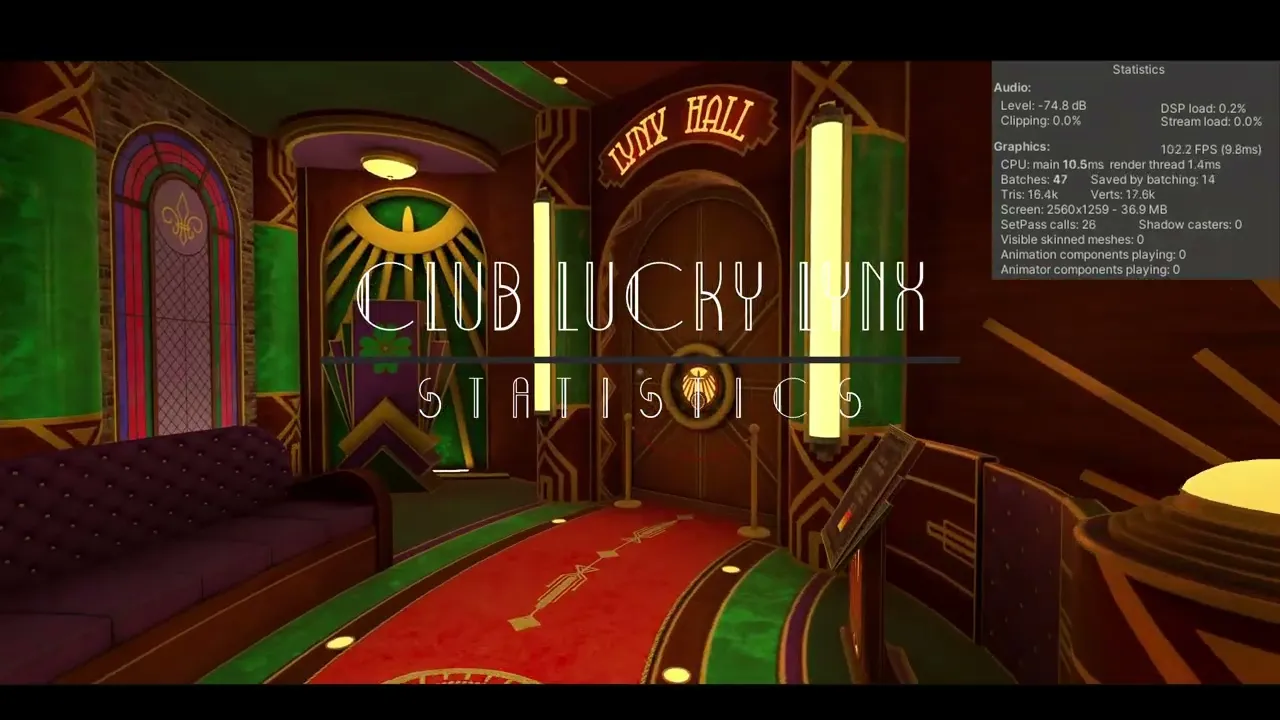
| The Statistics |
|---|
| 4K Video walkthrough showcasing live the backend statistics of the world through unity stats window. Here you will see information about batches, setpass calls, cpu threads and more. |
| Zoomed the statistics window for a better overview |
| Dev Blog Navigation |
|---|
| Below is presented the whole development process with a detailed breakdown of every single process. |
| The Idea |
|---|
| The project began with an initial first-floor layout designed by ceasar_draakovich. My objective was to translate that layout into a space inspired by the New Orleans Art Deco movement. I wanted to capture the soul of that era, utilizing a palette of deep, contrasting colors to fully immerse guests in a historic yet vibrant atmosphere. |

First floor layout idea by ceasar_draakovich

| Once I joined the project, we collaborated closely to refine the initial concepts. We implemented several quality-of-life improvements and polished the first-floor layout to ensure a better player flow and more intuitive navigation. This phase was crucial, as it established a solid foundation for the rest of the development process. |

Polished layout and solidified concept

| Blockout (Version 1) |
|---|
| With the layout finalized, I moved into the blockout phase. This process was divided into three distinct stages to ensure every detail was accounted for. |
| In the first iteration, I focused heavily on polishing metrics and scale. It was vital to ensure the proportions felt right for the players before moving into high-detail work. This stage acted as my "3D sketch," allowing me to visualize the volume of the club in real-time. |
| One of the primary creative challenges during this phase was the vertical architecture. I had to conceptualize how the second floor would integrate with the first, specifically focusing on how the two levels would converge at the ceiling to create a grand, cohesive interior. |

1) Foyer

2) Main Hall

3) Grand Staircase

4) Second Floor with Stage


| Blockout (Version 2) |
|---|
| Following the initial blockout, we conducted a thorough feedback audit. I worked closely with the owners to implement their specific vision, making the necessary structural adjustments to ensure the space met all project requirements. |
| In this second iteration, I began to introduce a preliminary color palette and initial lighting passes. Setting the lighting early in the process is crucial for me, as it allows to define the mood and "read" the environment's depth. This helped us visualize the direction of the atmosphere and ensured the Art Deco theme was translating correctly from concept to 3D space. |

1) Foyer

2) Main Hall

3) Grand Staircase

4) Second Floor with Stage


| Blockout (Version 3) |
|---|
| The final blockout iteration was driven by a second feedback audit, where I solidified the lighting and established the core color scheme within Unity. By moving from a greybox into a basic color pass, I could finally see the environment’s personality emerge. |
| I intentionally introduced dark, grey-toned walls at this stage to establish high-contrast anchors. Defining wall colors can be challenging early on, so my philosophy is to start small and iterate. By setting these neutral foundations first, I created a "canvas" that allowed me to push the color scheme further and experiment with bolder Art Deco accents without losing the sense of the space. |

1) Foyer

2) Main Hall

3) Grand Staircase

4) Second Floor with Stage


| Texturing Phase (Version 1) |
|---|
| With the blockout approved and everyone aligned on the direction, I moved into the texturing and material polish phase. This is where the environment truly begins to feel like a living space. Like the blockout, this was a three-phase process designed to bridge the gap between simple geometry and a finished, high-fidelity experience. |
| In the first stage of this phase, I focused on neatly tying the assets together while pushing the color scheme further. I took a more experimental approach with the accents, using bold, vibrant colors to make the environment "pop." My goal was to ensure that every surface didn't just look realistic, but specifically served the New Orleans Art Deco aesthetic we established at the start. |

1) Foyer

2) Main Hall

3) Grand Staircase

4) Second Floor with Stage


| Texturing Phase (Version 2) |
|---|
| The second stage of the texturing phase was dedicated to high-level refinement and the implementation of "micro-details" that make a world feel lived-in and intentional. |
| I began introducing more complex elements, such as custom carpet symbol guides. This wasn't just an aesthetic choice, it was a functional design move to help guide guests through the space naturally. During this time, I also conducted further lighting experiments, fine-tuning how the light interacted with new material surfaces to ensure the Art Deco accents remained the focal point. This phase is all about pushing those "extra" ideas that transform a static room into an immersive experience. |

1) Foyer

2) Main Hall

3) Grand Staircase

4) Second Floor with Stage


| Texturing Phase (Version 3) |
|---|
| As we reached the final stretch, my focus shifted to targeted refinement. In my workflow, the texturing and polishing phases are deeply symbiotic since you cannot truly finish one without the other. As the textures reach their final state, they often reveal areas that need slight geometric adjustments or lighting tweaks to achieve perfect visual harmony. |
| This stage is all about addressing the "friction" in the environment by smoothing out transitions, adjusting material properties (like roughness or metallic values) to catch the light just right, and ensuring that every corner of the club meets the high standards we set at the beginning. It is a meticulous process of constant back-and-forth, ensuring that the final output is a seamless blend of art and technical execution. |

1) Foyer

2) Main Hall

3) Grand Staircase

4) Second Floor with Stage


| Polishing Phase |
|---|
| The final stage of development is dedicated to the "invisible" work that separates a hobbyist project from a professional-grade environment. This phase focuses on comprehensive optimization, material refinement, and ensuring a consistent level of quality across every corner of the world. |
| While the visual art is largely complete, this stage involves: |
| - Background Optimization: I perform a deep dive into the environment's performance, optimizing draw calls and texture memory to ensure a high frame rate for all players. |
| - Material Harmonization: I revisit every material to ensure they react correctly to the finalized lighting, creating a seamless visual experience. |
| - Scripting & Backend Testing: A significant portion of this phase is dedicated to technical implementation. I conduct various backend tests and refine scripts to ensure that interactive elements like the teleport systems or lighting triggers that function flawlessly. |

1) Foyer

2) Main Hall

3) Grand Staircase

4) Second Floor with Stage


| VIP Hallway: Honeypot |
|---|
| To expand the environment efficiently, the VIP hallways were built using repurposed assets. By leveraging mesh and material batching, I was able to add these engaging new spaces with minimal performance impact—extending the world without compromising the frame rate. |

VIP Hallway (WIP)

VIP Hallway Reception (WIP)


VIP Hallway Finished

VIP Hallway Reception Finished


| VIP Hallway Functionality |
|---|
| I developed a system for the VIP areas to enhance player privacy and immersion. Using a mix of scripting and interactive triggers, the rooms react in real-time to user activity: |
| Dynamic Signage: Interactive displays switch between "Open" and "Busy" based on room occupancy. |
| Privacy Logic: Once a room is locked, entry buttons are hidden and a velvet rope appears in the hallway to signal the room is in use. |
| Anti-Softlock Measures: To ensure the room remains accessible, I’ve implemented logic that automatically unlocks the space if a user crashes or respawns. |

1) VIP Room Open State

2) VIP Room Close State


1) VIP Room Open State

2) VIP Room Close State


| VIP Rooms |
|---|
| In line with the project's optimization strategy, the VIP Suites were designed using repurposed assets to maintain a high level of detail without increasing the technical load. |
| These spaces were crafted to provide a cozy, intimate atmosphere, complete with a functional privacy lock system controllable from the inside. |

1) VIP Room Entrance

2) VIP Room Guest POV


1) VIP Room Entrance

2) VIP Room Guest POV


| Dancer Room |
|---|
| The Dancer Room was constructed entirely through strategic asset reuse, utilizing existing meshes and materials to keep the environment lightweight and performance-friendly. |
| The layout was specifically designed for player flow, featuring three mirrors and three distinct performance zones. This allows dancers to spread out evenly, ensuring the area remains open and uncluttered. |

1) Dancer Room

2) Dancer Room Teleport Map


| Dancer room functionality |
|---|
| To further improve movement throughout the club, I integrated a direct teleportation hub. This system features a top-down projection map of the entire venue. The interface is highly intuitive: |
| Interactivity: Dancers can hover over the map to see destination points. |
| Visual Cues: Teleporting points are represented by illuminated lamps. |
| Seamless Travel: Simply clicking on a glowing lamp instantly teleports the user to the corresponding area. |
| By combining visual feedback with functional UI, I’ve ensured that the club is not only beautiful but also effortless to navigate for the dancers. |

Teleport Map

Using the teleport


| Project Technical Stats |
|---|
| //////////////////////////////////////////////////////////////////////////////// |
| General Information | |
|---|---|
| Tier | Themed Environment |
| Zones | Main Area, 2 VIP Hallways, 8 VIP Rooms, Dancer Room |
| Size | 32MB |
| Finished | 40 days |
| Technical Stats | |
|---|---|
| Size on GVRAM | ~300MB |
| Triangles | 450K |
| Material Count | 32 |
| Batches | 100-200 average in the main area. Less then 100 in other parts. |
| SetPass Calls | Less then 100 |
| CPU Threads | 10-11.1 ms at all times |
| PostProcessing | None |
| FPS at all times (PCVR Quest2) | Capped 90 |
Navigation
The Coronet
| Commission for Blind Wolf owner - Disz |
|---|
| Rise above the city of a New York skyline frozen in its most glamorous era. The Coronet is an art deco jewel which encapsulates everything that Blind Wolf stands for - glamourous and elegant life intertwined with luxury and status. A place where furry community can thrive and socialize. |
| References from Disz, WonderingWendigo, JaxFox and the rest of the Blind Wolf upper staff can be found on the Official Blind Wolf discord! |
| Final Result |
|---|
| Below you will see the result of my hard work that i performed, from beautiful visuals up to the most smallest technical breakdown you can ever find. |
| The Development |
|---|
| Video showcasing every stage of the development and how it came to its conclusion. |

| The Statistics |
|---|
| 4K Video walkthrough showcasing live the backend statistics of the world through unity stats window. Here you will see information about batches, setpass calls, cpu threads and more. |
| Zoomed the statistics window for a better overview |
| Dev Blog Navigation |
|---|
| Below is presented the whole development process with a detailed breakdown of every single process. |
| The Project |
|---|
| Project was developed in full secrecy from the community as a surprise, limiting the access only to few key owners of Blind Wolf. |
| THE IDEA |
|---|
| The project began with an initial first-floor layout designed by Disz himself. My objective was to translate that layout into a space inspired by the New York Art Deco movement. The idea was to create a luxurious space for the community of Blind Wolf which would reflect perfectly everything they stand for. So was established the foundation with the sketches below. |

Layout Sketch by Disz

Layout sketch with second floor


| Eventually Disz made some more sketch concepts from which I could bounce off of and start building. While the sketches were an amazing foundation to start with, I had pretty much full creative freedom and was free to change things however I found applicable. |

Sketch for Movie area

Sketch for the fireplace area

Top down and front view of pool

Pool water system


| Golden selling point of the world needed to be building itself and Disz suggested several options which I could choose and mix together in order to achieve that art deco feeling. I went with Option C as that was perfect for showcasing the Blind Wolf logo and the structure itself was very promising. With taking that into consideration I added my own interpretation of the concept in order to contribute to the feeling of the building being in motion. |

Option A

Option B

Option C


| Blockout (Iteration 1) |
|---|
| Once the layout and sketches alongside with references were collected it was time to finally start the first phase of the blockout stage. Eventually I followed the layout sketches I was provided with to establish the base form and already on this stage I heavily started to experiment with the looks of certain shapes to get my footing on the style I am going for. |
| A massive source of inspiration for this project came straight from the heart of New York's the iconic interior of the Chrysler Building. I was absolutely captivated by its lobby, particularly the way the lighting forms those striking, arrow like shapes. That single detail became the foundational anchor for the entire environment, eventually inspiring the name of the world itself... The Coronet. |
| Because Art Deco is inherently monumental, getting the scale right was crucial. The physical size and metrics of the architecture had to immediately convey a grand, sweeping feeling the moment you step inside. From the very beginning, I focused on blending sharp, striking geometric shapes with smooth, elegant curves. This creates a beautiful visual contrast throughout the space, giving the world a dynamic and rich sense of depth. |

Spawn Lobby

Lounge


| This version of blockout entered its first feedback audit and was presented to some of the owners of Blind Wolf - Disz, WonderingWendigo and JaxFox for evaluation which in the end was very well received. |

Spawn Lobby

Lounge

Lounge Full

Pool Terrace

The Coronet


| Blockout (Iteration 2) |
|---|
| After the first feedback audit I desperately needed a breakthrough which would give this place its signature look already, that would define the rest of the development. This version of the blockout already was significantly different as it introduced many bold changes to the original layout and shaped it further intro its own character. |
| Proper lighting was introduced to the scene which would setup the iconic warm feel of the vintage art deco alongside with big changes of layout such as adding a second floor to it with the personal office, bedroom and more. The terrace area with pool got significantly modified alongside with the facade of the building, where I added yet another iconic symbol of 1930's era that are searchlights which majestically illuminate the Blind Wolf logo at the top of the building. |
| While searchlights were used in wars mainly at that time to spot enemies, later on it didn't prevent them from becoming one of the distinctive visit cards of not only art deco but also became a new language of art. Addition of searchlights was inspired by the iconic 20th Century Fox intro. Slowly I introduced as well more color to the blockout to make things more vibrant in order to break down mundane grey color which can blend things together way too much. |

Searchlight used in war

Searchlight used in a civilian setup

Searchlights illuminating LA


| This version of blockout entered its second feedback audit and was presented to some of the owners of Blind Wolf - Disz, WonderingWendigo and JaxFox for evaluation which in the end was very well received as well. |

Spawn Lobby

Lounge

Lounge Full

Pool Terrace

The Coronet

The Coronet Main View

The Coronet Second Floor


| Blockout (Iteration 3) |
|---|
| After the second feedback audit we got to the final stage of the blockout which was groundbreaking point because it finally settled down on the whole visual style and storytelling of the environment itself. This version drastically pushes the boundaries forward towards that classy probation-era style of art deco. Here a proper coloring was introduced to the whole space and final metrics/sizes were set in stone. Some elements here at this stage already can be seen fully textured such as windows and some posters, which is done for the sake of already experimenting with future color scheme of the world and general understanding what do we want to get in the end. |
| Perhaps the most defining addition to the world's overall style is the new Pool Terrace. Here, a massive emphasis was placed on the searchlights, turning them into the true centerpiece of the environment. Even while static, their striking composition gives the space an incredibly uplifting energy, but just wait until you see them sweep into motion when the DJ takes the stage. |
| The entire terrace is designed to make you feel like the "king of the hill." Stepping onto the rooftop's beautiful red carpet, surrounded by a majestic city view and the glow of the Blind Wolf symbol looking down from above, immerses you right in the center of high society. It perfectly captures that feeling of being the star of the most exclusive, vibrant gathering spot in town. |
| A massive shoutout goes to Wendigo, the artist behind the signature art style of Blind Wolf. They provided some incredible visual artworks that were absolutely instrumental in developing the gorgeous **stained glass windows ** which really sealed the Coronet’s premium aesthetic. |
| Finally, at its heart, this project is a community world designed to comfortably host over 60 people at a time. To make sure everyone has a place to gather and hang out, we added a massive drinking table down by the pool that can easily seat 24 people. And for those looking for a slightly more relaxed vibe, that custom built card table up on the second floor of the Coronet is perfectly sized to host an intimate group of 8+ players. |

Spawn Lobby

Lounge

Lounge Full

Pool Terrace

The Coronet

The Coronet Main View

The Coronet Second Floor


| Technical Flex |
|---|
| To bring even more life into the environment, I wanted the posters to wave gently in the breeze. But how do you add that kind of dynamic movement without tanking the framerate? The answer is a clever, lightweight technique called Vertex Animation. |
| Instead of relying on heavy, performance-draining cloth simulations, this method uses some sneaky math to move the geometry of the mesh in a specific pattern. It perfectly emulates the feel of fabric catching the wind while using a microscopic 0.0006% of the GPU's processing power. What makes this setup even better is the attention to detail. None of the posters wave in the exact same way. Each one references its closest neighbor and naturally offsets its animation, creating a beautifully randomized, organic flow across the entire space. |

| Poster Idea Exploration |
|---|
| One of the most exciting ideas I explored in this space was leaning into a dreamy, retro futuristic take on Art Deco. While people often associate the style purely with luxury and status, it was originally a highly visionary movement focused on a scientifically advanced future. To capture that spirit, I incorporated another iconic symbol of the era: double metal propellers. |
| These propellers are attached to coronet shaped holders that display massive Blind Wolf posters on either side of the terrace. The constant spinning adds life and movement to the area, posing a fun "What if?" scenario what if society advanced into a sci-fi future but kept its Art Deco aesthetics? The best part is how incredibly optimized it is. The entire visual relies on a simple bobbing animation and rotating geometry, which costs practically zero processing power for your GPU. |

Brass/Burungudy

Coronet Shaped

Monumental

DJ Screen

Balcony View


| However, world-building is all about iteration! After a feedback audit, we realized that having levitating screens and posters introduced a bit too much visual distraction. More importantly, it started to shift the tone away from Blind Wolf’s core identity and its grounded 1920s–30s Art Deco foundation. |
| To keep the atmosphere cohesive, we made the call to bring things back down to earth a bit. I swapped the floating propellers for elegant, stationary mounts. It turned out to be the perfect compromise, we got to keep the striking visual layout of the posters, but in a way that feels much more authentic to a real-world historical timeline. Even though the flying displays didn't make the final cut, it was a fantastic, fun experiment that ultimately helped us refine the true vibe of the space. |
| Texturing Phase (Iteration 1) |
|---|
| Following our third feedback audit, it was finally time to dive into one of the most critical phases of the project which would be texturing. Smart texturing has the power to completely elevate a world and save its look if you know how to play to its strengths. |
| To pull this off, I leaned heavily into the modularity of the environment. If you have ever wondered how your favorite games manage to look incredible while still running smoothly, this is the secret! By building the world out of a flexible, optimized set of decorative modules, I was able to maintain a consistent style while keeping performance rock solid. Preparing this foundational kit gave me exactly the right building blocks to start bringing the final, polished look to life. |
| It might sound like development magic, but the six modules you see below all share just one single material. What makes them truly powerful is their flexibility, you can stretch, scale, and snap them together in endless combinations to construct completely new, intricate structures. |
| Building a modular system like this is a fun but demanding challenge. It requires strict math and exact, rounded measurements to ensure every piece clicks together flawlessly, much like lego bricks. While there are some wildly advanced tricks I use to push optimization even further, getting these basics right is crucial. The more precise these foundational building blocks are, the more natural the world’s scale feels. It ultimately gives us the freedom to pack in even richer, high quality details without ever sacrificing performance. |

Module Set


Module Set

| Moving from greybox to a more textured geometry was a massive leap for both visuals and optimization. By leveraging efficient UV unwrapping and custom compression, the entire world runs beautifully on just 10-12 materials as of this phase. I locked the textures at 2K resolution, putting our total GPU VRAM footprint at an easy 130MB. While we could drop to 1K and squeeze the VRAM down to a funny 45MB, VR demands crispness. The 2K textures ensure the world remains sharp and immersive without resorting to unnecessary overkill. |
| With the groundwork laid, I shifted my focus to the lighting to craft that perfect cozy atmosphere. After five solid days of tweaking, the space really started to come to life, as you can see in the shots below. |
| The secret to this monumental yet inviting look is a carefully balanced three-color palette. A rich, dark green marble serves as the foundation of the room, while brass and gold accents step in to break it up, adding elegant ornaments and guiding lines. Because the lighting is so warm, it bounces beautifully off the gold highlights. It gives the whole environment a luxurious, welcoming feel that makes it the ultimate spot for community gatherings. |
| Finally, when shaping the finer details of the environment, I leaned heavily on the 3-5-7 rule. At its core, this is a classic interior design principle that relies on odd-numbered proportions to create visual balance. Odd numbers naturally feel more organic and less rigid than perfectly symmetrical even numbers. If you take a close look around the space, you'll start to notice this pattern hidden in plain sight, whether it's a set of three steps, three decorative lines, or a grouping of five arrows. It's a subtle psychological touch, but it goes a long way in making the world feel harmonious and naturally inviting. |

Spawn Lobby

Lounge

Lounge Full

Pool Terrace

The Coronet

The Coronet Main View

The Coronet Second Floor


| Every inch of this environment is carefully engineered with sightlines and perspective in mind, ensuring that no matter where you stand, you are treated to a beautifully framed view. |
| For example, in the shot below, you can see the main spawn area all the way from the upper terrace where a future DJ booth will be set up. Notice how crisp and readable the details remain, even from a distance. Designing with this kind of visual clarity in mind is exactly what gives the world its massive, immersive sense of depth and scale. |

Spawn Lobby

Terrace View


| To make exploring the world feel effortless, I used inviting perspective lines that naturally guide your eye toward key points of interest. It acts as a subtle, intuitive navigation system that draws you exactly where you need to go without ever needing a map. |
| You might also recognize a major source of inspiration for this space from the iconic Chrysler Building. Its influence is baked right into the architecture, like the striking five-arrow doorway. In the second picture, the elevator doors are actually a direct homage to the Chrysler Building's famous design. As a fun little detail, I even inserted a small Blind Wolf logo into the metalwork, blending it in so nicely that it feels like a natural piece of the original ornamentation. |

Chrysler elevator door

Chrysler elevator doors texture


Coronet Doorway

Chrysler elevator doors reference


| Stepping up to the second floor of The Coronet, you are immediately welcomed by a beautifully cozy hallway. Large, striking paintings line the walls on either side, while carpets naturally guide your steps toward the main area. This floor is designed as an inviting, private retreat. Following the path which leads you right to a classic card table the perfect spot to gather with friends and hang out in a more intimate space, far away from the loud music and bustling energy of the main lounge below. |

Second Floor Hallway

Card Table View


Room Overview

Navigation

The Jungle Trophy Awards

Open Slot
Open Slot


Navigation
Fez Hat for WonderingWendigo

Open Slot


Navigation
Jungle Awards
“NSFW CONTENT — 18+ ONLY”
“Contains artistic nudity and suggestive text.”
Commission for wolf0Turntable showcase of a set of 12 silly awards for The Jungle furry lapdancing club. Designed in just 3-5 days.
Showcase
Navigation

Personal projct

Coming Soon

Empty Slot


Navigation
Cthulhu Cathedral
One of the biggest projects i worked on so far. Everything is made and designed by me except VFX and sounds.
Personal project not for sale made with Unity 6
Creation Showcase
This is the same approach i am using while creating VRC Worlds.

Navigation
My skills in asset creation and optimization.

Emperor's Seal

Skateboard

Sauer Bar Pistol

Empty Slot


Navigation
Final Render

Wireframe

Navigation
Final Render


Wireframe


Navigation
Final Render


Wireframe


Navigation
World Creation Pricelist
| The Professional Advantage |
|---|
| 40+ Player Stability: Engineered with advanced draw-call batching to ensure high FPS during crowded events. |
| Crash Protection: Aggressive VRAM management to prevent "Out of Memory" crashes for mid-range and Quest users. |
| Industry Speed: My 7-year professional pipeline delivers 3-month projects in just 30–45 days. |
| Zero-Lag Visuals: Movie-quality lighting (Bakery) with 0 impact on real-time performance. |
Optimization
For existing worlds suffering from lag, crashes, or poor lighting. I perform a deep-dive engineering audit to achieve a professional performance rank and peak FPS.
| Scope |
|---|
| Fixing lightmaps, reducing draw calls via mesh optimization, material batching, cleaning hierarchy, and VRAM management. |
| Project Timeline & Delivery |
|---|
| 3 – 5 Days |
| Price |
|---|
| Starting from $500 |
Elite Showcase Scene
A high-detail, single-room environment (e.g., Luxury Studio, Sci-Fi Lab, Boutique Store). Perfect for high-end private residences or specialized photography hubs.
| Features |
|---|
| Custom-engineered lighting bakes (Bakery), unique PBR materials, and cinematic atmosphere. |
| Client Requirement |
|---|
| Please provide reference images. Projects without references incur a $100 research/moodboarding fee. |
| Project Timeline & Delivery |
|---|
| 14 – 21 Days |
| Price |
|---|
| Starting from $750 |
Themed Environment
A multi-area world (2-4 connected zones) with professional level design. These are built from the ground up to be "Event Ready"—visually stunning but engineered for performance to handle 40+ users.
| Features |
|---|
| Atmospheric FX, optimized prop placement, and basic interactive scripting (toggles, video players, etc.). |
| Client Requirement |
|---|
| Please provide reference images. Projects without references incur a $100 research/moodboarding fee. |
| Project Timeline & Delivery |
|---|
| 30 – 45 Days |
| Price |
|---|
| Starting from $2500 |
Navigation
Custom 3D Asset Creation Pricelist
| The Professional Advantage |
|---|
| Optimized for VRChat: Unlike store-bought assets, my props are built specifically to minimize VRAM impact and draw calls. |
| Production-Ready: Every asset comes with a clean Unity prefab, properly labeled and ready for drag-and-drop implementation. |
| Commercial Quality: You receive a unique asset that no one else in VRChat owns, giving your world or avatar a signature look. |
Basic Assets
Single-piece static props or simple wearable accessories.
| Sub-Tiers |
|---|
| Environment: Specialized food, simple furniture, or architectural signage. |
| Avatar: Basic jewelry, footwear, hats, or simple lingerie/underwear pieces. |
| Client Requirement |
|---|
| Please provide reference images. Projects without references incur a $100 research/moodboarding fee. |
| Project Timeline & Delivery |
|---|
| 3 - 5 Days |
| Price |
|---|
| Starting from $150 |
Feature Prop
Complex environment centerpieces or detailed clothing items.
| Sub-Tiers |
|---|
| Environment: Interactive world items, hero props, or intricate seating. |
| Avatar: Technical Clothing (e.g., Hoodies, Pants, Bodysuits) with expert weight-painting for furry armatures. |
| Client Requirement |
|---|
| Please provide reference images. Projects without references incur a $100 research/moodboarding fee. |
| Project Timeline & Delivery |
|---|
| 7 - 14 Days |
| Price |
|---|
| Starting from $450 |
Signature Outfits & Sets
Complete character aesthetics or environment asset packs.
| Sub-Tiers |
|---|
| Environment: Asset Packs (5–8 pieces) like themed clutter sets or modular environment kits. |
| Avatar: Full Custom Outfits (e.g., Tech-wear, Cyberpunk Armor, or Complex Fantasy Sets). |
| Client Requirement |
|---|
| Please provide reference images. Projects without references incur a $100 research/moodboarding fee. |
| Price |
|---|
| Starting from $1200 |
Navigation
Terms of Service
| 1. Professional Guarantee & Deliverables |
|---|
| Performance Standard: I guarantee that all environments are engineered for maximum stability and high framerates. My optimization workflow focuses on draw-call reduction, texture atlasing, and optimized GPU frame times to ensure a smooth experience even in high-occupancy instances. |
| Note: Performance is guaranteed for the initial delivered project. The Creator is not responsible for performance drops caused by the addition of unoptimized third-party assets or scripts after delivery. |
| Technical Fidelity: All work is built using industry-standard budgets for geometry (Triangle Count) and material efficiency. This ensures the highest possible visual quality while maintaining a low hardware footprint. |
| Deliverables: Assets: Optimized FBX files with clean UVs and PBR texture sets. |
| Worlds: An organized Unity project/package, fully configured for VRChat SDK3, utilizing professional light-baking and occlusion culling. |
| 2. Pricing and Payment |
|---|
| Quote Validity: All quotes are based on the client's initial, approved design brief and are valid for 30 days. |
| Deposit: A 50% Non-Refundable Deposit is required to secure a slot. This covers the professional time for research, layout blockouts, and initial technical setup. |
| Final Payment: The remaining 50% Balance is due upon approval of the final watermarked preview. Source files/Unity packages are transferred only after full payment is received. |
| Professional Hourly Rate: For technical support or major scope changes after the blockout phase, the rate is $55 USD/hour. |
| 3. Workflow and Revisions |
|---|
| Phased Pipeline: I work in three distinct phases: (1) Blockout/Layout, (2) Texturing/Lighting, (3) Final Polish/Optimization. |
| Revisions Included: Two (2) Minor Revision Rounds are included free of charge during the Work-In-Progress (WIP) stage. |
| Minor revisions are limited to small adjustments (e.g., color tweaks, minor prop repositioning, small texture fixes). |
| Major revisions (e.g., changing the core layout, adding substantial new geometry after blockout approval) will incur the hourly fee. |
| Timeline: An estimated delivery window will be provided with the initial quote. The timeline starts the day the 50% deposit is received. Client response time is critical; delays in approval may extend the delivery date. |
| 4. Copyright and Usage Rights |
|---|
| Client Usage Rights: Upon completion, the Client receives the final agreed-upon 3D world, assets, or 2D textures. The Product may not be used for any commercial purpose without the explicit written approval of the Creator. The Client is permitted to use the Product for non-commercial promotional content, including streams, videos, and images, only after receiving full approval from the Creator. All other rights remain with the Creator unless otherwise agreed in writing. |
| Source Files: Original editable project files (.spp e.t.c.) are not included by default but are available for a +40% add-on fee. |
| Creator Portfolio Rights: I retain the right to use the completed, non-source work in my professional portfolio, social media, and advertising materials. |
| Credit Requirement: The client agrees to provide clear creator credit to Mr.Rubinshtein in the VRChat world description and/or the avatar description (if applicable). |
Navigation
Contact
Contact & Commissions
Let’s Build Something Exceptional.
I am currently accepting a limited number of commissions for high-end VRChat environments and technical optimization. By hiring a specialist with 7+ years of industry experience, you are investing in a world engineered for stability, speed, and visual impact.
| Commission Request Template |
|---|
| To ensure a fast and accurate quote, please copy and include the following details in your message: |
| Project Title: (e.g., "Neon District Club" or "Luxury Penthouse") |
| Service Tier: (Showcase Scene / Themed Environment / Optimization / Custom Asset) |
| Reference & Concept: (Link to Pinterest, Google Drive, or Moodboard. Note: Projects without references incur a research fee.) |
| Timeline: (When is your ideal launch date?) |
| Key Features: (e.g., Video players, toggles, interactive doors, specific mood/lighting.) |
| Estimated Budget: (Helps me scale the level of detail and asset custom-modeling to your needs.) |
| Reach Out |
|---|
| Contact me via my Discord server for the fastest response. I typically respond within 24–48 hours (Monday–Friday). |
| What Happens Next? |
|---|
| Technical Review: I review your brief to ensure the project aligns with my quality standards and schedule. |
| Consultation & Quote: We discuss the technical scope (VRAM targets, draw-call budgets) and I provide a formal project agreement. |
| Booking: A 50% deposit secures your slot in the production queue. |
| The Sprint: Phase 1 (Blockout & Layout) begins immediately. |